Département de Biomédecine Vétérinaire, Centre de Recherche en Reproduction Et Fertilité, Faculté de Médecine Vétérinaire, Université de Montréal, Saint-Hyacinthe, QC, Canada.
Cell Commun Signal. 2021 Jan 21;19(1):8. doi: 10.1186/s12964-020-00696-6.
First identified as a regulator of neuronal axon guidance, Slit/Robo signaling has since been implicated in additional physiologic and pathologic processes, such as angiogenesis, organogenesis and cancer progression. However, its roles in the regulation of testis function have been little explored.
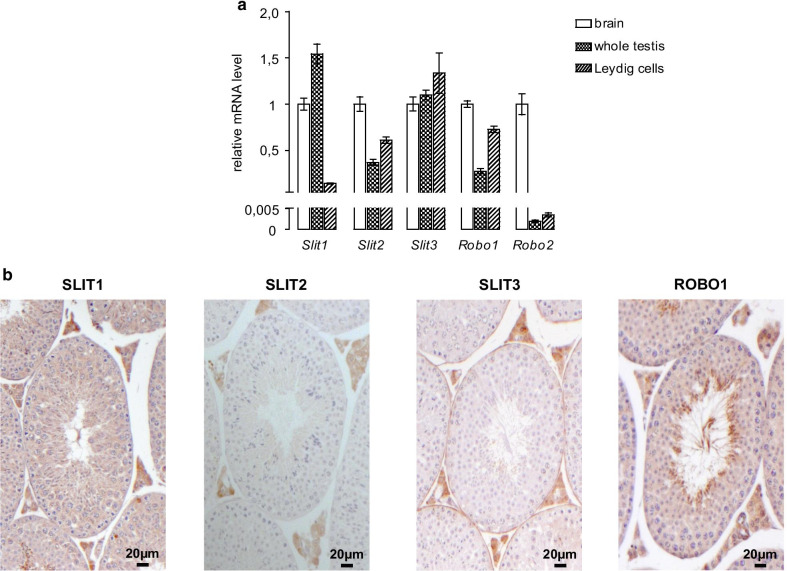
Immunohistochemistry and RT-qPCR analyses were performed to detect the expression of Slit/Robo signaling effectors in the adult mouse testis. To identify the roles and mechanisms of Slit/Robo signaling in the regulation of steroidogenesis, RT-qPCR, immunoblotting and hormone measurements were carried out using Leydig cells (primary cultures and the MA10 cell line) treated with exogenous SLIT ligands, and testes from Robo1-null mice.
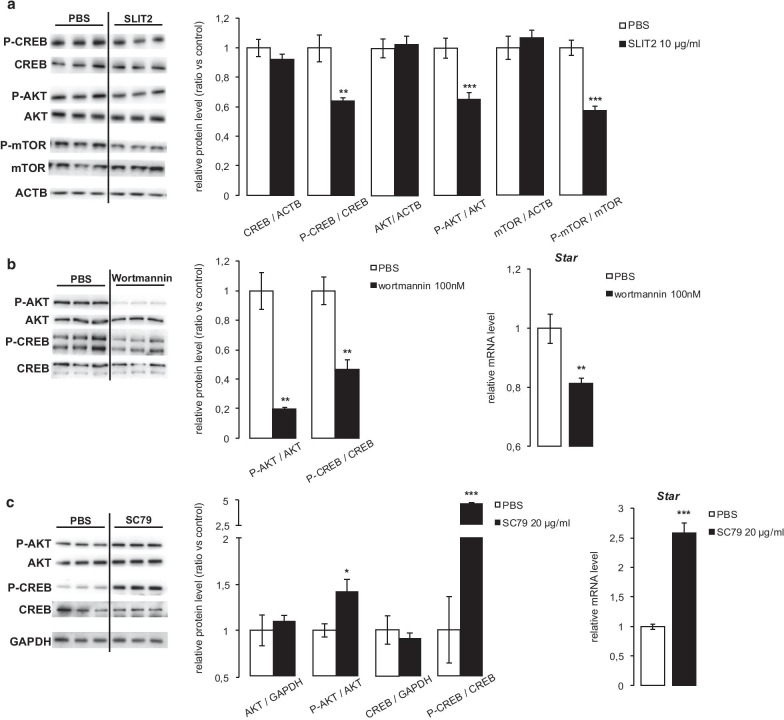
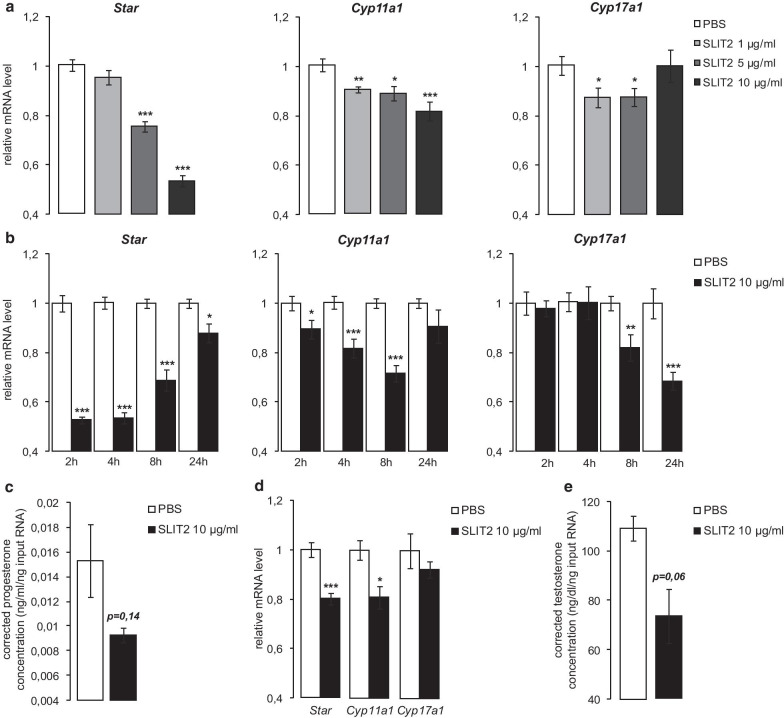
Slit1, -2 and -3 and Robo1 and -2 expression was detected in the adult mouse testis, particularly in Leydig cells. In vitro treatment of Leydig cells with exogenous SLIT ligands led to a decrease in the expression of the steroidogenic genes Star, Cyp11a1, and Cyp17a1. SLIT2 treatment decreased the phosphorylation of the key steroidogenic gene regulator CREB, possibly in part by suppressing AKT activity. Furthermore, SLIT2 treatment reduced the responsiveness of MA10 cells to luteinizing hormone by decreasing the expression of Lhcgr. Consistent with these in vitro results, an increase in testicular Star mRNA levels and intra-testicular testosterone concentrations were found in Robo1-null mice. Finally, we showed that the expression of the Slit and Robo genes in Leydig cells is enhanced by testosterone treatment in vitro, by an AR-independent mechanism.
Taken together, these results suggest that Slit/Robo signaling represents a novel mechanism that regulates Leydig cell steroidogenesis. It may act in an autocrine/paracrine manner to mediate negative feedback by testosterone on its own synthesis. Video Abstract.
Slit/Robo 信号最初被鉴定为神经元轴突导向的调节剂,此后被认为参与了其他生理和病理过程,如血管生成、器官发生和癌症进展。然而,其在调节睾丸功能中的作用尚未得到充分探索。
通过免疫组织化学和 RT-qPCR 分析检测成年小鼠睾丸中 Slit/Robo 信号效应物的表达。为了确定 Slit/Robo 信号在调节类固醇生成中的作用和机制,使用外源性 SLIT 配体处理 Leydig 细胞(原代培养和 MA10 细胞系)和 Robo1 基因敲除小鼠的睾丸,进行 RT-qPCR、免疫印迹和激素测量。
Slit1、-2 和 -3 以及 Robo1 和 -2 在成年小鼠睾丸中表达,特别是在 Leydig 细胞中。体外用外源性 SLIT 配体处理 Leydig 细胞导致类固醇生成基因 Star、Cyp11a1 和 Cyp17a1 的表达减少。SLIT2 处理降低了关键类固醇生成基因调节因子 CREB 的磷酸化,可能部分是通过抑制 AKT 活性。此外,SLIT2 处理通过降低 Lhcgr 的表达降低了 MA10 细胞对促黄体生成激素的反应性。与这些体外结果一致,在 Robo1 基因敲除小鼠中发现睾丸 Star mRNA 水平和睾丸内睾酮浓度增加。最后,我们表明,体外睾酮处理可增强 Leydig 细胞中 Slit 和 Robo 基因的表达,其机制与 AR 无关。
综上所述,这些结果表明 Slit/Robo 信号代表了一种调节 Leydig 细胞类固醇生成的新机制。它可能通过自分泌/旁分泌方式发挥作用,介导睾酮对自身合成的负反馈。