NIHR London In Vitro Diagnostics Co-operative, London, UK.
Division of Medical Sciences and Graduate Entry Medicine, University of Nottingham, UK.
Age Ageing. 2021 May 5;50(3):668-672. doi: 10.1093/ageing/afab015.
Care home residents are at high risk of dying from coronavirus disease 2019 (COVID-19). Regular testing, producing rapid and reliable results is important in this population because infections spread quickly, and presentations are often atypical or asymptomatic. This study evaluated current testing pathways in care homes to explore the role of point-of-care tests (POCTs).
A total of 10 staff from eight care homes, purposively sampled to reflect care organisational attributes that influence outbreak severity, underwent a semi-structured remote videoconference interview. Transcripts were analysed using process mapping tools and framework analysis focussing on perceptions about, gaps within and needs arising from current pathways.
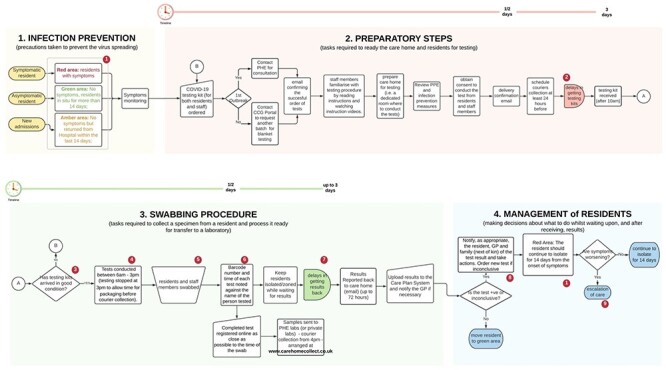
Four main steps were identified in testing: infection prevention, preparatory steps, swabbing procedure and management of residents. Infection prevention was particularly challenging for mobile residents with cognitive impairment. Swabbing and preparatory steps were resource-intensive, requiring additional staff resource. Swabbing required flexibility and staff who were familiar to the resident. Frequent approaches to residents were needed to ensure they would participate at a suitable time. After-test management varied between sites. Several homes reported deviating from government guidance to take more cautious approaches, which they perceived to be more robust.
Swab-based testing is organisationally complex and resource-intensive in care homes. It needs to be flexible to meet the needs of residents and provide care homes with rapid information to support care decisions. POCT could help address gaps but the complexity of the setting means that each technology must be evaluated in context before widespread adoption in care homes.
养老院居民因 2019 年冠状病毒病(COVID-19)而死亡的风险很高。在该人群中,定期进行测试并获得快速可靠的结果非常重要,因为感染传播迅速,而且临床表现通常不典型或无症状。本研究评估了养老院目前的检测途径,以探讨即时检测(POCT)的作用。
从 8 家养老院中,有针对性地选取了 10 名工作人员,反映出影响疫情严重程度的养老院组织属性,对他们进行了半结构化远程视频会议访谈。使用过程映射工具和框架分析对转录本进行了分析,重点关注对当前途径的看法、差距和需求。
共确定了测试的四个主要步骤:感染预防、准备步骤、拭子采样程序和居民管理。对于有认知障碍的流动居民,感染预防特别具有挑战性。拭子采样和准备步骤需要大量资源,需要额外的工作人员。拭子采样需要灵活性和熟悉居民的工作人员。需要频繁接触居民,以确保他们在合适的时间参与。检测后的管理在不同地点有所不同。一些养老院报告说偏离了政府的指导意见,采取了更为谨慎的方法,他们认为这些方法更为稳健。
在养老院中,基于拭子的检测在组织上复杂且资源密集。它需要具有灵活性,以满足居民的需求,并为养老院提供快速的信息,以支持护理决策。POCT 可以帮助解决差距,但由于环境的复杂性,在广泛应用于养老院之前,必须对每种技术进行具体情况评估。