Department of General, Trauma and Reconstructive Surgery, University Hospital, LMU Munich, Marchioninistr. 15, 81377, Munich, Germany.
Arch Orthop Trauma Surg. 2022 Jun;142(6):997-1002. doi: 10.1007/s00402-021-03756-9. Epub 2021 Jan 23.
Treatment of older adult hip fracture patients can be challenging and requires early postoperative mobilisation to prevent complications. Simple clinical tools to predict mobilisation/weight-bearing difficulties after hip fracture surgery are scarcely available and analysis of handgrip strength could be a feasible approach. In the present study, we hypothesised that patients with reduced handgrip strength show incapability to follow postoperative weight-bearing instructions.
Eighty-four patients aged ≥ 65 years with a proximal femur fracture (trochanteric, n = 45 or femoral neck, n = 39), who were admitted to a certified orthogeriatric center, were consecutively enrolled in a prospective study design. Five days after surgery (intramedullary nailing or arthroplasty), a standardised assessment of handgrip strength and a gait analysis (via insole forcesensors) was performed.
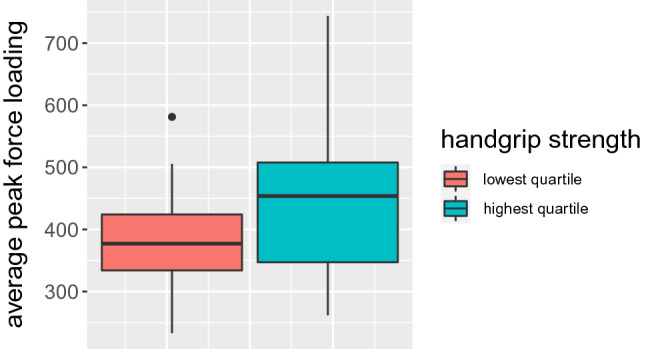
Handgrip strength showed positive correlation with average peak force during gait on the affected limb (0.259), postoperative Parker Mobility Score (0.287) and Barthel Index (0.306). Only slight positive correlation was observed with gait speed (0.157). These results were congruent with multivariate regression analysis.
Assessment of handgrip strength is a simple and reliable tool for early prediction of postoperative mobilisation complications like the inability to follow weight-bearing instructions in older hip fracture patients. Follow-up studies should evaluate if these findings also match with other fracture types and result in personalised adjustment of current aftercare patterns. In addition, efforts should be made to combine objectively collected data as handgrip strength or gait speed in a prediction model for long-term outcome of orthogeriatric patients.
治疗老年髋部骨折患者具有挑战性,需要术后早期活动以预防并发症。目前缺乏简单的临床工具来预测髋部骨折手术后的活动/负重困难,而分析握力可能是一种可行的方法。本研究假设握力较弱的患者无法遵循术后负重指导。
84 名年龄≥65 岁的股骨近端骨折(转子间骨折 n=45 或股骨颈骨折 n=39)患者,连续纳入一项前瞻性研究设计。在手术后 5 天,对患者进行标准的握力评估和步态分析(通过鞋垫压力传感器)。
握力与患侧步态的平均峰值力(0.259)、术后 Parker 活动能力评分(0.287)和巴氏指数(0.306)呈正相关。仅与步态速度呈轻微正相关(0.157)。这些结果与多元回归分析一致。
握力评估是一种简单可靠的工具,可早期预测髋部骨折老年患者术后活动并发症,如无法遵循负重指导。进一步的研究应该评估这些发现是否也适用于其他骨折类型,并导致当前康复模式的个性化调整。此外,应努力将客观收集的数据(如握力或步态速度)结合到预测骨科老年患者长期预后的模型中。