Institutes of Biomedical Sciences, Shanxi University, Taiyuan, 030006, China.
Key laboratory of Medical Molecular Biology of Shanxi Province, Shanxi University, Taiyuan, 030006, China.
BMC Mol Cell Biol. 2021 Jan 23;22(1):8. doi: 10.1186/s12860-021-00347-9.
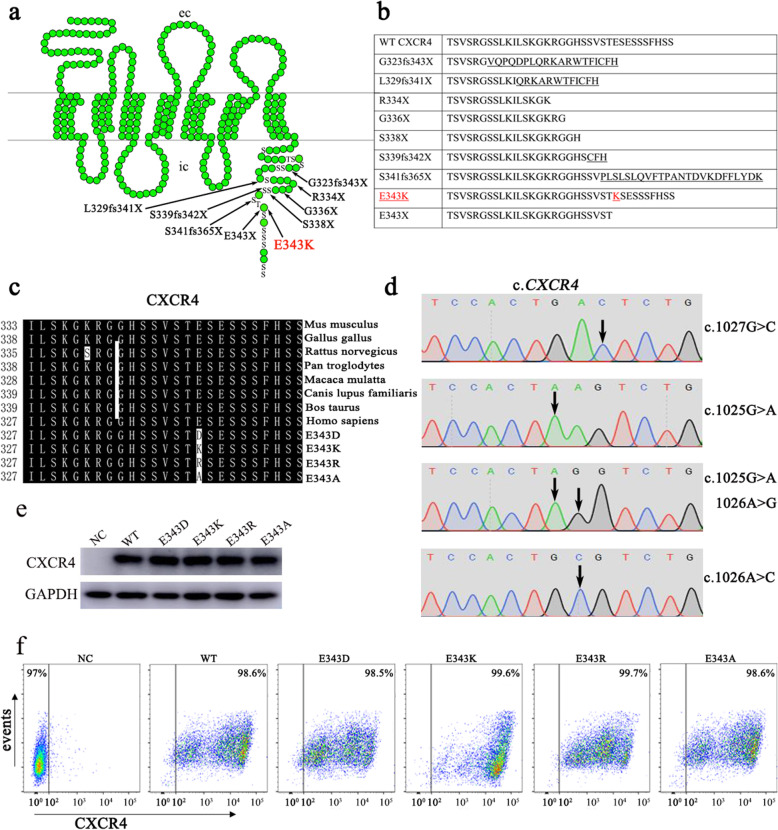
Warts, hypogammaglobulinemia, recurrent bacterial infections and myelokathexis (WHIM) syndrome is a primary immunodeficiency disease (PID) usually caused by autosomal dominant mutations in the chemokine receptor CXCR4 gene. To date, a total of nine different mutations including eight truncation mutations and one missense mutation (E343K, CXCR4) distributed in the C-terminus of CXCR4 have been identified in humans. Studies have clarified that the loss of phosphorylation sites in the C-terminus of truncated CXCR4 impairs the desensitization process, enhances the activation of G-protein, prolongs downstream signaling pathways and introduces over immune responses, thereby causing WHIM syndrome. So far, there is only one reported case of WHIM syndrome with a missense mutation, CXCR4, which has a full length of C-terminus with entire phosphorylation sites, no change in all potential phosphorylation sites. The mechanism of the missense mutation (CXCR4) causing WHIM syndrome is unknown. This study aimed to characterize the effect of mutation at the 343 site of CXCR4 causing the replacement of arginine/E with glutamic acid/K on the receptor signal transduction, and elucidate the mechanism underling CXCR4 causing WHIM in the reported family.
We completed a series of mutagenesis to generate different mutations at the 343 site of CXCR4 tail, and established a series of HeLa cell lines stably expressing CXCR4 or CXCR4 (glutamic acid/E replaced with aspartic acid/D) or CXCR4 (glutamic acid/E replaced with lysine/K) or CXCR4 (glutamic acid/E replaced with arginine/R) or CXCR4 (glutamic acid/E replaced with alanine/A) and then systematically analyzed functions of the CXCR4 mutants above. Results showed that the cells overexpressing of CXCR4 had no functional changes with comparison that of wild type CXCR4. However, the cells overexpressing of CXCR4 or CXCR4 or CXCR4 had enhanced cell migration, prolonged the phosphorylation of ERK1/2, p38, JNK1/2/3, aggravated activation of PI3K/AKT/NF-κB signal pathway, introduced higher expression of TNFa and IL6, suggesting over immune response occurred in CXCR4 mutants with charge change at the 343 site of receptor tail, as a result, causing WHIM syndrome. Biochemical analysis of those mutations at the 343 site of CXCR4 above shows that CXCR4 mutants with no matter positive or neutral charge have aberrant signal pathways downstream of activated mutated CXCR4, only CXVR4 with negative charge residues at the site shows normal signal pathway post activation with stromal-derived factor (SDF1, also known as CXCL12).
Taken together, our results demonstrated that the negative charge at the 343 site of CXCR4 plays an essential role in regulating the down-stream signal transduction of CXCR4 for physiological events, and residue charge changes, no matter positive or neutral introduce aberrant activities and functions of CXCR4, thus consequently lead to WHIM syndrome.
疣、低丙种球蛋白血症、反复细菌感染和髓过氧化物酶(WHIM)综合征是一种原发性免疫缺陷病(PID),通常由趋化因子受体 CXCR4 基因的常染色体显性突变引起。迄今为止,已在人类中发现了总共 9 种不同的突变,包括 8 种截断突变和 1 种错义突变(E343K,CXCR4),分布在 CXCR4 的 C 末端。研究表明,截断 CXCR4 的 C 末端磷酸化位点的缺失会损害脱敏过程,增强 G 蛋白的激活,延长下游信号通路,并引入过度的免疫反应,从而导致 WHIM 综合征。到目前为止,只有一例报道的 CXCR4 错义突变(WHIM 综合征),其 C 末端全长具有完整的磷酸化位点,所有潜在磷酸化位点均未发生变化。CXCR4 引起 WHIM 综合征的错义突变(CXCR4)的机制尚不清楚。本研究旨在研究 CXCR4 第 343 位氨基酸突变(精氨酸/E 被谷氨酸/K 取代)对受体信号转导的影响,并阐明在该家族中报道的 CXCR4 引起 WHIM 的潜在机制。
我们完成了一系列突变,在 CXCR4 尾巴的第 343 位产生了不同的突变,并建立了一系列稳定表达 CXCR4 或 CXCR4(谷氨酸/E 被天冬氨酸/D 取代)或 CXCR4(谷氨酸/E 被赖氨酸/K 取代)或 CXCR4(谷氨酸/E 被精氨酸/R 取代)或 CXCR4(谷氨酸/E 被丙氨酸/A 取代)的 HeLa 细胞系,并系统地分析了上述 CXCR4 突变体的功能。结果表明,与野生型 CXCR4 相比,过表达 CXCR4 的细胞没有功能变化。然而,过表达 CXCR4 或 CXCR4 或 CXCR4 的细胞迁移增强,ERK1/2、p38、JNK1/2/3 的磷酸化延长,PI3K/AKT/NF-κB 信号通路激活加重,TNFa 和 IL6 的表达升高,提示受体尾部第 343 位电荷变化的 CXCR4 突变体发生过度免疫反应,从而导致 WHIM 综合征。对上述 CXCR4 第 343 位突变的生化分析表明,无论正电荷还是中性电荷,CXCR4 突变体下游的激活突变 CXCR4 都存在异常信号通路,只有第 343 位带有负电荷残基的 CXVR4 在激活后表现出正常的信号通路基质衍生因子(SDF1,也称为 CXCL12)。
综上所述,我们的结果表明,CXCR4 第 343 位的负电荷在调节 CXCR4 的下游信号转导方面起着至关重要的作用生理事件,并且残基电荷的变化,无论是正电荷还是中性电荷,都会引入 CXCR4 的异常活性和功能,从而导致 WHIM 综合征。


