Russo T A, Tully K, Palm C, Neill C
Department of Geosciences and the Earth and Environmental Systems Institute, Pennsylvania State University, 310 Deike Building, University Park, PA 16802, USA.
Columbia Water Center, Columbia University, 500 West 120th St., New York, NY 10027, USA.
Nutr Cycl Agroecosyst. 2017;108:195-209. doi: 10.1007/s10705-017-9852-z. Epub 2017 May 16.
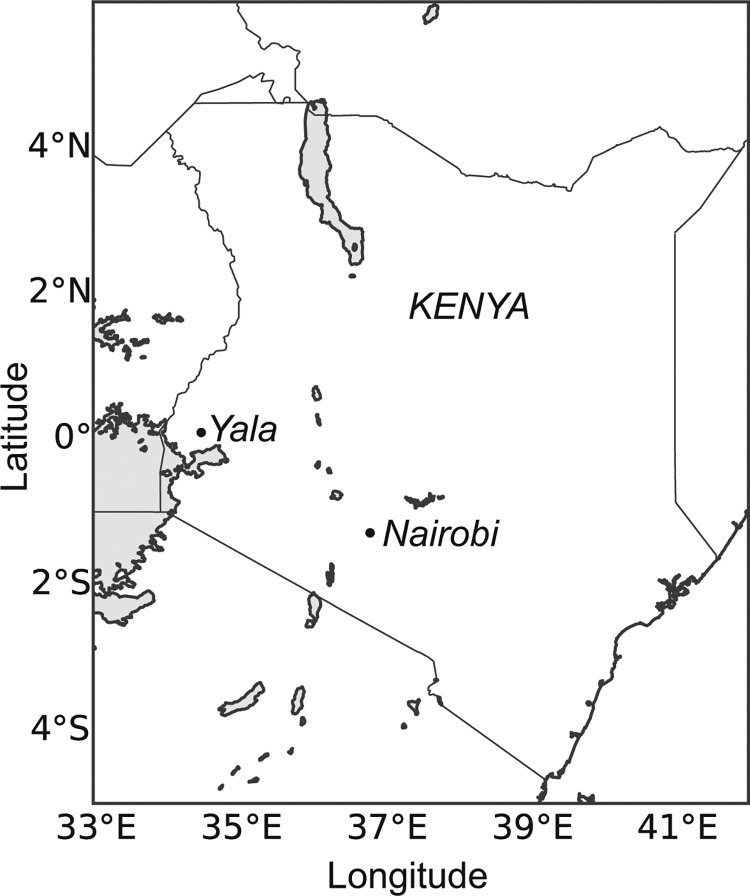
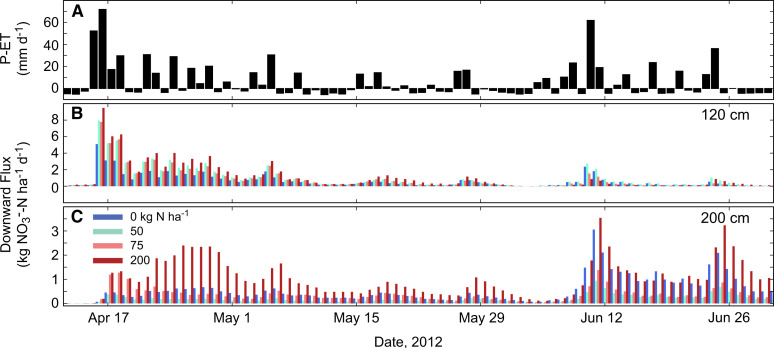
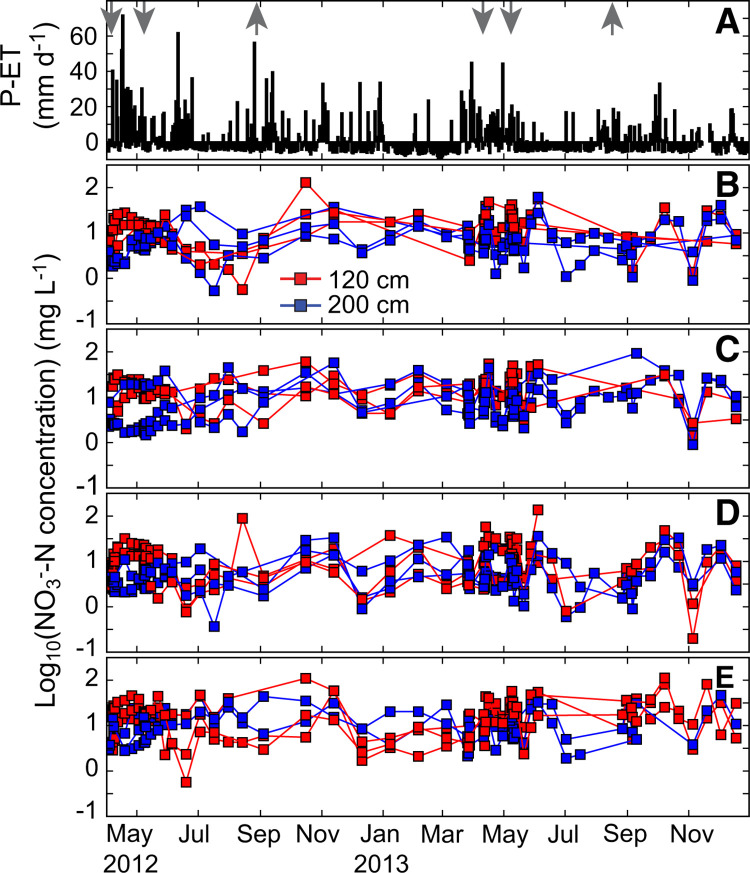
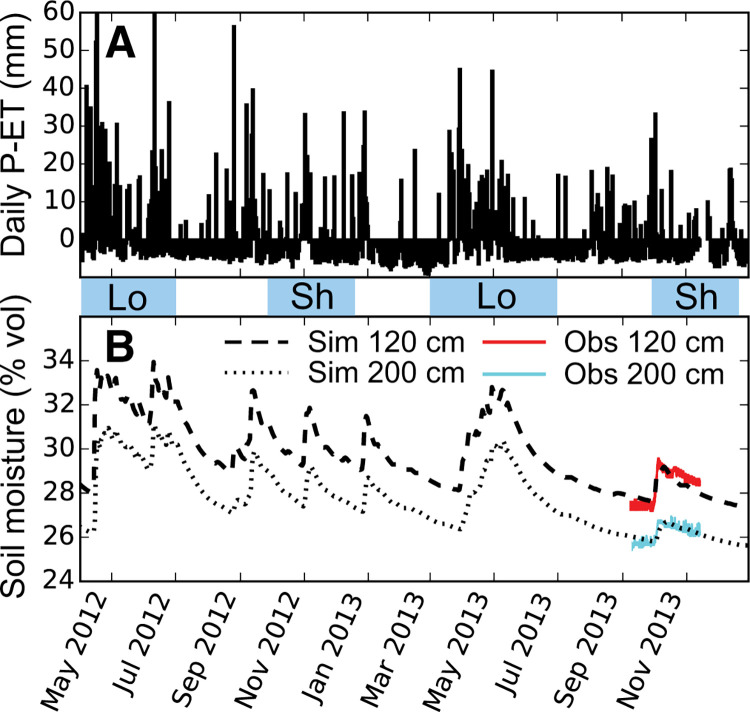
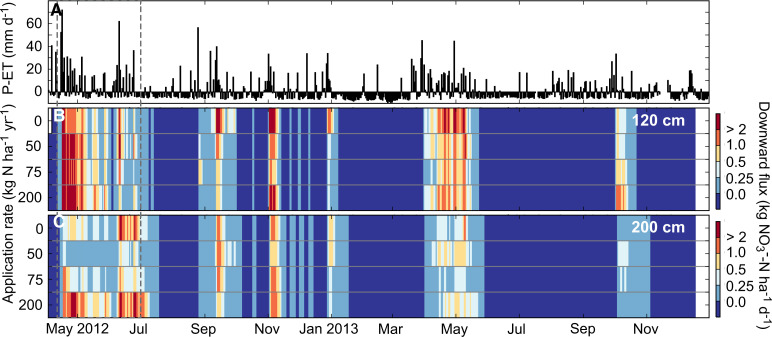
Meeting food security requirements in sub-Saharan Africa (SSA) will require increasing fertilizer use to improve crop yields, however excess fertilization can cause environmental and public health problems in surface and groundwater. Determining the threshold of reasonable fertilizer application in SSA requires an understanding of flow dynamics and nutrient transport in under-studied, tropical soils experiencing seasonal rainfall. We estimated leaching flux in Yala, Kenya on a maize field that received from 0 to 200 kg ha of nitrogen (N) fertilizer. Soil pore water concentration measurements during two growing seasons were coupled with results from a numerical fluid flow model to calculate the daily flux of nitrate-nitrogen (NO -N). Modeled NO -N losses to below 200 cm for 1 year ranged from 40 kg N ha year in the 75 kg N ha year treatment to 81 kg N ha year in the 200 kg N ha treatment. The highest soil pore water NO -N concentrations and NO -N leaching fluxes occurred on the highest N application plots, however there was a poor correlation between N application rate and NO -N leaching for the remaining N application rates. The drought in the second study year resulted in higher pore water NO -N concentrations, while NO -N leaching was disproportionately smaller than the decrease in precipitation. The lack of a strong correlation between NO -N leaching and N application rate, and a large decrease in flux between 120 and 200 cm suggest processes that influence NO -N retention in soils below 200 cm will ultimately control NO -N leaching at the watershed scale.-the daily flux of nitrate-nitrogen (NO -N). The lack of a strong correlation between NO -N leaching and N application rate, and a large decrease in flux between 120 and 200 cm suggest processes that influence NO -N retention in soils below 200 cm will ultimately control NO -N leaching at the watershed scale.
要满足撒哈拉以南非洲地区(SSA)的粮食安全需求,就需要增加化肥使用量以提高作物产量,然而过度施肥会给地表水和地下水带来环境及公共卫生问题。要确定SSA地区合理施肥的阈值,就需要了解在研究较少、经历季节性降雨的热带土壤中的水流动力学和养分运移情况。我们在肯尼亚的亚拉地区一块施氮量为0至200千克/公顷的玉米田上估算了淋溶通量。在两个生长季节进行的土壤孔隙水浓度测量与数值流体流动模型的结果相结合,以计算硝态氮(NO₃-N)的每日通量。模拟得出,在1年时间内,硝态氮损失至200厘米以下的量在75千克氮/公顷·年的处理中为40千克氮/公顷·年,在200千克氮/公顷的处理中为81千克氮/公顷·年。硝态氮淋溶通量最高的情况出现在施氮量最高的地块上,然而对于其余施氮量而言,施氮量与硝态氮淋溶之间的相关性较差。第二个研究年份的干旱导致孔隙水中硝态氮浓度升高,而硝态氮淋溶量的减少幅度远小于降水量的减少幅度。硝态氮淋溶与施氮量之间缺乏强相关性,以及在120至200厘米深度之间通量大幅下降,这表明影响200厘米以下土壤中硝态氮保留的过程最终将控制流域尺度上的硝态氮淋溶。——硝态氮(NO₃-N)的每日通量。硝态氮淋溶与施氮量之间缺乏强相关性,以及在120至200厘米深度之间通量大幅下降,这表明影响200厘米以下土壤中硝态氮保留的过程最终将控制流域尺度上的硝态氮淋溶。