Marciniak Camille, Chávez-Talavera Oscar, Caiazzo Robert, Hubert Thomas, Zubiaga Lorea, Baud Gregory, Quenon Audrey, Descat Amandine, Vallez Emmanuelle, Goossens Jean François, Kouach Mostafa, Vangelder Vincent, Gobert Mathilde, Daoudi Mehdi, Derudas Bruno, Pigny Pascal, Klein André, Gmyr Valéry, Raverdy Violeta, Lestavel Sophie, Laferrère Blandine, Staels Bart, Tailleux Anne, Pattou François
U1190, Institut Pasteur de Lille, University of Lille, Inserm, Lille, France.
U1011, Institut Pasteur de Lille, University of Lille, Inserm Lille, France.
Am J Physiol Endocrinol Metab. 2021 Apr 1;320(4):E772-E783. doi: 10.1152/ajpendo.00356.2020. Epub 2021 Jan 25.
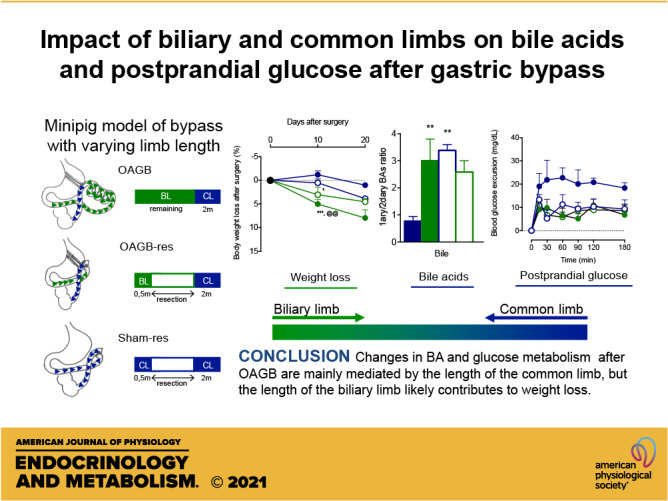
The alimentary limb has been proposed to be a key driver of the weight-loss-independent metabolic improvements that occur upon bariatric surgery. However, the one anastomosis gastric bypass (OAGB) procedure, consisting of one long biliary limb and a short common limb, induces similar beneficial metabolic effects compared to Roux-en-Y Gastric Bypass (RYGB) in humans, despite the lack of an alimentary limb. The aim of this study was to assess the role of the length of biliary and common limbs in the weight loss and metabolic effects that occur upon OAGB. OAGB and sham surgery, with or without modifications of the length of either the biliary limb or the common limb, were performed in Gottingen minipigs. Weight loss, metabolic changes, and the effects on plasma and intestinal bile acids (BAs) were assessed 15 days after surgery. OAGB significantly decreased body weight, improved glucose homeostasis, increased postprandial GLP-1 and fasting plasma BAs, and qualitatively changed the intestinal BA species composition. Resection of the biliary limb prevented the body weight loss effects of OAGB and attenuated the postprandial GLP-1 increase. Improvements in glucose homeostasis along with changes in plasma and intestinal BAs occurred after OAGB regardless of the biliary limb length. Resection of only the common limb reproduced the glucose homeostasis effects and the changes in intestinal BAs. Our results suggest that the changes in glucose metabolism and BAs after OAGB are mainly mediated by the length of the common limb, whereas the length of the biliary limb contributes to body weight loss. Common limb mediates postprandial glucose metabolism change after gastric bypass whereas biliary limb contributes to weight loss.
有人提出,消化肢是减肥手术中出现的与体重减轻无关的代谢改善的关键驱动因素。然而,单吻合口胃旁路术(OAGB),由一个长的胆胰肢和一个短的共同肢组成,尽管没有消化肢,但与Roux-en-Y胃旁路术(RYGB)相比,在人类中诱导出了类似的有益代谢效应。本研究的目的是评估胆胰肢和共同肢的长度在OAGB术后体重减轻和代谢效应中的作用。在哥廷根小型猪中进行了OAGB和假手术,对胆胰肢或共同肢的长度进行或不进行修改。术后15天评估体重减轻、代谢变化以及对血浆和肠道胆汁酸(BAs)的影响。OAGB显著降低了体重,改善了葡萄糖稳态,增加了餐后GLP-1和空腹血浆BAs,并定性改变了肠道BAs的种类组成。切除胆胰肢可防止OAGB的体重减轻效应,并减弱餐后GLP-1的增加。无论胆胰肢长度如何,OAGB术后葡萄糖稳态均得到改善,同时血浆和肠道BAs也发生了变化。仅切除共同肢可重现葡萄糖稳态效应和肠道BAs的变化。我们的结果表明,OAGB术后葡萄糖代谢和BAs的变化主要由共同肢的长度介导,而胆胰肢的长度有助于体重减轻。共同肢介导胃旁路术后餐后葡萄糖代谢变化,而胆胰肢有助于体重减轻。