Division of Vascular Surgery, Department of Surgery, Lankenau Medical Center, Wynnewood, PA.
Division of Vascular Surgery, Department of Surgery, Lankenau Medical Center, Wynnewood, PA.
Ann Vasc Surg. 2021 May;73:133-138. doi: 10.1016/j.avsg.2021.01.059. Epub 2021 Jan 22.
COVID-19, the syndrome caused by the novel SARS-CoV2, is associated with high rates of acute kidney injury requiring renal replacement therapy (RRT). It is well known that despite the ease of bedside insertion, the use of nontunneled dialysis catheters (NTDCs) is associated with increased complications compared to tunneled dialysis catheters (TDCs). Our objective was to develop a strategy for TDC placement at the bedside to provide effective dialysis access, conserve resources and decrease personnel exposure at our medical center in an epicenter of the COVID-19 pandemic.
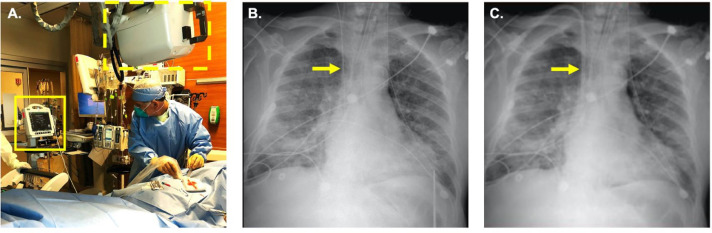
A technique for bedside TDC insertion with ultrasound and plain radiographs in the intensive care unit was developed. Test or clinically COVID-19-positive patients requiring RRT were evaluated for bedside emergent NTDC or nonemergent TDC placement. Patients who underwent NTDC placement were monitored for ongoing RRT needs and were converted to TDC at the bedside after 3-5 days. We prospectively collected patient data focusing on complications and mortality.
Of the 36 consultations for dialysis access in COVID-positive patients from March 19 through June 5, 2020, a total of 24 bedside TDCs were placed. Only one patient developed a complication, which was pneumothorax and cardiac tamponade during line placement. In-hospital mortality in the cohort was 63.9%.
Bedside TDC placement has served to conserve resources, prevent complications with transport to and from the operating room, and decrease personnel exposure during the COVID-19 pandemic. This strategy warrants further consideration and could be used in critically ill patients regardless of COVID status.
由新型 SARS-CoV2 引起的 COVID-19 与需要肾脏替代治疗(RRT)的高急性肾损伤率相关。众所周知,尽管床边插入很容易,但与隧道透析导管(TDC)相比,使用非隧道透析导管(NTDC)会增加并发症。我们的目标是在床边开发一种 TDC 放置策略,为我们的医疗中心提供有效的透析通路,节省资源并减少人员暴露,因为该医疗中心是 COVID-19 大流行的中心。
在重症监护病房中使用超声和普通 X 光片开发了床边 TDC 插入技术。评估需要 RRT 的测试或临床 COVID-19 阳性患者是否需要床边紧急 NTDC 或非紧急 TDC 放置。对接受 NTDC 放置的患者进行监测,以评估其持续的 RRT 需求,并在 3-5 天后在床边将其转换为 TDC。我们前瞻性收集了患者数据,重点关注并发症和死亡率。
在 2020 年 3 月 19 日至 6 月 5 日期间,对 COVID-19 阳性患者进行了 36 次透析通路咨询,共放置了 24 根床边 TDC。只有一名患者发生并发症,即在导管放置过程中发生气胸和心脏压塞。该队列的院内死亡率为 63.9%。
床边 TDC 放置有助于节省资源,防止因往返手术室而引起的并发症,并减少 COVID-19 大流行期间的人员暴露。这种策略值得进一步考虑,并且可以在无论 COVID-19 状态如何的危重患者中使用。