Bogdanović Milica D, Ćuković Katarina B, Subotić Angelina R, Dragićević Milan B, Simonović Ana D, Filipović Biljana K, Todorović Slađana I
Department of Plant Physiology, Institute for Biological Research "Siniša Stanković"-National Institute of Republic of Serbia, University of Belgrade, Bulevar Despota Stefana 142, 11060 Belgrade, Serbia.
Plants (Basel). 2021 Jan 21;10(2):199. doi: 10.3390/plants10020199.
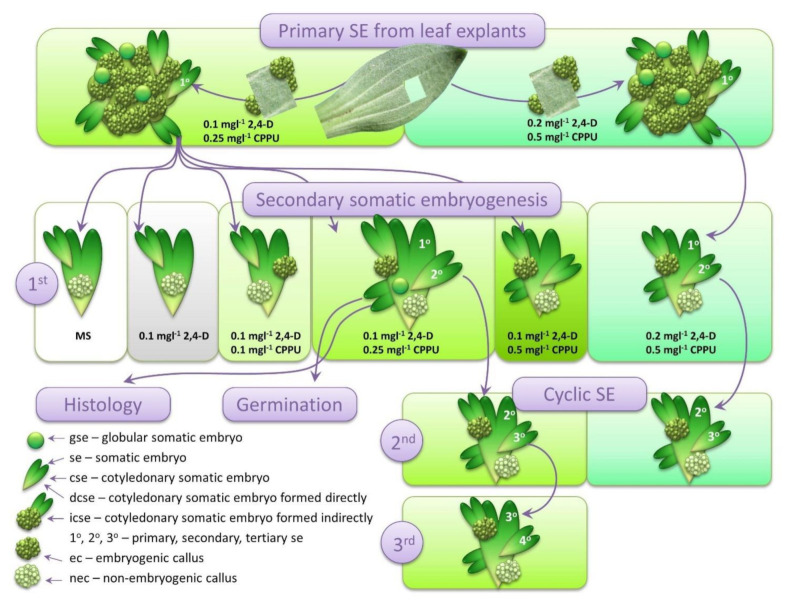
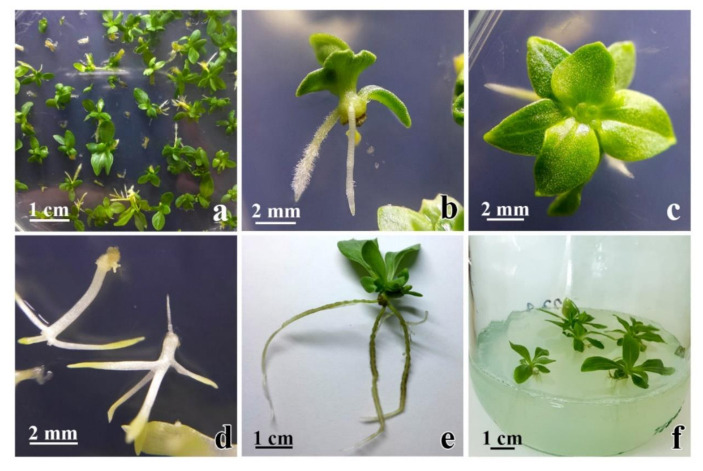
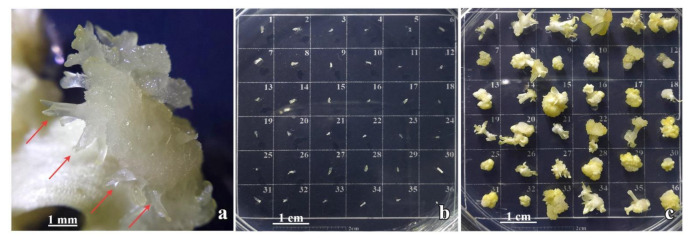
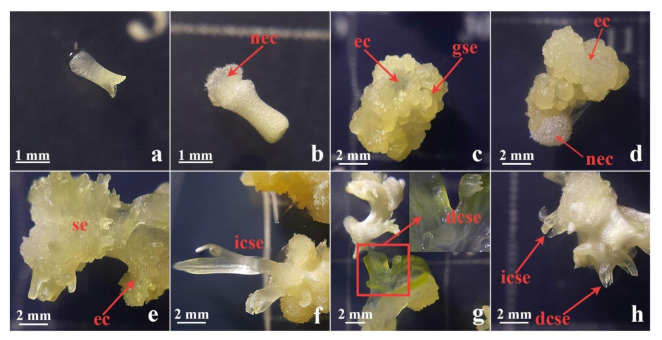
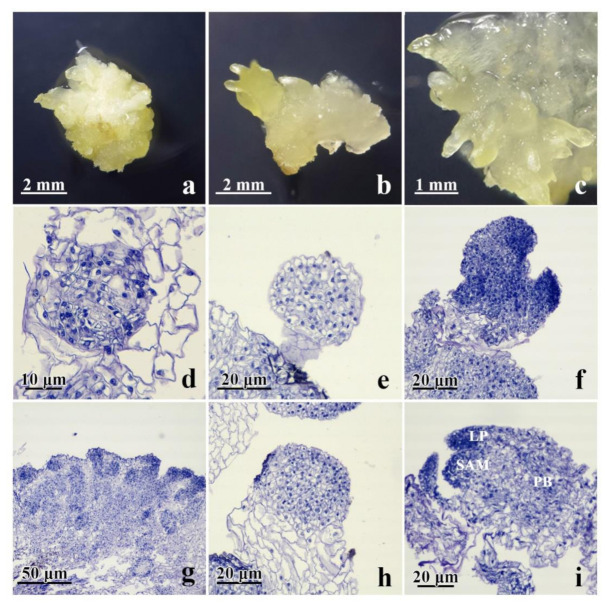
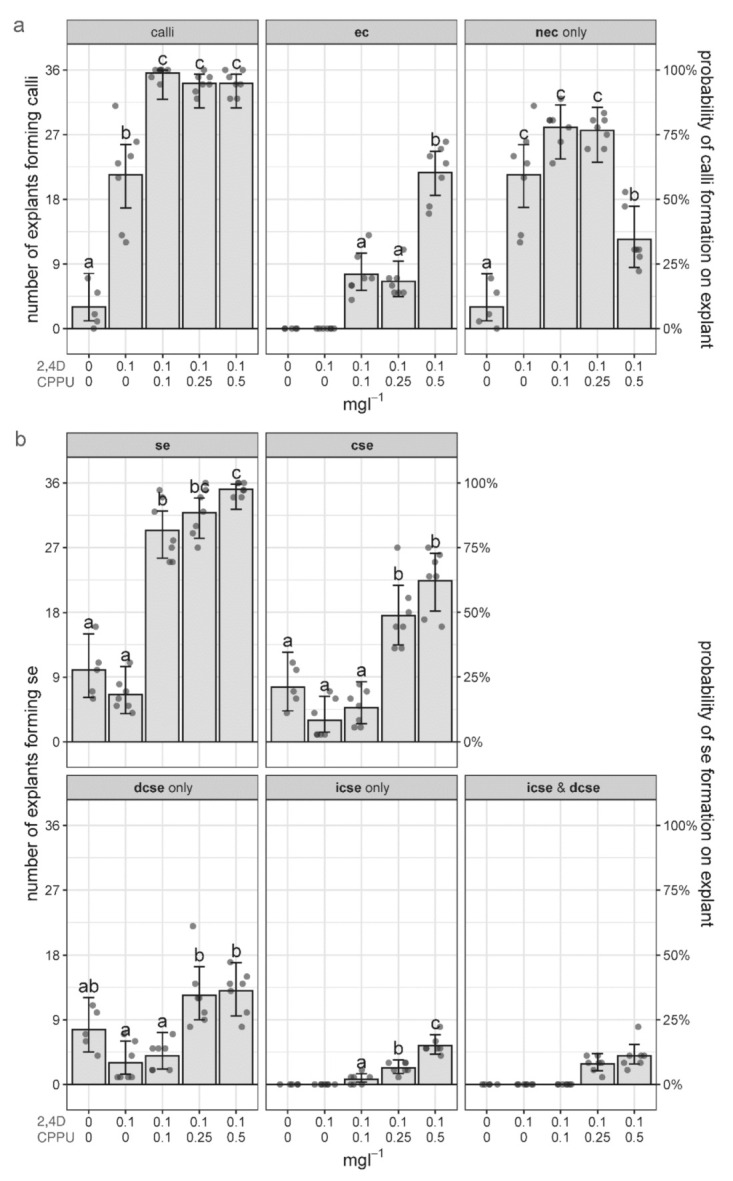
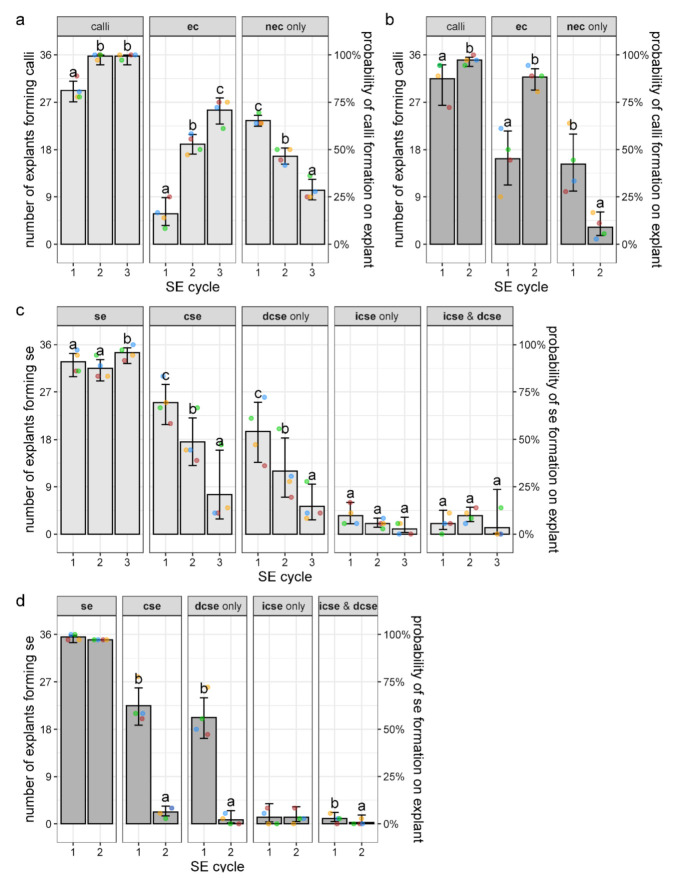
Somatic embryogenesis (SE) is a developmental process during which plant somatic cells, under suitable conditions, produce embryogenic cells that develop into somatic embryos (). SE is the most important method for plant propagation in vitro, having both fundamental and applicative significance. SE can be induced from different tissues and organs, but when are used as explants, the process is recognized as secondary or cyclic SE. We induced secondary SE in by application of 2,4-dichlorophenoxyacetic acid (2,4-D) and -(2-chloro-4-pyridyl)-'-phenylurea (CPPU). A medium containing 0.1 mgL 2,4-D and 0.25 mgL CPPU was optimal in terms of the number of primary SE explants forming , the number of well-developed per explant, and morphological appearance of the obtained . These concentrations allowed SE to progress through three cycles, whereas at higher concentrations of 0.2 mgL 2,4-D and 0.5 mgL CPPU, only two cycles were achieved. Histological analysis revealed that secondary are formed both directly and indirectly. Secondary SE readily germinated and converted into plantlets. Induction of cyclic SE contributes to the conservation efforts of this endangered medicinal plant and expands the spectrum of in vitro developmental pathways described in centaury-an emerging model in developmental biology.
体细胞胚胎发生(SE)是一个发育过程,在此过程中植物体细胞在适宜条件下产生胚性细胞,进而发育成体细胞胚。SE是植物离体繁殖最重要的方法,具有基础和应用双重意义。SE可从不同组织和器官诱导产生,但当使用[具体组织或器官未提及]作为外植体时,该过程被认为是次生或循环性SE。我们通过施用2,4 - 二氯苯氧乙酸(2,4 - D)和N - (2 - 氯 - 4 - 吡啶基)- N' - 苯基脲(CPPU)在[植物名称未提及]中诱导次生SE。就形成[具体结构未提及]的初生SE外植体数量、每个外植体发育良好[具体结构未提及]的数量以及所获得[具体结构未提及]的形态外观而言,含有0.1 mg/L 2,4 - D和0.25 mg/L CPPU的培养基是最优的。这些浓度使SE能够进行三个循环,而在0.2 mg/L 2,4 - D和0.5 mg/L CPPU的较高浓度下,仅实现了两个循环。组织学分析表明,次生[具体结构未提及]以直接和间接两种方式形成。次生SE易于萌发并转化为小植株。循环性SE的诱导有助于这种濒危药用植物的保护工作,并扩展了在发育生物学中新兴模式植物——矢车菊中所描述的离体发育途径的范围。