HealthCore, Inc., 123 Justison Street, Suite 200, Wilmington, DE, 19801, USA.
Pfizer Inc., New York, NY, USA.
BMC Cancer. 2021 Jan 25;21(1):97. doi: 10.1186/s12885-021-07790-z.
There is limited real-world safety information on palbociclib for treatment of advanced stage HR+/HER2- breast cancer.
We conducted a cohort study of breast cancer patients initiating palbociclib and fulvestrant from February 2015 to September 2017 using the HealthCore Integrated Research Database (HIRD), a longitudinal claims database of commercial health plan members in the United States. The historical comparator cohort comprised patients initiating fulvestrant monotherapy from January 2011 to January 2015. Propensity score matching and Cox regression were used to estimate hazard ratios for various safety events. For acute liver injury (ALI), additional analyses and medical record validation were conducted.
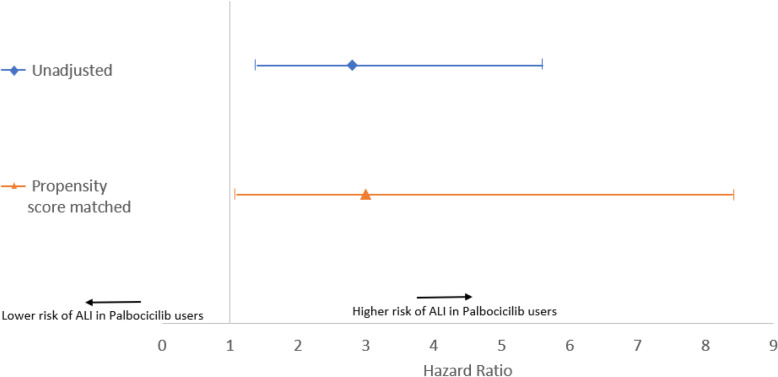
There were 2445 patients who initiated palbociclib including 566 new users of palbociclib-fulvestrant, and 2316 historical new users of fulvestrant monotherapy. Compared to these historical new users of fulvestrant monotherapy, new users of palbociclib-fulvestrant had a greater than 2-fold elevated risk for neutropenia, leukopenia, thrombocytopenia, stomatitis and mucositis, and ALI. Incidence of anemia and QT prolongation were more weakly associated, and incidences of serious infections and pulmonary embolism were similar between groups after propensity score matching. After adjustment for additional ALI risk factors, the elevated risk of ALI in new users of palbociclib-fulvestrant persisted (e.g. primary ALI algorithm hazard ratio (HR) = 3.0, 95% confidence interval (CI) = 1.1-8.4).
This real-world study found increased risks of several adverse events identified in clinical trials, including neutropenia, leukopenia, and thrombocytopenia, but no increased risk of serious infections or pulmonary embolism when comparing new users of palbociclib-fulvestrant to fulvestrant monotherapy. We observed an increased risk of ALI, extending clinical trial findings of significant imbalances in grade 3/4 elevations of alanine aminotransferase (ALT).
在治疗晚期激素受体阳性(HR+)/人表皮生长因子受体 2 阴性(HER2-)乳腺癌方面,有关帕博西尼的真实世界安全性信息有限。
我们使用美国商业健康计划成员的纵向索赔数据库(HealthCore Integrated Research Database,HIRD),对 2015 年 2 月至 2017 年 9 月期间开始使用帕博西尼和氟维司群的乳腺癌患者进行了队列研究。历史对照组包括 2011 年 1 月至 2015 年 1 月开始氟维司群单药治疗的患者。使用倾向评分匹配和 Cox 回归来估计各种安全性事件的风险比。对于急性肝损伤(ALI),还进行了额外的分析和病历验证。
共有 2445 例患者开始使用帕博西尼,其中 566 例为帕博西尼-氟维司群组的新使用者,2316 例为氟维司群组的历史新使用者。与这些氟维司群组的历史新使用者相比,帕博西尼-氟维司群组的中性粒细胞减少症、白细胞减少症、血小板减少症、口腔炎和黏膜炎以及 ALI 的风险增加了两倍以上。贫血和 QT 延长的发生率与风险的相关性较弱,并且在倾向评分匹配后,两组的严重感染和肺栓塞发生率相似。在调整其他 ALI 危险因素后,帕博西尼-氟维司群组新使用者的 ALI 风险仍然较高(例如,原发性 ALI 算法风险比(HR)=3.0,95%置信区间(CI)=1.1-8.4)。
这项真实世界研究发现,与氟维司群组的历史新使用者相比,几种在临床试验中确定的不良事件的风险增加,包括中性粒细胞减少症、白细胞减少症和血小板减少症,但严重感染或肺栓塞的风险没有增加。我们观察到 ALI 的风险增加,这扩展了临床试验中丙氨酸氨基转移酶(ALT)水平 3/4 升高的显著失衡的结果。