Department of Anesthesiology, Zhujiang Hospital, Southern Medical University, Guangzhou, 510000, China.
Department of Gynecology, Zhujiang Hospital, Southern Medical University, Guangzhou, China.
Stem Cell Res Ther. 2021 Jan 25;12(1):84. doi: 10.1186/s13287-021-02152-9.
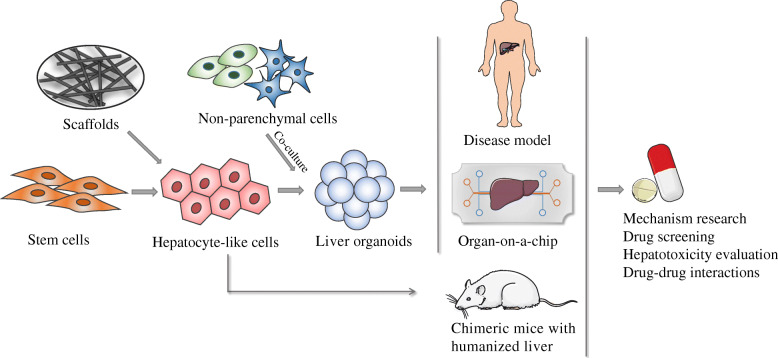
Drug-induced liver injury (DILI) is one of the leading causes of clinical trial failures and high drug attrition rates. Currently, the commonly used hepatocyte models include primary human hepatocytes (PHHs), animal models, and hepatic cell lines. However, these models have disadvantages that include species-specific differences or inconvenient cell extraction methods. Therefore, a novel, inexpensive, efficient, and accurate model that can be applied to drug screening is urgently needed. Owing to their self-renewable ability, source abundance, and multipotent competence, stem cells are stable sources of drug hepatotoxicity screening models. Because 3D culture can mimic the in vivo microenvironment more accurately than can 2D culture, the former is commonly used for hepatocyte culture and drug screening. In this review, we introduce the different sources of stem cells used to generate hepatocyte-like cells and the models for hepatotoxicity testing that use stem cell-derived hepatocyte-like cells.
药物性肝损伤(DILI)是临床试验失败和高药物淘汰率的主要原因之一。目前,常用的肝细胞模型包括原代人肝细胞(PHH)、动物模型和肝细胞系。然而,这些模型存在物种特异性差异或不方便的细胞提取方法等缺点。因此,迫切需要一种新型的、廉价的、高效的、准确的可应用于药物筛选的模型。由于其自我更新能力、来源丰富和多能性,干细胞是药物肝毒性筛选模型的稳定来源。由于 3D 培养比 2D 培养更能准确模拟体内微环境,前者常用于肝细胞培养和药物筛选。在这篇综述中,我们介绍了用于生成肝样细胞的不同来源的干细胞,以及使用干细胞衍生的肝样细胞进行肝毒性测试的模型。