Department of Psychiatry, University of Pittsburgh, Pittsburgh, PA, USA.
Brain Imaging Research Center, Department of Psychiatry, University of Arkansas for Medical Sciences, Little Rock, AR, USA.
Mol Psychiatry. 2021 Sep;26(9):4919-4930. doi: 10.1038/s41380-021-01017-0. Epub 2021 Jan 25.
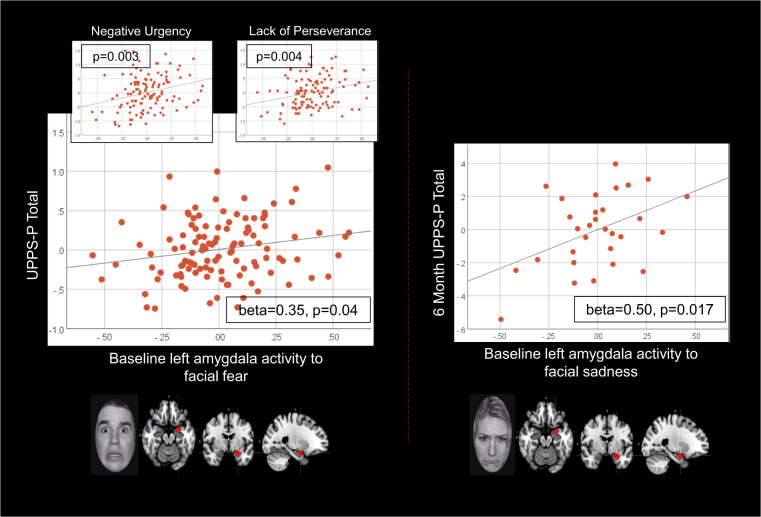
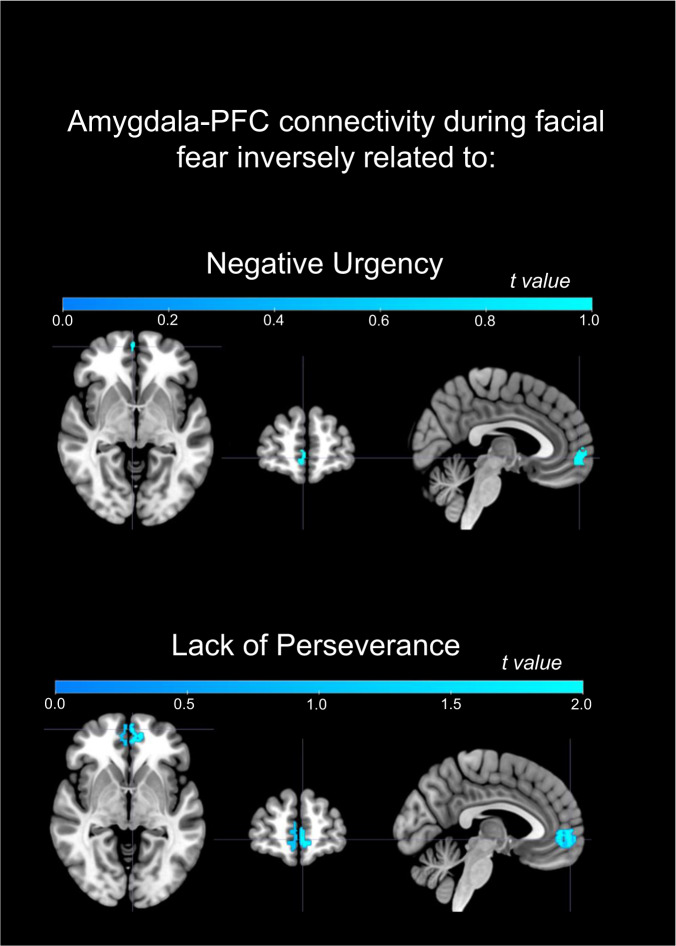
Impulsivity (rash action with deleterious outcomes) is common to many psychiatric disorders. While some studies indicate altered amygdala and prefrontal cortical (PFC) activity associated with impulsivity, it remains unclear whether these patterns of neural activity are specific to impulsivity or common to a range of affective and anxiety symptoms. To elucidate neural markers specific to impulsivity, we aimed to differentiate patterns of amygdala-PFC activity and functional connectivity associated with impulsivity from those associated with affective and anxiety symptoms, and identify measures of this circuitry predicting future worsening of impulsivity. Using a face emotion processing task that reliably activates amygdala-PFC circuitry, neural activity and connectivity were assessed in a transdiagnostically-recruited sample of young adults, including healthy (N = 47) and treatment-seeking individuals (N = 67). Relationships were examined between neural measures and impulsivity, anhedonia, and affective and anxiety symptoms at baseline (N = 114), and at 6 months post scan (N = 30). Impulsivity, particularly negative urgency and lack of perseverance, was related to greater amygdala activity (beta = 0.82, p = 0.003; beta = 0.68, p = 0.004; respectively) and lower amygdala-medial PFC functional connectivity (voxels = 60, t = 4.45, p = 0.017; voxels = 335, t = 5.26, p = 0.001; respectively) to facial fear. Left vlPFC, but not amygdala, activity to facial anger was inversely associated with mania/hypomania (beta = -2.08, p = 0.018). Impulsivity 6 months later was predicted by amygdala activity to facial sadness (beta = 0.50, p = 0.017). There were no other significant relationships between neural activity and 6-month anhedonia, affective, and anxiety symptoms. Our findings are the first to associate amygdala-PFC activity and functional connectivity with impulsivity in a large, transdiagnostic sample, providing neural targets for future interventions to reduce predisposition to impulsivity and related future mental health problems in young adults.
冲动(鲁莽行为导致不良后果)是许多精神疾病的共同特征。虽然一些研究表明,杏仁核和前额叶皮层(PFC)的活动与冲动有关,但目前尚不清楚这些神经活动模式是否特定于冲动,还是与一系列情感和焦虑症状有关。为了阐明与冲动有关的特定神经标记物,我们旨在区分与冲动相关的杏仁核-前额叶皮层活动和功能连接模式与与情感和焦虑症状相关的模式,并确定预测冲动未来恶化的电路测量值。使用一种可靠地激活杏仁核-前额叶皮层电路的面部情绪处理任务,我们评估了一组来自年轻成年人的跨诊断招募样本的神经活动和连接,包括健康者(N=47)和寻求治疗者(N=67)。在基线(N=114)和扫描后 6 个月(N=30),研究了神经测量值与冲动、快感缺失以及情感和焦虑症状之间的关系。冲动,特别是负性冲动和缺乏坚持力,与杏仁核活动增加(β=0.82,p=0.003;β=0.68,p=0.004;分别)和杏仁核-内侧前额叶功能连接降低(体素=60,t=4.45,p=0.017;体素=335,t=5.26,p=0.001;分别)有关。左侧 vlPFC 对面部愤怒的活动与躁狂/轻躁狂呈负相关(β=-2.08,p=0.018),而不是杏仁核。6 个月后的冲动由对悲伤面部的杏仁核活动预测(β=0.50,p=0.017)。神经活动与 6 个月快感缺失、情感和焦虑症状之间没有其他显著关系。我们的研究结果首次在一个大型跨诊断样本中,将杏仁核-前额叶皮层的活动和功能连接与冲动联系起来,为未来的干预措施提供了神经靶点,以降低年轻人冲动倾向和相关未来心理健康问题的风险。