Flannagan Ronald S, Farrell Tayler J, Trothen Steven M, Dikeakos Jimmy D, Heinrichs David E
Blood Adv. 2021 Jan 26;5(2):459-474. doi: 10.1182/bloodadvances.2020002833.
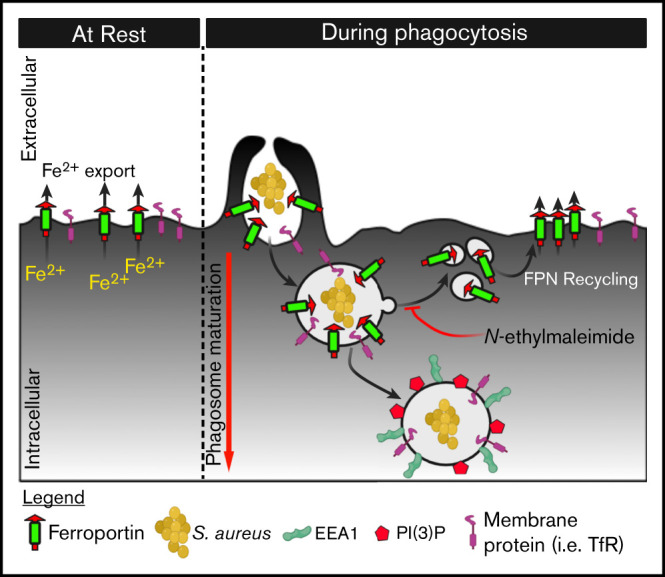
Nutrient sequestration is an essential facet of host innate immunity. Macrophages play a critical role in controlling iron availability through expression of the iron transport protein ferroportin (FPN), which extrudes iron from the cytoplasm to the extracellular milieu. During phagocytosis, the limiting phagosomal membrane, which derives from the plasmalemma, can be decorated with FPN and, if functional, will move iron from the cytosol into the phagosome lumen. This serves to feed iron to phagocytosed microbes and would be counterproductive to the many other known host mechanisms working to starve microbes of this essential metal. To understand how FPN is regulated during phagocytosis, we expressed FPN as a green fluorescent protein-fusion protein in macrophages and monitored its localization during uptake of various phagocytic targets, including Staphylococcus aureus, Salmonella enterica serovar Typhimurium, human erythrocytes, and immunoglobulin G opsonized latex beads. We find that FPN is rapidly removed, independently of Vps34 and PI(3)P, from early phagosomes and does not follow recycling pathways that regulate transferrin receptor recycling. Live-cell video microscopy showed that FPN movement on the phagosome is dynamic, with punctate and tubular structures forming before FPN is trafficked back to the plasmalemma. N-ethylmaleimide-sensitive factor, which disrupts soluble NSF attachment protein receptor (SNARE)-mediated membrane fusion and trafficking, prevented FPN removal from the phagosome. Our data support the hypothesis that removal of FPN from the limiting phagosomal membrane will, at the cellular level, ensure that iron cannot be pumped into phagosomes. We propose this as yet another mechanism of host nutritional immunity to subvert microbial growth.
营养螯合是宿主固有免疫的一个重要方面。巨噬细胞在通过表达铁转运蛋白铁转运蛋白1(FPN)来控制铁的可用性方面发挥着关键作用,该蛋白将铁从细胞质挤出到细胞外环境中。在吞噬过程中,源自质膜的限制性吞噬体膜可以被FPN修饰,如果其功能正常,将把铁从细胞质转运到吞噬体腔中。这有助于为吞噬的微生物提供铁,而这与许多其他已知的宿主机制相悖,这些机制旨在使微生物缺乏这种必需金属。为了了解吞噬过程中FPN是如何被调节的,我们在巨噬细胞中将FPN表达为绿色荧光蛋白融合蛋白,并在摄取各种吞噬靶点(包括金黄色葡萄球菌、鼠伤寒沙门氏菌、人红细胞和免疫球蛋白G调理的乳胶珠)的过程中监测其定位。我们发现FPN从早期吞噬体中迅速被清除,与Vps34和磷脂酰肌醇-3-磷酸(PI(3)P)无关,并且不遵循调节转铁蛋白受体循环的回收途径。活细胞视频显微镜显示,FPN在吞噬体上的移动是动态的,在FPN被运回质膜之前会形成点状和管状结构。N-乙基马来酰亚胺敏感因子会破坏可溶性NSF附着蛋白受体(SNARE)介导的膜融合和运输,它阻止了FPN从吞噬体中被清除。我们的数据支持这样的假设,即在细胞水平上,从限制性吞噬体膜上清除FPN将确保铁不能被泵入吞噬体。我们提出这是宿主营养免疫颠覆微生物生长的又一种机制。