Children's Hospital of Soochow University, Institutes for Translational Medicine, State Key Laboratory of Radiation Medicine and Protection, Medical College of Soochow University, Soochow University, Suzhou, China.
Shanghai Institute of Nutrition and Health, Shanghai Institutes for Biological Sciences, University of Chinese Academy of Sciences, Chinese Academy of Sciences, Shanghai, China.
Cell Mol Gastroenterol Hepatol. 2021;12(1):81-98. doi: 10.1016/j.jcmgh.2021.01.013. Epub 2021 Jan 23.
BACKGROUND & AIMS: Fulminant hepatitis (FH) is a clinical syndrome characterized by sudden and severe liver dysfunction. Dot1L, a histone methyltransferase, is implicated in various physiologic and pathologic processes, including transcription regulation and leukemia. However, the role of Dot1L in regulating inflammatory responses during FH remains elusive.
Propionibacterium acnes (P. acnes)-primed, lipopolysaccharides (LPS)-induced FH was established in C57BL/6 mice and was treated with the Dot1L inhibitor EPZ-5676. Myeloid derived suppressor cells (MDSCs) were depleted by anti-Gr-1 antibody to evaluate their therapeutic roles in Dot1L treatment of FH. Moreover, peripheral blood of patients suffered with FH and healthy controls was collected to determine the expression profile of Dot1L-SOCS1-iNOS axis in their MDSCs.
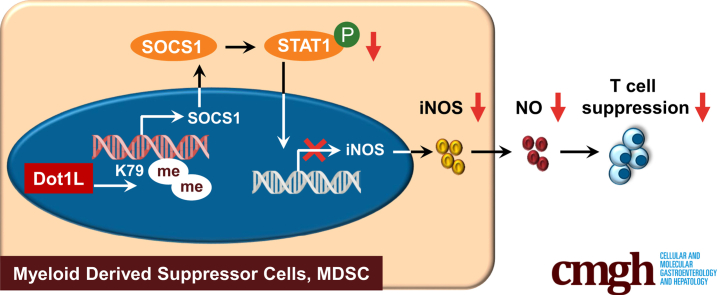
Here we identified that EPZ-5676, pharmacological inhibitor of Dot1L, attenuated the liver injury of mice subjected to FH. Dot1L inhibition led to decreased T helper 1 cell response and expansion of regulatory T cells (Tregs) during FH. Interestingly, Dot1L inhibition didn't directly target T cells, but dramatically enhanced the immunosuppressive function of MDSCs. Mechanistically, Dot1L inhibition epigenetically suppressed SOCS1 expression, thus inducing inducible nitric oxide synthase (iNOS) expression in a STAT1-dependent manner. Moreover, in human samples, the levels of Dot1L and SOCS1 expression were upregulated in MDSCs, accompanied by decreased expression of iNOS in patients with FH, compared with healthy controls.
Altogether, our findings established Dot1L as a critical regulator of MDSC immunosuppressive function for the first time, and highlighted the therapeutic potential of Dot1L inhibitor for FH treatment.
暴发性肝炎(FH)是一种以突然出现严重肝功能障碍为特征的临床综合征。Dot1L,一种组蛋白甲基转移酶,参与多种生理和病理过程,包括转录调控和白血病。然而,Dot1L 在调节 FH 时的炎症反应中的作用仍不清楚。
采用丙酸杆菌(P. acnes)诱导、脂多糖(LPS)诱导的 C57BL/6 小鼠 FH 模型,并给予 Dot1L 抑制剂 EPZ-5676 进行治疗。用抗 Gr-1 抗体耗竭髓系来源抑制细胞(MDSCs),以评估其在 Dot1L 治疗 FH 中的治疗作用。此外,收集 FH 患者和健康对照者的外周血,以确定 Dot1L-SOCS1-iNOS 轴在 MDSCs 中的表达谱。
我们发现,Dot1L 的药理学抑制剂 EPZ-5676 可减轻 FH 小鼠的肝损伤。Dot1L 抑制导致 FH 期间 Th1 细胞反应减弱和调节性 T 细胞(Tregs)扩增。有趣的是,Dot1L 抑制不是直接靶向 T 细胞,而是显著增强 MDSC 的免疫抑制功能。机制上,Dot1L 抑制通过表观遗传抑制 SOCS1 的表达,从而以 STAT1 依赖性方式诱导诱导型一氧化氮合酶(iNOS)的表达。此外,在人类样本中,与健康对照者相比,FH 患者 MDSCs 中 Dot1L 和 SOCS1 的表达上调,同时 iNOS 的表达下调。
总之,我们的研究结果首次确立了 Dot1L 作为 MDSC 免疫抑制功能的关键调节因子,并强调了 Dot1L 抑制剂治疗 FH 的治疗潜力。