Lannoy Séverine, Duka Theodora, Carbia Carina, Billieux Joël, Fontesse Sullivan, Dormal Valérie, Gierski Fabien, López-Caneda Eduardo, Sullivan Edith V, Maurage Pierre
Stanford University, Department of Psychiatry and Behavioral Sciences, Stanford, California, USA; Louvain Experimental Psychopathology research group (LEP), Psychological Sciences Research Institute, UCLouvain, Louvain-la-Neuve, Belgium.
Behavioral and Clinical Neuroscience, School of Psychology, University of Sussex, Brighton, UK; Sussex Addiction and Intervention Centre, University of Sussex, Brighton, UK.
Clin Psychol Rev. 2021 Mar;84:101971. doi: 10.1016/j.cpr.2021.101971. Epub 2021 Jan 13.
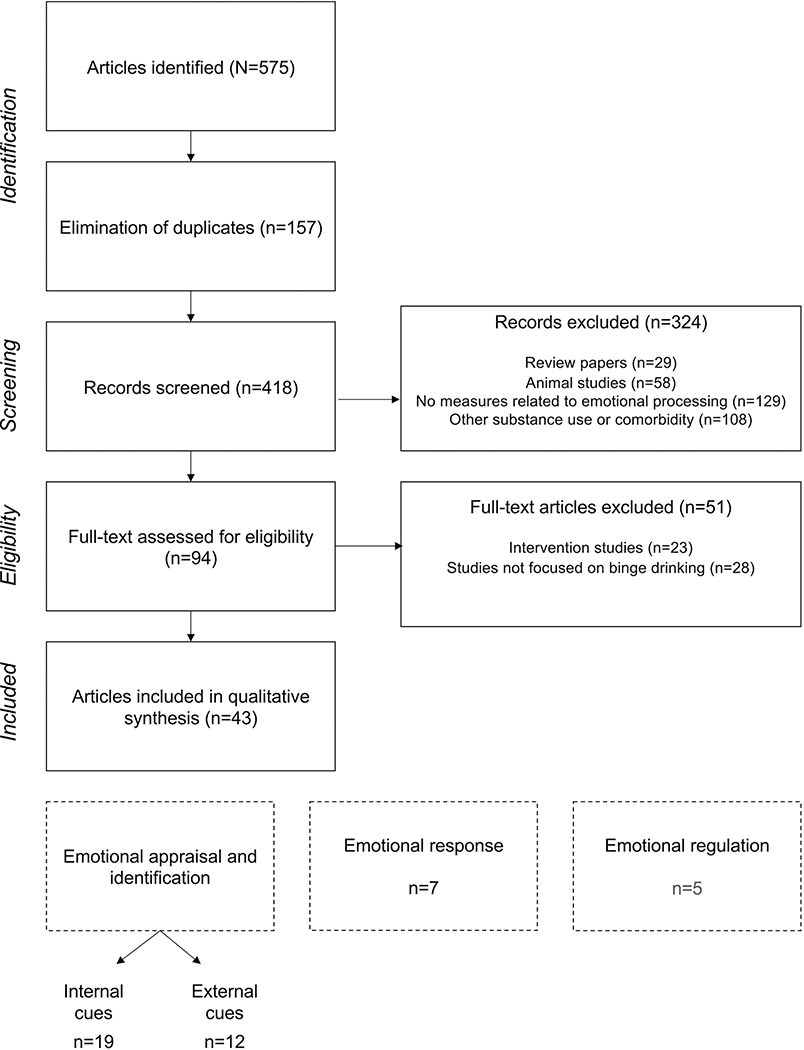
Binge drinking is a widespread alcohol consumption pattern commonly engaged by youth. Here, we present the first systematic review of emotional processes in relation to binge drinking. Capitalizing on a theoretical model describing three emotional processing steps (emotional appraisal/identification, emotional response, emotional regulation) and following PRISMA guidelines, we considered all identified human studies exploring emotional abilities among binge drinkers. A literature search was conducted in PubMed, Scopus, and PsychINFO, and a standardized methodological quality assessment was performed for each study. The main findings offered by the 43 studies included are: 1) regarding emotional appraisal/identification, binge drinking is related to heightened negative emotional states, including greater severity of depressive and anxiety symptoms, and have difficulties in recognizing emotional cues expressed by others; 2) regarding emotional response, binge drinkers exhibit diminished emotional response compared with non-binge drinkers; 3) regarding emotional regulation, no experimental data currently support impaired emotion regulation in binge drinking. Variability in the identification and measurement of binge drinking habits across studies limits conclusions. Nevertheless, current findings establish the relevance of emotional processes in binge drinking and set the stage for new research perspectives to identify the nature and extent of emotional impairments in the onset and maintenance of excessive alcohol use.
暴饮是一种普遍存在的饮酒模式,常见于年轻人。在此,我们首次对与暴饮相关的情绪过程进行系统综述。基于描述三个情绪处理步骤(情绪评估/识别、情绪反应、情绪调节)的理论模型,并遵循PRISMA指南,我们纳入了所有已识别的探讨暴饮者情绪能力的人体研究。在PubMed、Scopus和PsychINFO中进行了文献检索,并对每项研究进行了标准化的方法学质量评估。纳入的43项研究的主要发现包括:1)关于情绪评估/识别,暴饮与负面情绪状态加剧有关,包括抑郁和焦虑症状更严重,且难以识别他人表达的情绪线索;2)关于情绪反应,与非暴饮者相比,暴饮者的情绪反应减弱;3)关于情绪调节,目前尚无实验数据支持暴饮者存在情绪调节受损。各研究中暴饮习惯的识别和测量存在差异,限制了结论。尽管如此,当前的研究结果确立了情绪过程在暴饮中的相关性,并为新的研究视角奠定了基础,以确定过度饮酒的起始和维持过程中情绪障碍的性质和程度。