School of Geoscience and Technology, Zhengzhou University, Zhengzhou 450001, China.
College of Atmospheric Sciences, Lanzhou University, Lanzhou 730000, China.
Int J Environ Res Public Health. 2021 Jan 24;18(3):1024. doi: 10.3390/ijerph18031024.
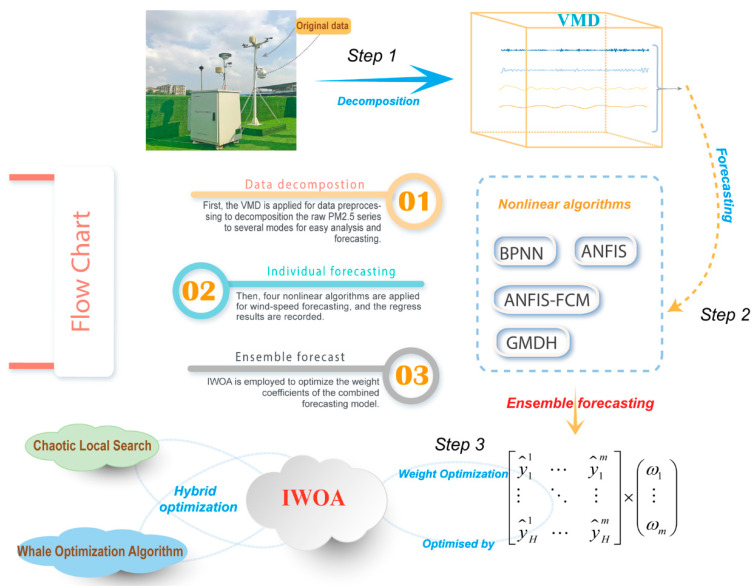
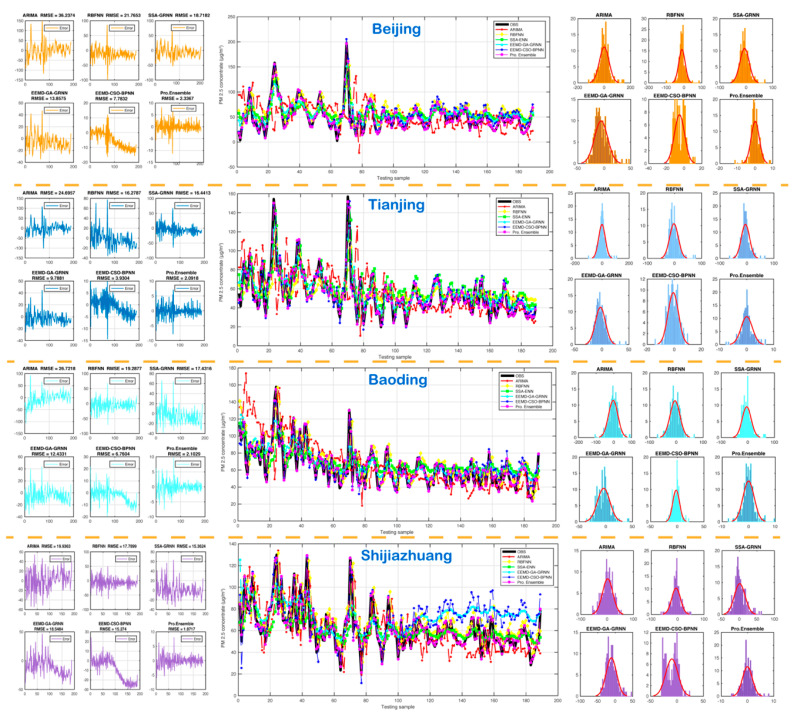
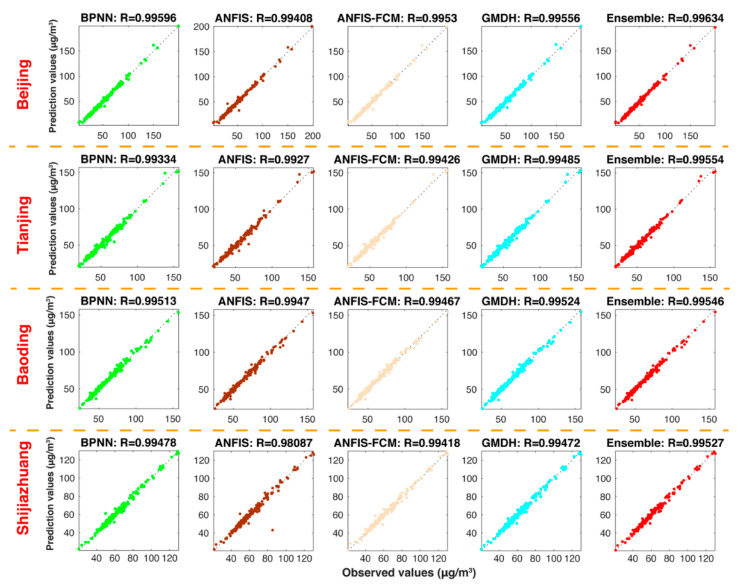
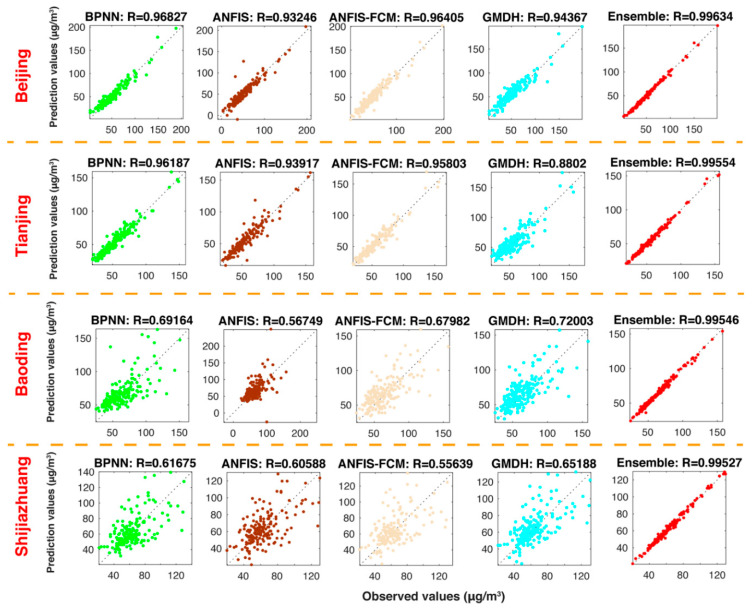
The non-stationarity, nonlinearity and complexity of the PM series have caused difficulties in PM prediction. To improve prediction accuracy, many forecasting methods have been developed. However, these methods usually do not consider the importance of data preprocessing and have limitations only using a single forecasting model. Therefore, this paper proposed a new hybrid decomposition-ensemble learning paradigm based on variation mode decomposition (VMD) and improved whale-optimization algorithm (IWOA) to address complex nonlinear environmental data. First, the VMD is employed to decompose the PM sequences into a set of variational modes (VMs) with different frequencies. Then, an ensemble method based on four individual forecasting approaches is applied to forecast all the VMs. With regard to ensemble weight coefficients, the IWOA is applied to optimize the weight coefficients, and the final forecasting results were obtained by reconstructing the refined sequences. To verify and validate the proposed learning paradigm, four daily PM datasets collected from the Jing-Jin-Ji area of China are chosen as the test cases to conduct the empirical research. The experimental results indicated that the proposed learning paradigm has the best results in all cases and metrics.
PM 序列的非平稳性、非线性和复杂性给 PM 预测带来了困难。为了提高预测精度,已经开发了许多预测方法。然而,这些方法通常不考虑数据预处理的重要性,并且仅使用单一的预测模型存在局限性。因此,本文提出了一种基于变分模态分解(VMD)和改进的鲸鱼优化算法(IWOA)的新的混合分解-集成学习范例,以解决复杂的非线性环境数据。首先,使用 VMD 将 PM 序列分解为具有不同频率的一组变分模态(VM)。然后,应用基于四种个体预测方法的集成方法来预测所有的 VM。至于集成权重系数,应用 IWOA 优化权重系数,并通过重构精细序列来获得最终的预测结果。为了验证和验证所提出的学习范例,选择了来自中国京津冀地区的四个每日 PM 数据集作为测试案例进行实证研究。实验结果表明,在所提出的范例中,所有案例和指标的结果都是最好的。