Vajavaara Heli, Mortensen Julie Bondgaard, Leivonen Suvi-Katri, Hansen Ida Monrad, Ludvigsen Maja, Holte Harald, Jørgensen Judit, Bjerre Mette, d'Amore Francesco, Leppä Sirpa
Research Program Unit, Applied Tumor Genomics Research Program, Faculty of Medicine, University of Helsinki, 00014 Helsinki, Finland.
Department of Oncology, Helsinki University Hospital Comprehensive Cancer Center, 00029 Helsinki, Finland.
Cancers (Basel). 2021 Jan 22;13(3):398. doi: 10.3390/cancers13030398.
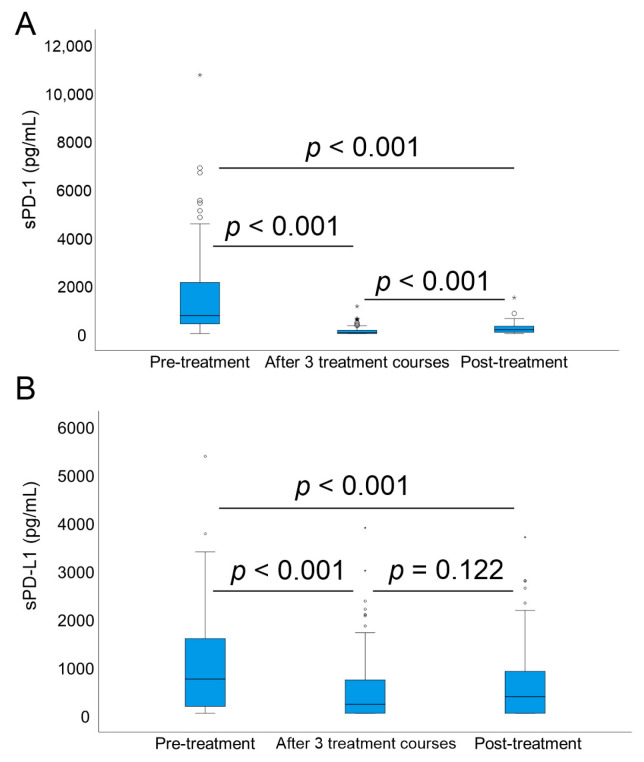
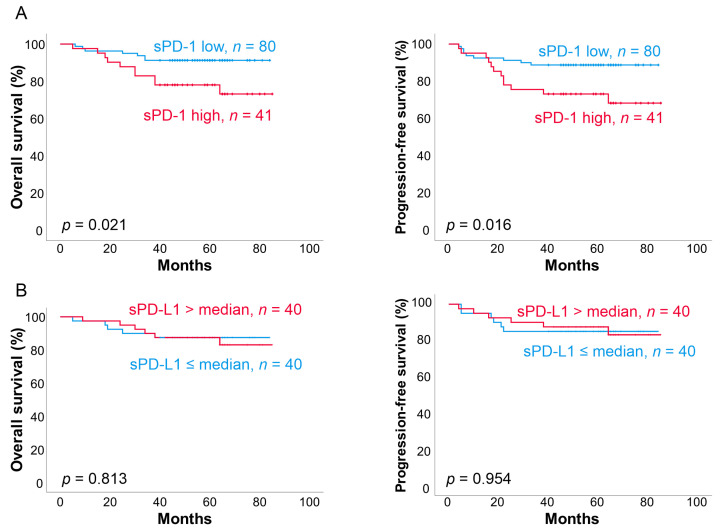
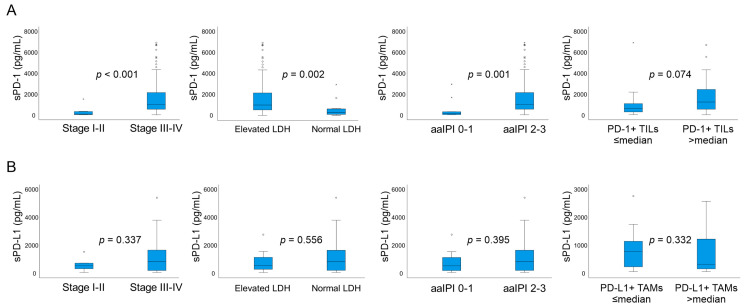
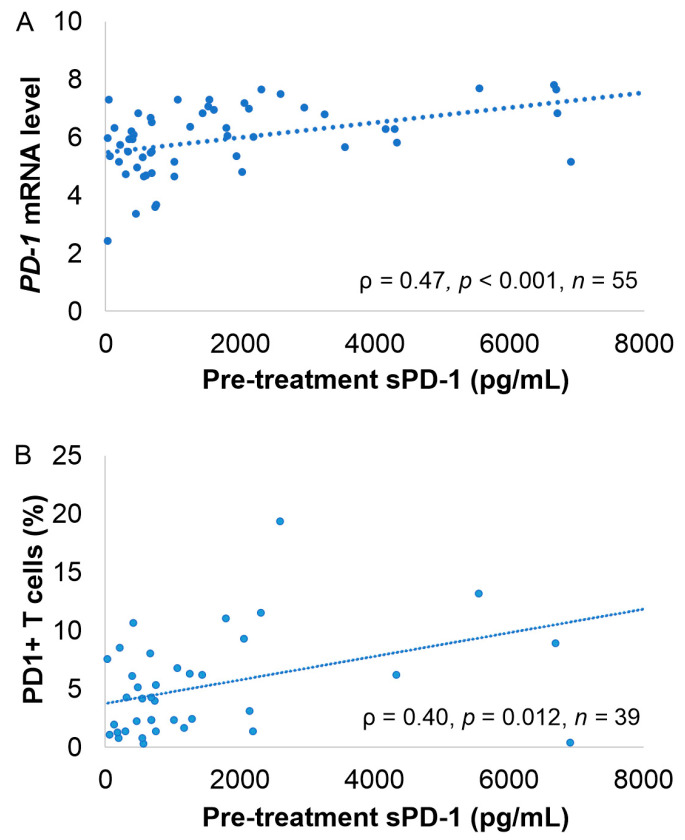
Interaction of checkpoint receptor programmed death 1 (PD-1) with its ligand 1 (PD-L1) downregulates T cell effector functions and thereby leads to tumor immune escape. Here, we aimed to determine the clinical significance of soluble PD-1 (sPD-1) and soluble PD-L1 (sPD-L1) in patients with diffuse large B-cell lymphoma (DLBCL). We included 121 high-risk DLBCL patients treated in the Nordic NLG-LBC-05 trial with dose-dense immunochemotherapy. sPD-1 and sPD-L1 levels were measured from serum samples collected prior to treatment, after three immunochemotherapy courses, and at the end of therapy. sPD-1 and sPD-L1 levels were the highest in pretreatment samples, declining after three courses, and remaining low post-treatment. Pretreatment sPD-1 levels correlated with the quantities of PD1+ T cells in tumor tissue and translated to inferior survival, while no correlation was observed between sPD-L1 levels and outcome. The relative risk of death was 2.9-fold (95% CI 1.12-7.75, = 0.028) and the risk of progression was 2.8-fold (95% CI 1.16-6.56, = 0.021) in patients with high pretreatment sPD-1 levels compared to those with low levels. In conclusion, pretreatment sPD-1 level is a predictor of poor outcome after dose-dense immunochemotherapy and may be helpful in further improving molecular risk profiles in DLBCL.
检查点受体程序性死亡蛋白1(PD-1)与其配体1(PD-L1)的相互作用会下调T细胞效应功能,从而导致肿瘤免疫逃逸。在此,我们旨在确定可溶性PD-1(sPD-1)和可溶性PD-L1(sPD-L1)在弥漫性大B细胞淋巴瘤(DLBCL)患者中的临床意义。我们纳入了121例在北欧NLG-LBC-05试验中接受剂量密集免疫化疗的高危DLBCL患者。在治疗前、三个免疫化疗疗程后以及治疗结束时采集的血清样本中检测sPD-1和sPD-L1水平。sPD-1和sPD-L1水平在预处理样本中最高,三个疗程后下降,治疗后仍保持较低水平。预处理sPD-1水平与肿瘤组织中PD1+T细胞数量相关,并转化为较差的生存率,而sPD-L1水平与预后之间未观察到相关性。与低预处理sPD-1水平的患者相比,高预处理sPD-1水平的患者死亡相对风险为2.9倍(95%CI 1.12-7.75,P = 0.028),进展风险为2.8倍(95%CI 1.16-6.56,P = 0.021)。总之,预处理sPD-1水平是剂量密集免疫化疗后预后不良的预测指标,可能有助于进一步改善DLBCL的分子风险谱。