Johns Hopkins Bloomberg School of Public Health, 615 N. Wolfe St, Baltimore, MD, 21205, USA.
Livingstone Central Hospital, Akapelwa St, Livingstone, Zambia.
BMC Infect Dis. 2021 Jan 26;21(1):118. doi: 10.1186/s12879-021-05808-2.
Early infant diagnosis of HIV infection is challenging in sub-Saharan Africa, particularly in rural areas, leading to delays in diagnosis and treatment. Use of a point-of-care test would overcome many challenges. This study evaluated the validity of a novel point-of-care p24 antigen detection test (LYNX) in rural and urban settings in southern Zambia.
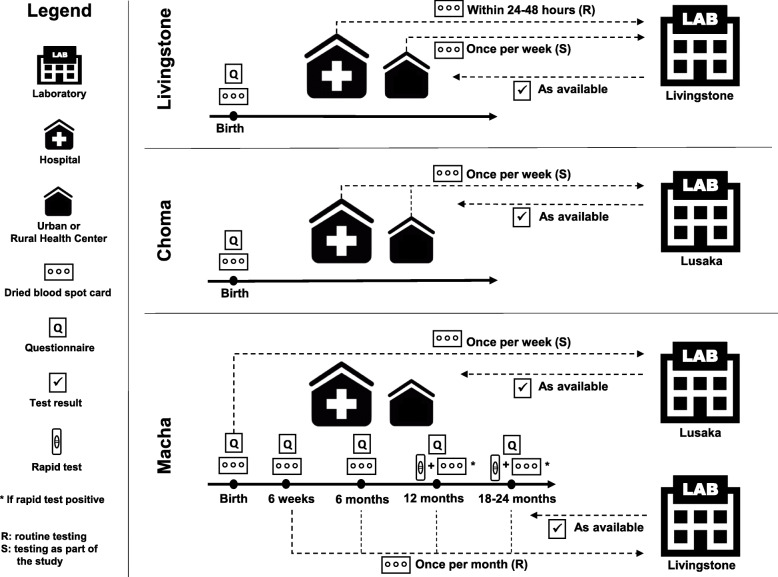
Two studies were conducted: a cross-sectional study from 2014 to 2015 at Macha Hospital (LYNX Hospital study) and a longitudinal study from 2016 to 2018 at 12 health facilities in Southern Province, Zambia (NSEBA study). In both studies, children attending the facilities for early infant diagnosis were enrolled and a blood sample was collected for routine testing at the central lab and immediate on-site testing with the LYNX test. The performance of the LYNX test was measured in comparison to nucleic acid-based testing at the central lab.
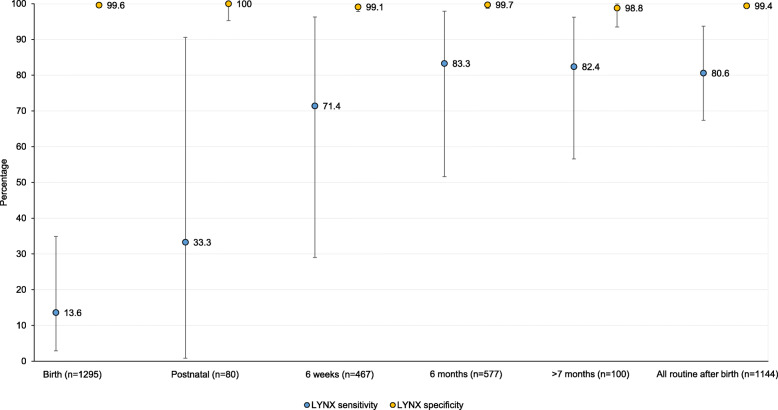
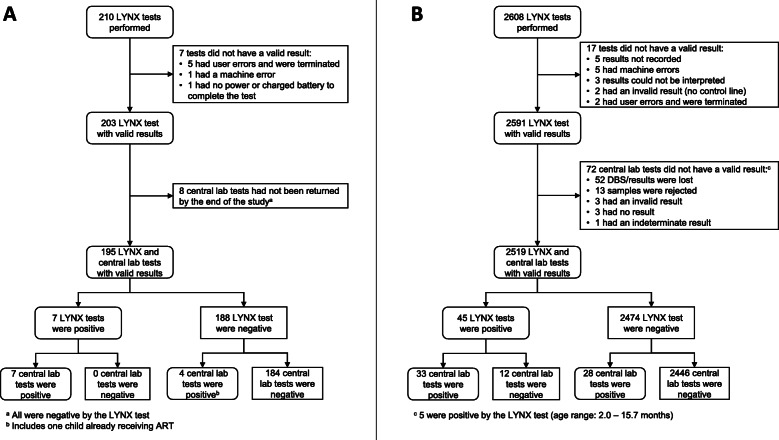
In the LYNX Hospital study, 210 tests were performed at a median age of 23.5 weeks (IQR: 8.9, 29.0). The sensitivity and specificity of the test were 70.0 and 100.0%, respectively. In the NSEBA study, 2608 tests were performed, including 1305 at birth and 1222 on children ≥4 weeks of age. For samples tested at birth, sensitivity was 13.6% (95% CI: 2.9, 34.9) and specificity was 99.6% (95% CI: 99.1, 99.9). While specificity was high for all ages, sensitivity increased with age and was higher for participants tested at ≥4 weeks of age (80.6%; 95% CI: 67.4, 93.7). Children with positive nucleic acid tests were more likely to be negative by the LYNX test if their mother received antiretroviral therapy during pregnancy (60.7% vs. 24.2%; p = 004).
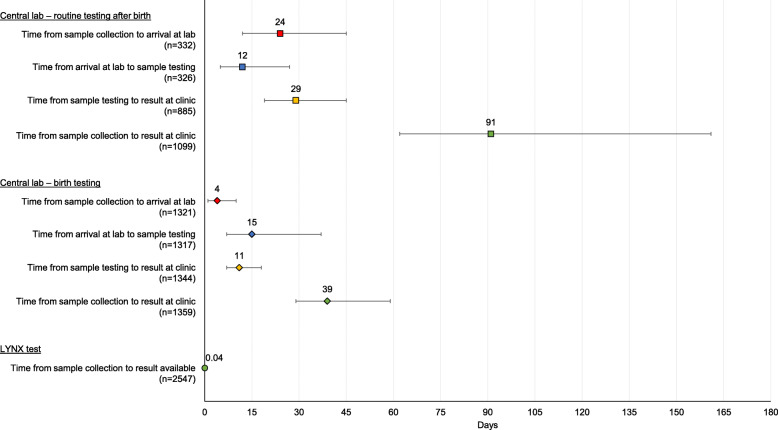
Considering the high specificity and moderate sensitivity that increased with age, the LYNX test could be of value for early infant diagnosis for infants ≥4 weeks of age, particularly in rural areas where centralized testing leads to long delays. Point-of-care tests with moderate sensitivity and high specificity that are affordable, easy-to-use, and easily implemented and maintained should be developed to expand access to testing and deliver same-day results to infants in areas where it is not feasible to implement nucleic acid-based point-of-care assays.
在撒哈拉以南非洲地区,尤其是在农村地区,艾滋病毒母婴传播的早期婴儿诊断具有挑战性,导致诊断和治疗的延误。使用即时检测将克服许多挑战。本研究评估了一种新型即时检测 p24 抗原检测试验(LYNX)在赞比亚南部农村和城市环境中的有效性。
进行了两项研究:2014 年至 2015 年在马查医院(LYNX 医院研究)进行的横断面研究,以及 2016 年至 2018 年在赞比亚南部 12 个卫生设施(NSEBA 研究)进行的纵向研究。在这两项研究中,招募了在设施中接受早期婴儿诊断的儿童,并采集了一份血液样本,用于在中央实验室进行常规检测,并在现场即时进行 LYNX 检测。将 LYNX 试验的性能与中央实验室的基于核酸的检测进行了比较。
在 LYNX 医院研究中,共进行了 210 次检测,中位年龄为 23.5 周(IQR:8.9,29.0)。该检测的敏感性和特异性分别为 70.0%和 100.0%。在 NSEBA 研究中,共进行了 2608 次检测,其中包括 1305 次在出生时和 1222 次在≥4 周龄的儿童。对于出生时检测的样本,敏感性为 13.6%(95%CI:2.9,34.9),特异性为 99.6%(95%CI:99.1,99.9)。虽然所有年龄组的特异性都很高,但敏感性随年龄增加而增加,在≥4 周龄的参与者中更高(80.6%;95%CI:67.4,93.7)。如果母亲在怀孕期间接受抗逆转录病毒治疗,核酸检测阳性的儿童通过 LYNX 检测呈阴性的可能性更高(60.7%比 24.2%;p=0.004)。
考虑到高特异性和随年龄增加而增加的中等敏感性,LYNX 检测对于≥4 周龄的婴儿的早期婴儿诊断可能具有价值,特别是在集中检测导致长时间延误的农村地区。应开发具有中等敏感性和高特异性、价格合理、易于使用、易于实施和维护的即时检测,以扩大检测的可及性,并为无法实施基于核酸的即时检测的地区的婴儿提供当日结果。