Kato K, Ochi M, Nakamura Y, Kamiya H, Utsunomiya T, Yano K, Michikura Y, Hara T, Kyono K, Takeuchi K, Nakayama T, Iwamasa J, Mio Y, Kuramoto T, Nagata Y, Jo T, Asada Y, Ohishi H, Osada H, Yoshida H
Kato Ladies Clinic, Tokyo 160-0023, Japan.
Japan Association of Private Assisted Reproductive Technology Clinics and Laboratories (Japan A-PART), Tokyo 160-0023, Japan.
Hum Reprod Open. 2021 Jan 16;2021(1):hoaa064. doi: 10.1093/hropen/hoaa064. eCollection 2021.
Is oocyte cryopreservation an applicable option for fertility preservation in unmarried patients with haematological malignancies?
Oocyte cryopreservation via the vitrification method is accessible and may be considered an option for fertility preservation in unmarried patients with haematological malignancies.
Haematological malignancies are most commonly observed amongst adolescent and young adult women. Although the survival rate and life expectancy of those with haematological malignancies have improved, chemotherapy and radiotherapy may impair their reproductive potential. Oocyte cryopreservation is thus an ideal option to preserve their fertility.
This study retrospectively evaluated 193 unmarried patients (age: 26.2 ± 0.4 years) with haematological malignancies, who consulted for oocyte cryopreservation across 20 different fertility centres in Japan between February 2007 and January 2015. The primary outcome measures were the oocyte retrievals and oocyte cryopreservation outcomes. The secondary outcome measures were the outcomes following oocyte warming for IVF.
PARTICIPANTS/MATERIALS SETTING METHODS: The patients had commenced ovarian stimulation cycles via antagonist, agonist, natural and minimal methods for oocyte retrievals, defined according to the treatment strategy of each respective fertility centre. A vitrification method using the Cryotop safety kit was used for oocyte cryopreservation. ICSIs were used for insemination of warmed oocytes. The endometrial preparation method for embryo transfer was hormonal replacement therapy, except in the case of a patient who underwent a spontaneous ovulatory cycle.
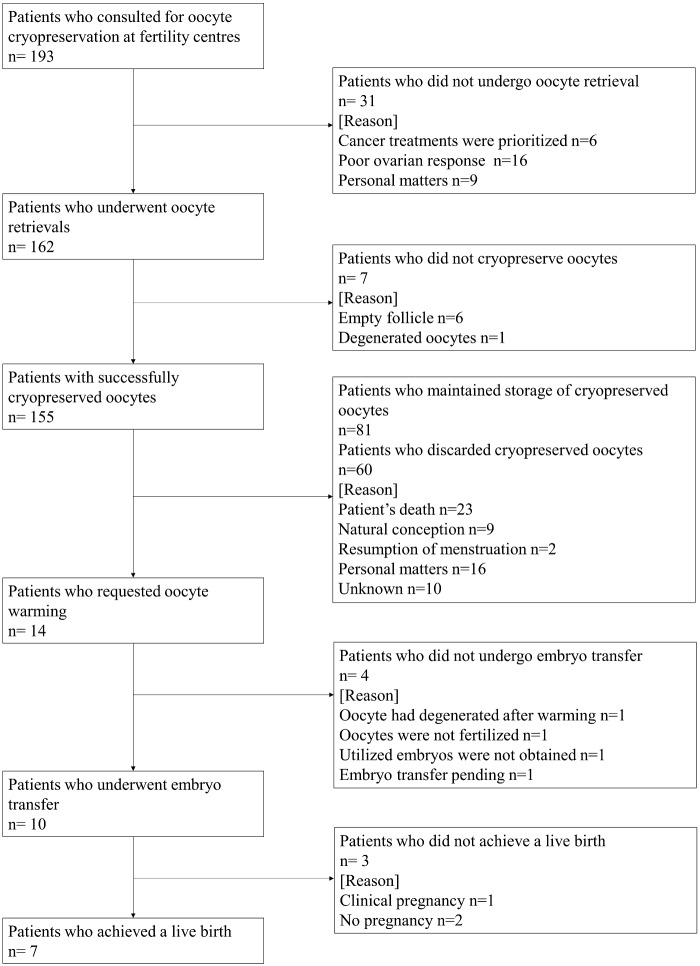
Among 193 patients, acute myeloid leukaemia (n = 45, 23.3%) was most common, followed by acute lymphoid leukaemia (n = 38, 19.7%) and Hodgkin's lymphoma (n = 30, 15.5%). In total, 162 patients (83.9%) underwent oocyte retrieval, and oocytes were successfully cryopreserved for 155 patients (80.3%). The mean number of oocyte retrieval cycles and cryopreserved oocytes were 1.7 ± 0.2 and 6.3 ± 0.4, respectively. As of December 2019, 14 patients (9.2%) had requested oocyte warming for IVF. The survival rate of oocytes after vitrification-warming was 85.2% (75/88). The rates of fertilisation and embryo development were 80.0% (60/75) and 46.7% (28/60), respectively. Ten patients (71.4%) had successful embryo transfers, and seven live births (50.0%) were achieved.
This study was limited by its retrospective nature. Additionally, there remains an insufficient number of cases regarding the warming of vitrified oocytes to reliably conclude whether oocyte cryopreservation is effective for patients with haematological malignancies. Further long-term follow-up study is required.
Oocyte retrieval and oocyte cryopreservation were accessible for patients with haematological malignancies; however, the number of oocyte retrievals may have been limited due to the initiation of cancer treatments. Acceptable embryonic and pregnancy outcomes could be achieved following oocyte warming; therefore, our results suggest that oocyte cryopreservation can be considered an option for fertility preservation in patients with haematological malignancies.
STUDY FUNDING/COMPETING INTERESTS: This research received no specific grant from any funding agency in the public, commercial or not-for-profit sectors. The authors declare no conflict of interest.
N/A.
对于患有血液系统恶性肿瘤的未婚患者,卵母细胞冷冻保存是否是一种可行的生育力保存选择?
通过玻璃化方法进行的卵母细胞冷冻保存是可行的,可被视为患有血液系统恶性肿瘤的未婚患者生育力保存的一种选择。
血液系统恶性肿瘤在青春期和年轻成年女性中最为常见。尽管血液系统恶性肿瘤患者的生存率和预期寿命有所提高,但化疗和放疗可能会损害其生殖潜能。因此,卵母细胞冷冻保存是保存其生育力的理想选择。
研究设计、规模、持续时间:本研究回顾性评估了193例患有血液系统恶性肿瘤的未婚患者(年龄:26.2±0.4岁),这些患者于2007年2月至2015年1月期间在日本20个不同的生育中心咨询卵母细胞冷冻保存。主要结局指标为卵母细胞采集和卵母细胞冷冻保存结局。次要结局指标为卵母细胞解冻后用于体外受精的结局。
参与者/材料、设置、方法:患者根据各自生育中心的治疗策略,通过拮抗剂、激动剂、自然和微刺激方法开始卵巢刺激周期以进行卵母细胞采集。使用Cryotop安全试剂盒的玻璃化方法进行卵母细胞冷冻保存。卵母细胞解冻后采用卵胞浆内单精子注射进行授精。除1例经历自发排卵周期的患者外,胚胎移植的子宫内膜准备方法为激素替代疗法。
193例患者中,急性髓系白血病(n = 45,23.3%)最为常见,其次是急性淋巴细胞白血病(n = 38,19.7%)和霍奇金淋巴瘤(n = 30,15.5%)。共有162例患者(83.9%)进行了卵母细胞采集,155例患者(80.3%)的卵母细胞成功冷冻保存。卵母细胞采集周期的平均数和冷冻保存的卵母细胞数分别为1.7±0.2和6.3±0.4。截至2019年12月,14例患者(9.2%)要求解冻卵母细胞用于体外受精。玻璃化冷冻-解冻后卵母细胞的存活率为85.2%(75/88)。受精率和胚胎发育率分别为80.0%(60/75)和46.7%(28/60)。10例患者(71.4%)胚胎移植成功,7例活产(50.0%)。
局限性、谨慎的原因:本研究受其回顾性性质的限制。此外,关于玻璃化冷冻卵母细胞解冻的病例数量仍然不足,无法可靠地得出卵母细胞冷冻保存对血液系统恶性肿瘤患者是否有效的结论。需要进一步的长期随访研究。
血液系统恶性肿瘤患者可以进行卵母细胞采集和卵母细胞冷冻保存;然而,由于癌症治疗的开始,卵母细胞采集的数量可能受到限制。卵母细胞解冻后可获得可接受的胚胎和妊娠结局;因此,我们的结果表明,卵母细胞冷冻保存可被视为血液系统恶性肿瘤患者生育力保存的一种选择。
研究资金/利益冲突:本研究未接受公共、商业或非营利部门任何资助机构的特定资助。作者声明无利益冲突。
无。