Department of Allergy, Renji Hospital, School of Medicine, Shanghai Jiao Tong University, Shanghai 200127, China.
Department of Pulmonology, Renji Hospital South Campus, School of Medicine, Shanghai Jiao Tong University, Shanghai 200127, China.
Clinics (Sao Paulo). 2021 Jan 20;76:e1713. doi: 10.6061/clinics/2021/e1713. eCollection 2021.
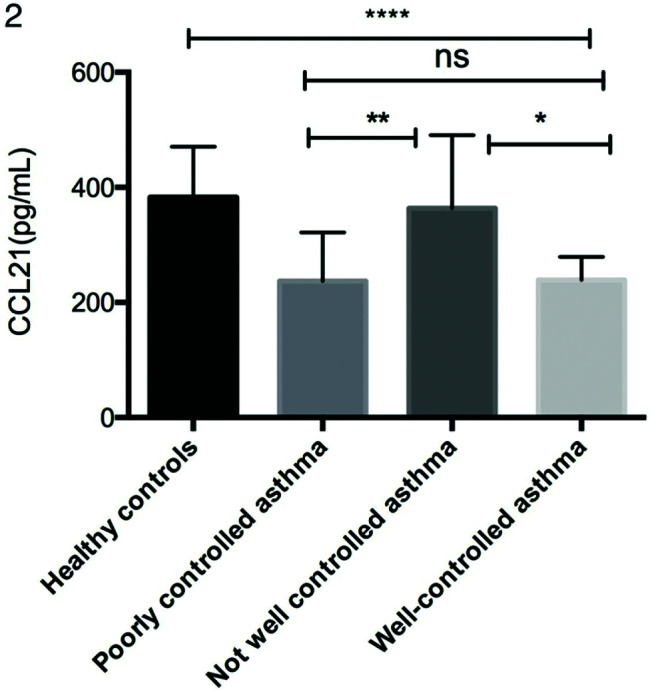
The chemokine ligand (CCL) 21 regulates the maturation, migration, and function of dendritic cells, and has been implicated in the pathogenesis of asthma. This study aimed to investigate the association between serum CCL21 levels and asthma control.
The serum levels of CCL21 and other inflammatory cytokines were analyzed in patients with asthma (n=44) and healthy controls (n=35) by enzyme-linked immunosorbent assay. IgE levels and eosinophil counts were determined by turbidimetric inhibition immunoassay and fully automatic blood analysis, respectively. The Asthma Control Test (ACT) questionnaire was used, and spirometry and fractional exhaled nitric oxide (FENO) measurements were performed. A multiple unpaired Student's t-test was performed to analyze the differences in CCL21 and interleukin levels between patients with asthma and healthy controls. The correlation of CCL21 levels with disease severity was evaluated using the Pearson's rank correlation test.
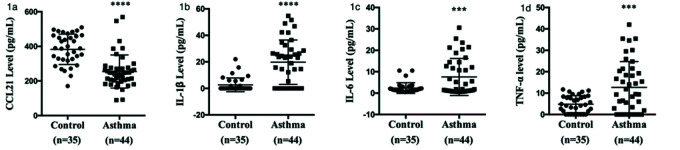
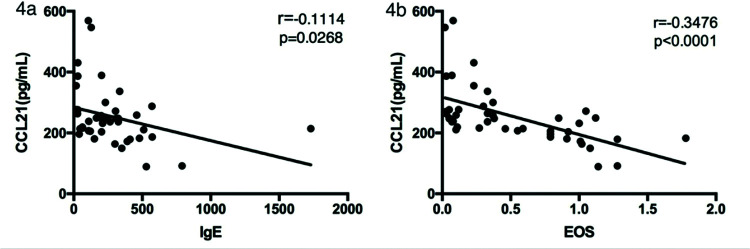
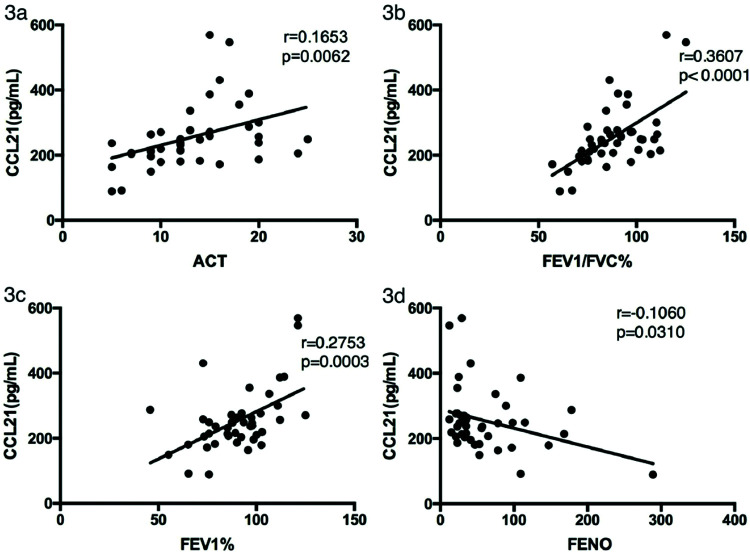
Serum CCL21 levels were lower in patients with asthma (254.78±95.66 pg/mL) than in healthy controls (382.95±87.77 pg/mL) (p<0.001). Patients with asthma had significantly higher levels of IL-1β (19.74±16.77 vs. 2.63±5.22 pg/mL), IL-6 (7.55±8.65 vs. 2.37±2.47 pg/mL), and tumor necrosis factor-α (12.70±12.03 vs. 4.82±3.97 pg/mL) compared with the controls. CCL21 levels were positively correlated with the ACT score (rs=0.1653, p=0.0062), forced expiratory volume in 1s (FEV1)/forced vital capacity (rs=0.3607, p<0.0001), and FEV1 (rs=0.2753, p=0.0003), and negatively correlated with FENO (rs=0.1060, p=0.0310). CCL21 levels were negatively correlated with serum IgE levels (rs=0.1114, p=0.0268) and eosinophil counts (rs=0.3476, p<0.0001).
Serum CCL21 levels may be a new biomarker for assessing asthma control.
趋化因子配体(CCL)21 调节树突状细胞的成熟、迁移和功能,与哮喘的发病机制有关。本研究旨在探讨血清 CCL21 水平与哮喘控制之间的关系。
采用酶联免疫吸附试验检测哮喘患者(n=44)和健康对照者(n=35)血清 CCL21 及其他炎症细胞因子水平。采用比浊抑制免疫法检测 IgE 水平,全自动血液分析检测嗜酸性粒细胞计数。采用哮喘控制测试(ACT)问卷,进行肺功能检查和呼出气一氧化氮(FENO)测量。采用单样本 t 检验比较哮喘患者和健康对照组之间 CCL21 和白细胞介素水平的差异。采用 Pearson 秩相关检验评估 CCL21 水平与疾病严重程度的相关性。
哮喘患者血清 CCL21 水平(254.78±95.66 pg/mL)低于健康对照组(382.95±87.77 pg/mL)(p<0.001)。与对照组相比,哮喘患者的白细胞介素-1β(19.74±16.77 vs. 2.63±5.22 pg/mL)、白细胞介素-6(7.55±8.65 vs. 2.37±2.47 pg/mL)和肿瘤坏死因子-α(12.70±12.03 vs. 4.82±3.97 pg/mL)水平显著升高。CCL21 水平与 ACT 评分呈正相关(rs=0.1653,p=0.0062),与用力呼气量/用力肺活量(rs=0.3607,p<0.0001)和用力呼气量(rs=0.2753,p=0.0003)呈正相关,与呼出气一氧化氮(rs=0.1060,p=0.0310)呈负相关。CCL21 水平与血清 IgE 水平(rs=0.1114,p=0.0268)和嗜酸性粒细胞计数(rs=0.3476,p<0.0001)呈负相关。
血清 CCL21 水平可能是评估哮喘控制的新生物标志物。