Braegelmann Christine, Fetter Tanja, Niebel Dennis, Dietz Lara, Bieber Thomas, Wenzel Joerg
Department of Dermatology and Allergy, University Hospital Bonn, Bonn, Germany.
Front Immunol. 2021 Jan 11;11:622511. doi: 10.3389/fimmu.2020.622511. eCollection 2020.
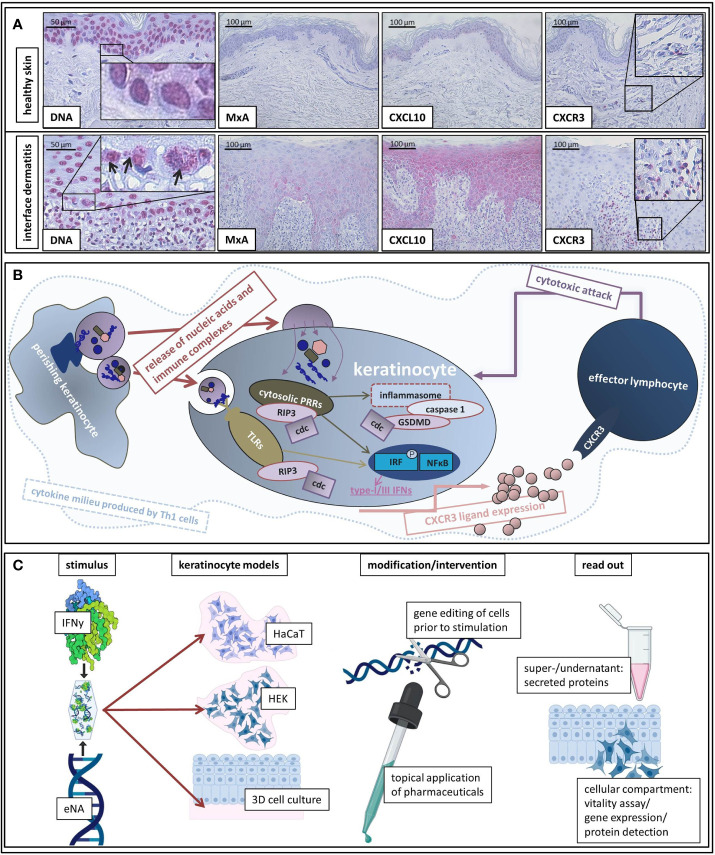
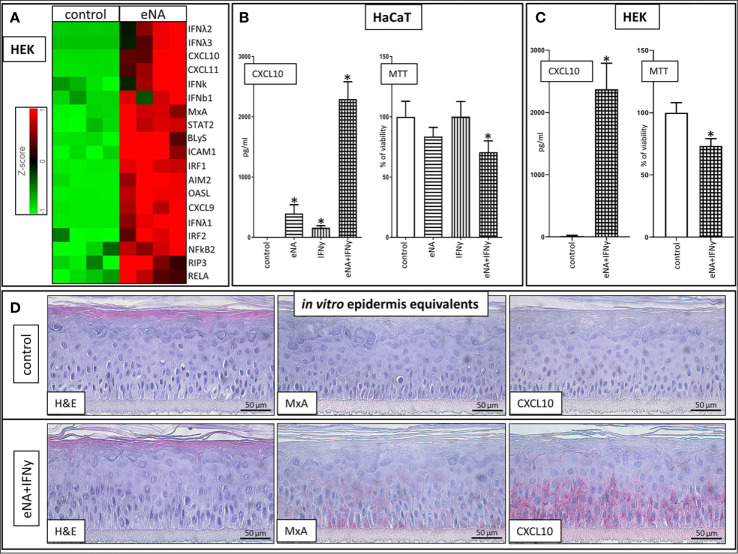
Interface dermatitis is a histopathological pattern mirroring a distinct cytotoxic immune response shared by a number of clinically diverse inflammatory skin diseases amongst which lichen planus and cutaneous lupus erythematosus are considered prototypic. Interface dermatitis is characterized by pronounced cytotoxic immune cell infiltration and necroptotic keratinocytes at the dermoepidermal junction. The initial inflammatory reaction is established by cytotoxic immune cells that express CXC chemokine receptor 3 and lesional keratinocytes that produce corresponding ligands, CXC motif ligands 9/10/11, recruiting the effector cells to the site of inflammation. During the resulting anti-epithelial attack, endogenous immune complexes and nucleic acids are released from perishing keratinocytes, which are then perceived by the innate immune system as danger signals. Keratinocytes express a distinct signature of pattern recognition receptors and binding of endogenous nucleic acid motifs to these receptors results in interferon-mediated immune responses and further enhancement of CXC chemokine receptor 3 ligand production. In this perspective article, we will discuss the role of innate nucleic acid sensing as a common mechanism in the perpetuation of clinically heterogeneous diseases featuring interface dermatitis based on own data and a review of the literature. Furthermore, we will introduce a keratinocyte-specific model of interface dermatitis as follows: Stimulation of human keratinocytes with endogenous nucleic acids alone and in combination with interferon gamma leads to pronounced production of distinct cytokines, which are essential in the pathogenesis of interface dermatitis. This experimental approach bears the capability to investigate potential therapeutics in this group of diseases with unmet medical need.
界面性皮炎是一种组织病理学模式,反映了多种临床不同的炎症性皮肤病所共有的独特细胞毒性免疫反应,其中扁平苔藓和皮肤红斑狼疮被认为是典型代表。界面性皮炎的特征是在真皮表皮交界处有明显的细胞毒性免疫细胞浸润和坏死性角质形成细胞。最初的炎症反应是由表达CXC趋化因子受体3的细胞毒性免疫细胞和产生相应配体(CXC基序配体9/10/11)的病变角质形成细胞建立的,这些配体将效应细胞招募到炎症部位。在由此产生的抗上皮攻击过程中,内源性免疫复合物和核酸从濒死的角质形成细胞中释放出来,然后被先天免疫系统视为危险信号。角质形成细胞表达一种独特的模式识别受体特征,内源性核酸基序与这些受体的结合导致干扰素介导的免疫反应,并进一步增强CXC趋化因子受体3配体的产生。在这篇观点文章中,我们将根据自己的数据和文献综述,讨论先天核酸传感作为一种共同机制在以界面性皮炎为特征的临床异质性疾病持续存在中的作用。此外,我们将介绍一种如下的角质形成细胞特异性界面性皮炎模型:用内源性核酸单独或与干扰素γ联合刺激人角质形成细胞会导致明显产生不同的细胞因子,这些细胞因子在界面性皮炎的发病机制中至关重要。这种实验方法有能力研究这类有未满足医疗需求的疾病的潜在治疗方法。