Iacobucci Ilaria, Qu Chunxu, Varotto Elena, Janke Laura J, Yang Xu, Seth Aman, Shelat Anang, Friske Jake D, Fukano Reiji, Yu Jiyang, Freeman Burgess B, Kennedy James A, Sperling Adam S, Zheng Rena, Wang Yingzhe, Jogiraju Harini, Dickerson Kirsten M, Payne-Turner Debbie, Morris Sarah M, Hollis Emily S, Ghosn Nina, Haggard Georgia E, Lindsley R Coleman, Ebert Benjamin L, Mullighan Charles G
Department of Pathology, St Jude Children's Research Hospital, Memphis, TN.
Pediatric Hematology-Oncology, Department of Woman's and Child's Health, University of Padova, Padova, Italy.
Blood. 2021 Mar 25;137(12):1628-1640. doi: 10.1182/blood.2020009103.
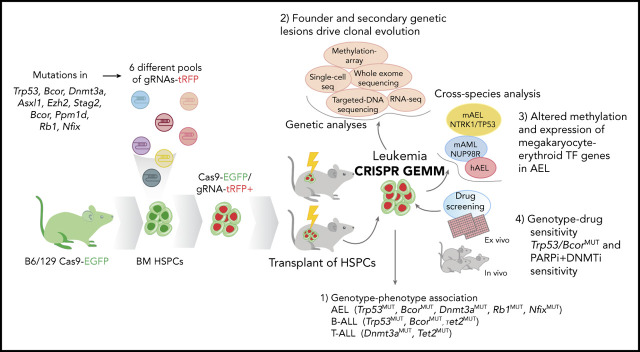
Acute erythroid leukemia (AEL) is characterized by a distinct morphology, mutational spectrum, lack of preclinical models, and poor prognosis. Here, using multiplexed genome editing of mouse hematopoietic stem and progenitor cells and transplant assays, we developed preclinical models of AEL and non-erythroid acute leukemia and describe the central role of mutational cooperativity in determining leukemia lineage. Different combination of mutations in Trp53, Bcor, Dnmt3a, Rb1, and Nfix resulted in the development of leukemia with an erythroid phenotype, accompanied by the acquisition of alterations in signaling and transcription factor genes that recapitulate human AEL by cross-species genomic analysis. Clonal expansion during tumor evolution was driven by mutational cooccurrence, with clones harboring a higher number of founder and secondary lesions (eg, mutations in signaling genes) showing greater evolutionary fitness. Mouse and human AEL exhibited deregulation of genes regulating erythroid development, notably Gata1, Klf1, and Nfe2, driven by the interaction of mutations of the epigenetic modifiers Dnmt3a and Tet2 that perturbed methylation and thus expression of lineage-specific transcription factors. The established mouse leukemias were used as a platform for drug screening. Drug sensitivity was associated with the leukemia genotype, with the poly (ADP-ribose) polymerase inhibitor talazoparib and the demethylating agent decitabine efficacious in Trp53/Bcor-mutant AEL, CDK7/9 inhibitors in Trp53/Bcor/Dnmt3a-mutant AEL, and gemcitabine and bromodomain inhibitors in NUP98-KDM5A leukemia. In conclusion, combinatorial genome editing has shown the interplay of founding and secondary genetic alterations in phenotype and clonal evolution, epigenetic regulation of lineage-specific transcription factors, and therapeutic tractability in erythroid leukemogenesis.
急性红系白血病(AEL)具有独特的形态学、突变谱、缺乏临床前模型以及预后不良等特点。在此,我们利用小鼠造血干细胞和祖细胞的多重基因组编辑及移植试验,开发了AEL和非红系急性白血病的临床前模型,并描述了突变协同作用在确定白血病谱系中的核心作用。Trp53、Bcor、Dnmt3a、Rb1和Nfix基因的不同突变组合导致了具有红系表型的白血病的发生,同时通过跨物种基因组分析发现,信号转导和转录因子基因发生了改变,这些改变与人类AEL相似。肿瘤进化过程中的克隆性扩增由突变共现驱动,携带更多起始和继发病变(如信号基因中的突变)的克隆显示出更高的进化适应性。小鼠和人类AEL均表现出调控红系发育的基因失调,特别是Gata1、Klf1和Nfe2,这是由表观遗传修饰因子Dnmt3a和Tet2的突变相互作用驱动的,这些突变扰乱了甲基化,进而影响了谱系特异性转录因子的表达。所建立的小鼠白血病模型被用作药物筛选平台。药物敏感性与白血病基因型相关,聚(ADP - 核糖)聚合酶抑制剂他拉唑帕尼和去甲基化药物地西他滨对Trp53/Bcor突变型AEL有效,CDK7/9抑制剂对Trp53/Bcor/Dnmt3a突变型AEL有效,吉西他滨和溴结构域抑制剂对NUP98 - KDM5A白血病有效。总之,组合基因组编辑揭示了起始和继发基因改变在表型和克隆进化、谱系特异性转录因子的表观遗传调控以及红系白血病发生中的治疗可及性方面的相互作用。