In Vitro Toxicology and Biomedicine, Department inaugurated by the Doerenkamp-Zbinden Foundation, University of Konstanz, Universitaetsstr. 10, 78464, Konstanz, Germany.
Cooperative Doctorate College InViTe, University of Konstanz, Konstanz, Germany.
Arch Toxicol. 2021 Feb;95(2):591-615. doi: 10.1007/s00204-020-02970-5. Epub 2021 Jan 29.
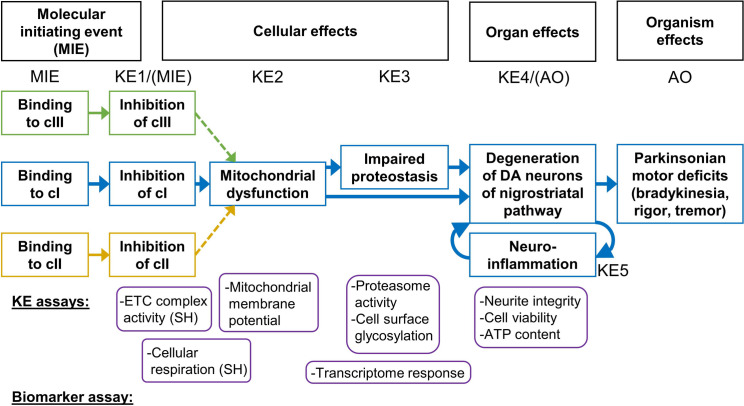
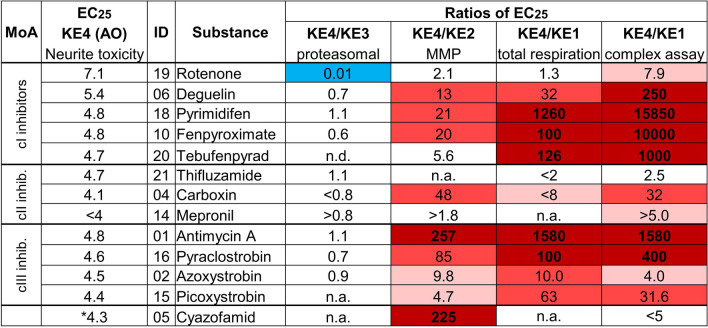
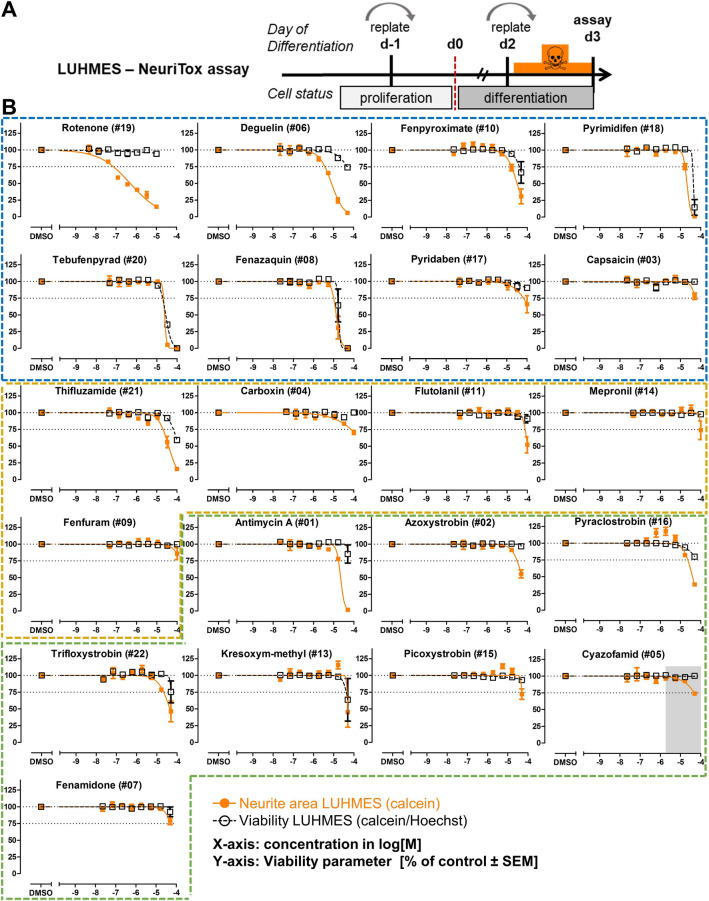
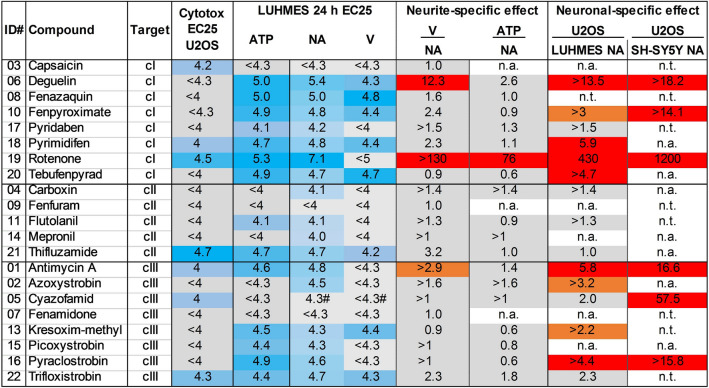
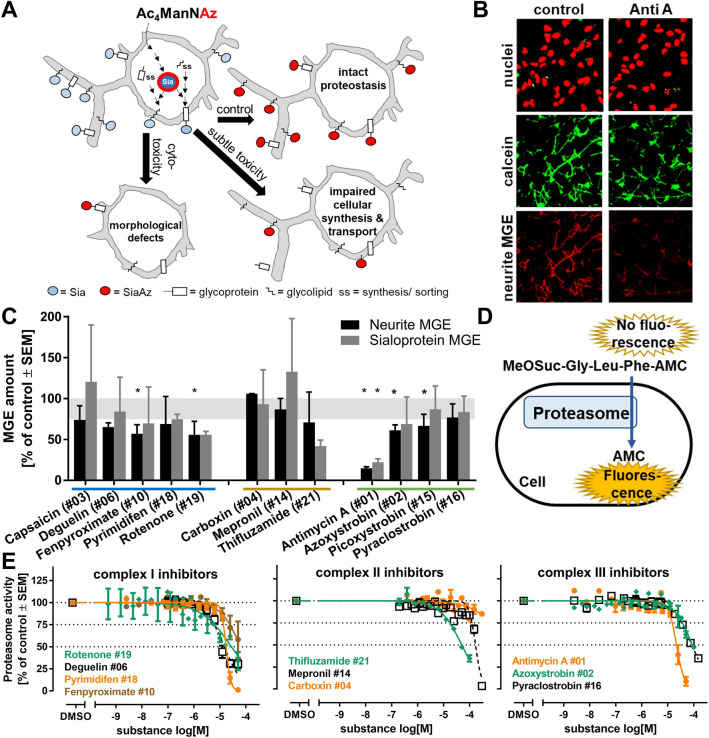
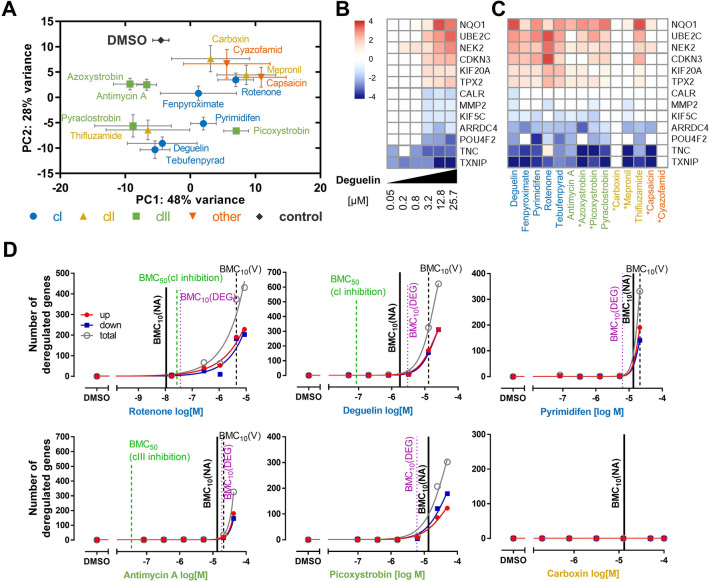
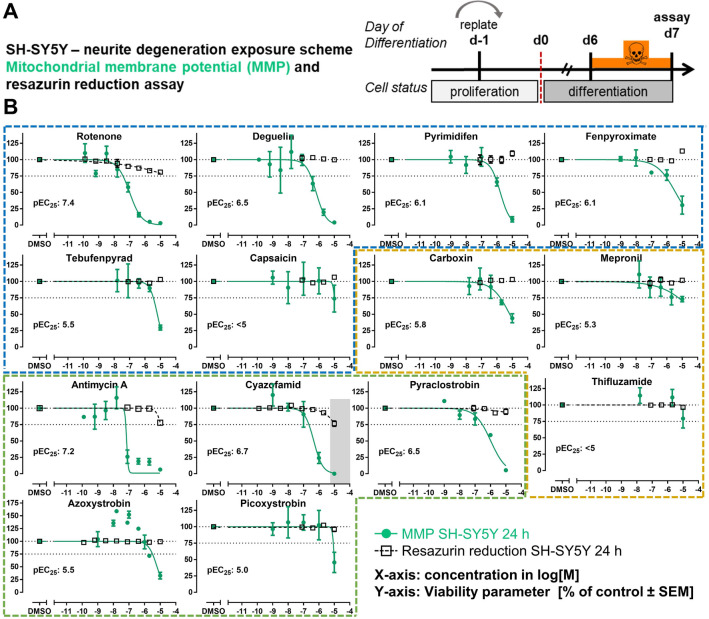
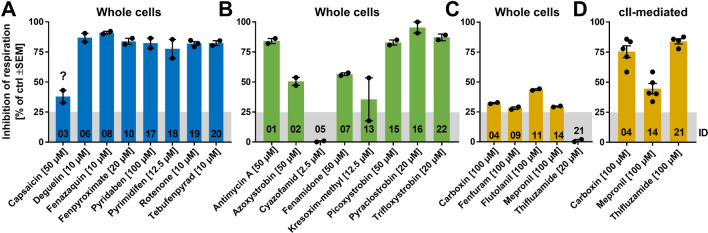
Inhibition of complex I of the mitochondrial respiratory chain (cI) by rotenone and methyl-phenylpyridinium (MPP +) leads to the degeneration of dopaminergic neurons in man and rodents. To formally describe this mechanism of toxicity, an adverse outcome pathway (AOP:3) has been developed that implies that any inhibitor of cI, or possibly of other parts of the respiratory chain, would have the potential to trigger parkinsonian motor deficits. We used here 21 pesticides, all of which are described in the literature as mitochondrial inhibitors, to study the general applicability of AOP:3 or of in vitro assays that are assessing its activation. Five cI, three complex II (cII), and five complex III (cIII) inhibitors were characterized in detail in human dopaminergic neuronal cell cultures. The NeuriTox assay, examining neurite damage in LUHMES cells, was used as in vitro proxy of the adverse outcome (AO), i.e., of dopaminergic neurodegeneration. This test provided data on whether test compounds were unspecific cytotoxicants or specifically neurotoxic, and it yielded potency data with respect to neurite degeneration. The pesticide panel was also examined in assays for the sequential key events (KE) leading to the AO, i.e., mitochondrial respiratory chain inhibition, mitochondrial dysfunction, and disturbed proteostasis. Data from KE assays were compared to the NeuriTox data (AO). The cII-inhibitory pesticides tested here did not appear to trigger the AOP:3 at all. Some of the cI/cIII inhibitors showed a consistent AOP activation response in all assays, while others did not. In general, there was a clear hierarchy of assay sensitivity: changes of gene expression (biomarker of neuronal stress) correlated well with NeuriTox data; mitochondrial failure (measured both by a mitochondrial membrane potential-sensitive dye and a respirometric assay) was about 10-260 times more sensitive than neurite damage (AO); cI/cIII activity was sometimes affected at > 1000 times lower concentrations than the neurites. These data suggest that the use of AOP:3 for hazard assessment has a number of caveats: (i) specific parkinsonian neurodegeneration cannot be easily predicted from assays of mitochondrial dysfunction; (ii) deriving a point-of-departure for risk assessment from early KE assays may overestimate toxicant potency.
鱼藤酮和甲基苯吡啶(MPP+)抑制线粒体呼吸链复合物 I(cI)会导致人类和啮齿动物多巴胺能神经元退化。为了正式描述这种毒性机制,已经开发了一个不良结局途径(AOP:3),该途径表明任何 cI 抑制剂,或者可能是呼吸链的其他部分的抑制剂,都有可能引发帕金森运动缺陷。我们在这里使用了 21 种农药,这些农药在文献中都被描述为线粒体抑制剂,以研究 AOP:3 的普遍适用性,或评估其激活的体外检测方法。我们详细研究了 5 种 cI、3 种复合物 II(cII)和 5 种复合物 III(cIII)抑制剂在人多巴胺能神经元细胞培养物中的作用。NeuriTox 检测,在 LUHMES 细胞中检测神经突损伤,被用作不良结局(AO)的体外替代物,即多巴胺能神经退行性变。该测试提供了关于测试化合物是无特异性细胞毒性剂还是特异性神经毒性剂的信息,并提供了关于神经突退化的效力数据。该农药组还在检测导致 AO 的顺序关键事件(KE)的检测中进行了检测,即线粒体呼吸链抑制、线粒体功能障碍和蛋白质稳态失调。KE 检测的数据与 NeuriTox 数据(AO)进行了比较。这里测试的 cII 抑制剂农药似乎根本不会触发 AOP:3。一些 cI/cIII 抑制剂在所有检测中都表现出一致的 AOP 激活反应,而其他抑制剂则没有。一般来说,检测的敏感性有明显的层次结构:基因表达的变化(神经元应激的生物标志物)与 NeuriTox 数据很好地相关;线粒体衰竭(通过线粒体膜电位敏感染料和呼吸测定法测量)比神经突损伤(AO)敏感约 10-260 倍;cI/cIII 活性在比神经突低 1000 多倍的浓度下有时会受到影响。这些数据表明,使用 AOP:3 进行危害评估有几个注意事项:(i)从线粒体功能障碍的检测中,无法轻易预测出特定的帕金森神经退行性变;(ii)从早期 KE 检测中得出风险评估的起始点可能会高估毒物的效力。