McKusick-Nathans Department of Genetic Medicine, Johns Hopkins University School of Medicine, Baltimore, MD 21205, USA.
Department of Surgery, Johns Hopkins University School of Medicine, Baltimore, MD 21205, USA.
Genes (Basel). 2021 Jan 27;12(2):183. doi: 10.3390/genes12020183.
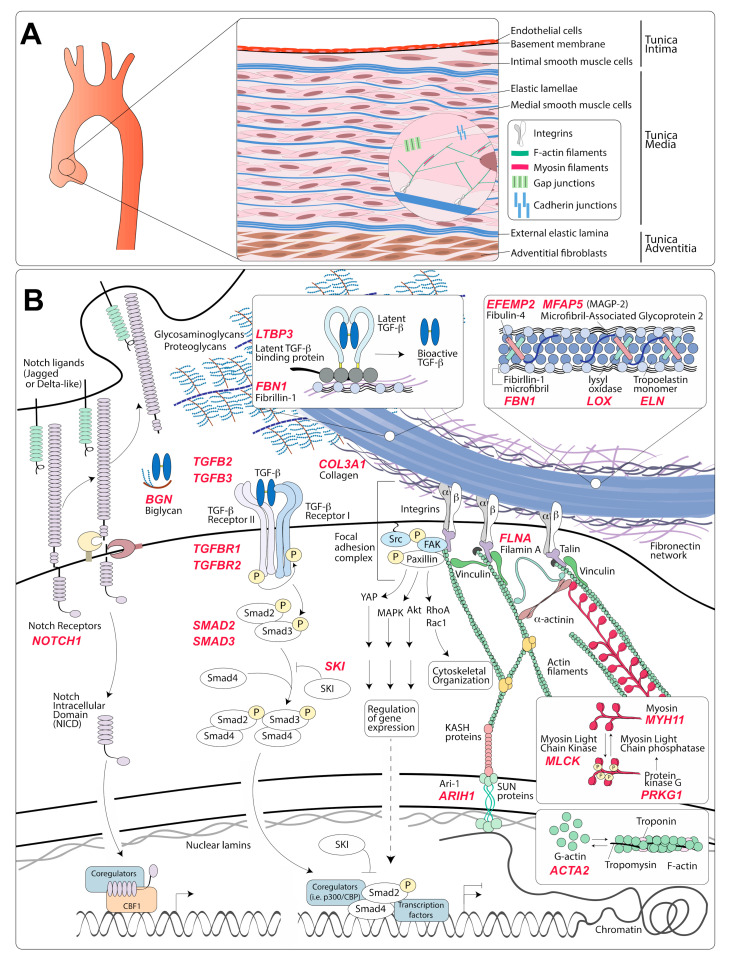
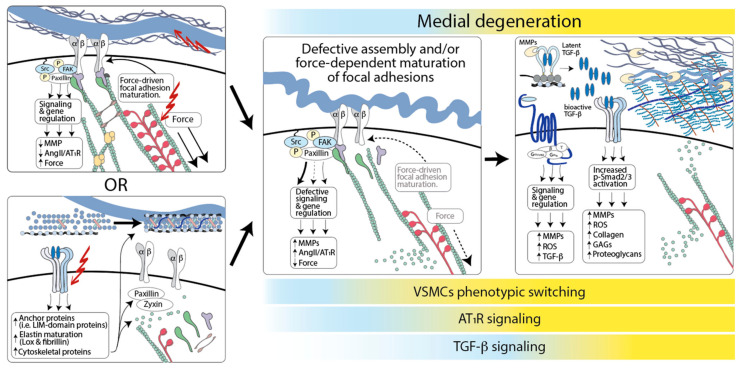
Thoracic aortic aneurysms (TAA) are permanent and localized dilations of the aorta that predispose patients to a life-threatening risk of aortic dissection or rupture. The identification of pathogenic variants that cause hereditary forms of TAA has delineated fundamental molecular processes required to maintain aortic homeostasis. Vascular smooth muscle cells (VSMCs) elaborate and remodel the extracellular matrix (ECM) in response to mechanical and biochemical cues from their environment. Causal variants for hereditary forms of aneurysm compromise the function of gene products involved in the transmission or interpretation of these signals, initiating processes that eventually lead to degeneration and mechanical failure of the vessel. These include mutations that interfere with transduction of stimuli from the matrix to the actin-myosin cytoskeleton through integrins, and those that impair signaling pathways activated by transforming growth factor-β (TGF-β). In this review, we summarize the features of the healthy aortic wall, the major pathways involved in the modulation of VSMC phenotypes, and the basic molecular functions impaired by TAA-associated mutations. We also discuss how the heterogeneity and balance of adaptive and maladaptive responses to the initial genetic insult might contribute to disease.
胸主动脉瘤(TAA)是主动脉的永久性局限性扩张,使患者面临主动脉夹层或破裂的致命风险。对导致遗传性 TAA 的致病变异的鉴定,描绘了维持主动脉稳态所必需的基本分子过程。血管平滑肌细胞(VSMC)根据其环境中的机械和生化线索,产生并重塑细胞外基质(ECM)。遗传性动脉瘤的致病变异会损害参与这些信号传递或解释的基因产物的功能,启动最终导致血管退化和机械功能衰竭的过程。这些变异包括干扰整合素将基质刺激传递到肌动球蛋白细胞骨架的突变,以及那些削弱转化生长因子-β(TGF-β)激活的信号通路的突变。在这篇综述中,我们总结了健康主动脉壁的特征、调节 VSMC 表型的主要途径,以及与 TAA 相关的突变所损害的基本分子功能。我们还讨论了对初始遗传损伤的适应性和失代偿性反应的异质性和平衡如何导致疾病。