Moshirfar Majid, Villarreal Alex, Thomson Andrew C, West William B, McCabe Shannon E, Quinonez Zanabria Eduardo, Graham Derrick B, Ronquillo Yasmyne C, Hoopes Phillip C
Hoopes Vision Research Center, Hoopes Vision, Draper, UT, USA.
Department of Ophthalmology and Visual Sciences, John A. Moran Eye Center, University of Utah School of Medicine, Salt Lake City, UT, USA.
Ophthalmol Ther. 2021 Mar;10(1):175-185. doi: 10.1007/s40123-021-00331-8. Epub 2021 Jan 30.
The efficacy and safety of photorefractive keratectomy (PRK) has been well documented, but outcomes of PRK enhancement following PRK remain understudied. This study aimed to evaluate the safety, efficacy, and predictability of PRK enhancement in patients with residual refractive error after primary PRK and compare these results to prior studies as well as Food and Drug Administration (FDA) safety and efficacy clinical endpoints.
This non-randomized, retrospective chart analysis included eyes with a history of PRK that underwent PRK enhancement at a single center. Post-enhancement data were documented at 3-month and 1-year visits. Patient characteristics between the study group and a control group who underwent primary PRK only were compared. Safety and efficacy measures included change in uncorrected distance visual acuity (UDVA), change in corrected distance visual acuity (CDVA), manifest refraction spherical equivalent (MRSE), amount of induced astigmatism, and presence of serious adverse events.
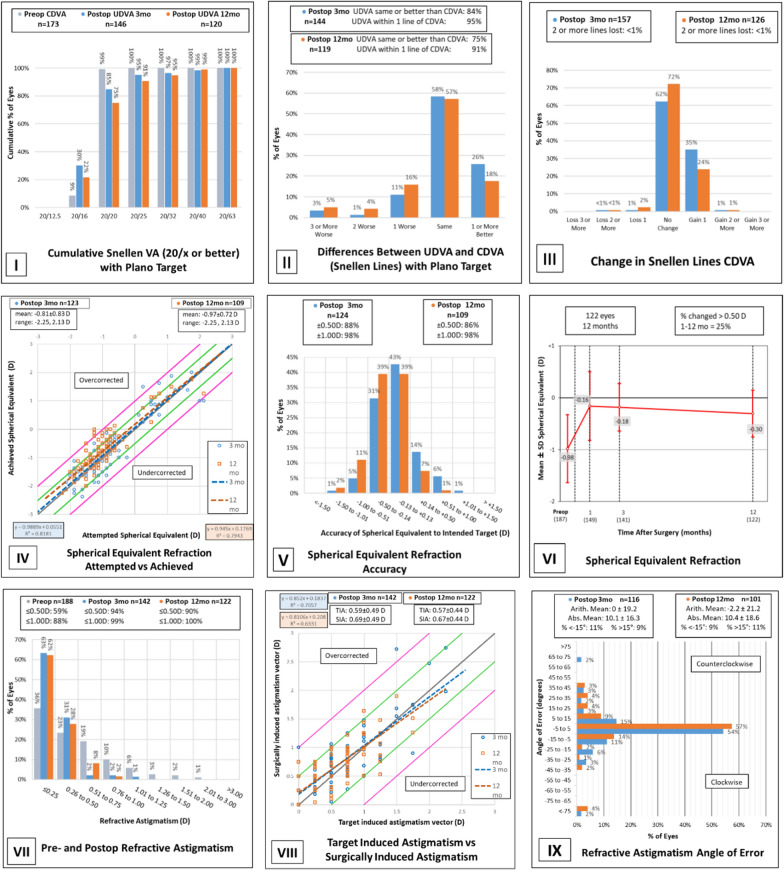
A total of 188 eyes from 141 patients were included. When compared to the control group, women underwent PRK enhancement at a higher rate than men (P = 0.004). The group undergoing PRK enhancement had a higher sphere (P = 0.013) and spherical equivalent (P = 0.004) than the control group at the time of primary PRK. MRSE was reduced to - 0.97 ± 0.72 D (- 2.25 to + 2.13 D) from pre-enhancement values of - 0.98 ± 0.66 D (- 2.75 to + 1.75 D) and stable over 12-month visits with 86% and 98% of eyes within ± 0.50 D and ± 1.00 D of target, respectively. UDVA of 20/20 or better was achieved in 75% of eyes. The UDVA of 75% of eyes remained the same or improved by 1 or more Snellen lines compared with pre-enhancement CDVA.
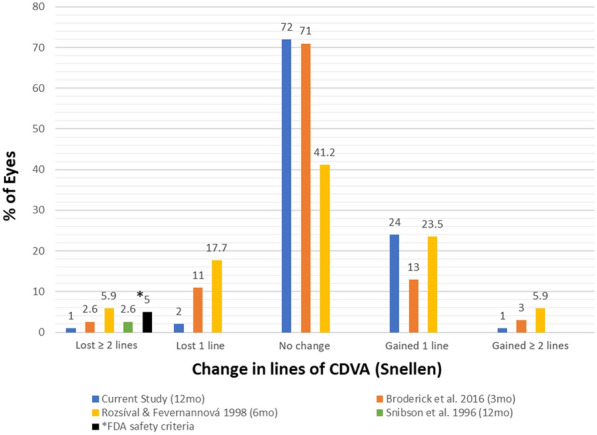
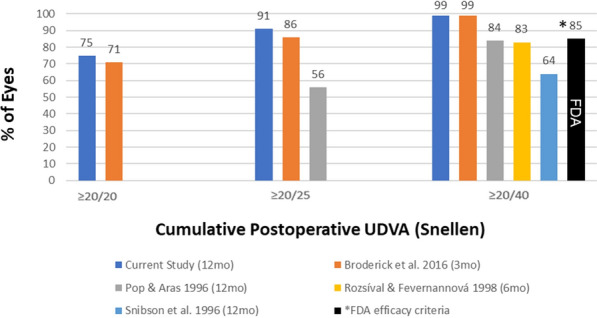
Our results demonstrate that, when compared with previous studies, modern PRK enhancement after PRK has improved visual acuity and refractive outcomes. Though PRK enhancement is not an FDA approved procedure, we show that it meets or exceeds the FDA criteria for the correction of refractive error.
准分子激光角膜切削术(PRK)的疗效和安全性已有充分记录,但PRK术后再次行PRK的效果仍研究不足。本研究旨在评估初次PRK后残留屈光不正患者再次行PRK的安全性、疗效和可预测性,并将这些结果与既往研究以及美国食品药品监督管理局(FDA)的安全性和疗效临床终点进行比较。
本项非随机、回顾性图表分析纳入了在单一中心接受过PRK且再次行PRK的患者的眼睛。在术后3个月和1年的随访中记录再次手术后的数据。比较了研究组与仅接受初次PRK的对照组之间的患者特征。安全性和疗效指标包括未矫正远视力(UDVA)的变化、矫正远视力(CDVA)的变化、显验光球镜等效度(MRSE)、诱导散光量以及严重不良事件的发生情况。
共纳入了141例患者的188只眼睛。与对照组相比,女性再次行PRK的比例高于男性(P = 0.004)。再次行PRK组在初次PRK时的球镜度数(P = 0.013)和球镜等效度(P = 0.004)高于对照组。MRSE从再次手术前的-0.98±0.66 D(-2.75至+1.75 D)降至-0.97±0.72 D(-2.25至+2.13 D),在12个月的随访中保持稳定,分别有86%和98%的眼睛在目标值±0.50 D和±1.00 D范围内。75%的眼睛达到了20/20或更好的UDVA。与再次手术前的CDVA相比,75%的眼睛的UDVA保持不变或提高了1行或更多Snellen行。
我们的结果表明,与既往研究相比,现代PRK术后再次行PRK改善了视力和屈光结果。虽然再次行PRK并非FDA批准的手术,但我们表明它符合或超过了FDA矫正屈光不正的标准。