Department of Poultry Science, University of Arkansas, Fayetteville 72701, USA.
Agricultural Statistics Laboratory, University of Arkansas, Fayetteville 72701, USA.
Poult Sci. 2021 Feb;100(2):1239-1247. doi: 10.1016/j.psj.2020.09.093. Epub 2020 Nov 4.
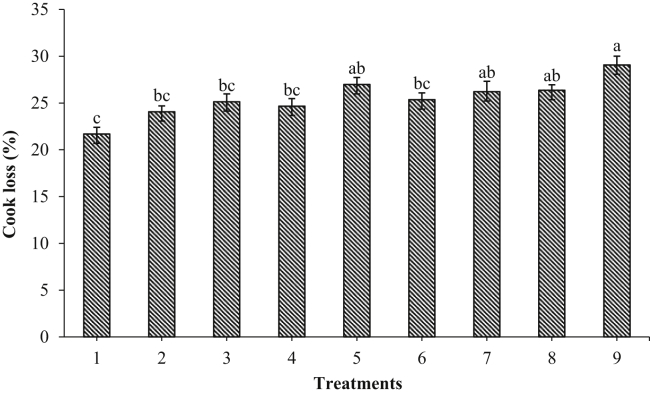
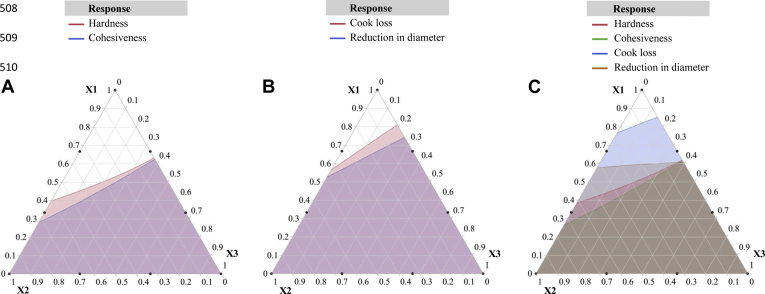
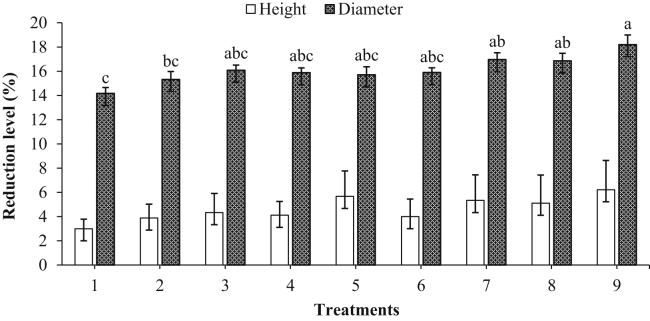
Potential applications of chicken meat with the woody breast (WB) condition in further processed products could provide processors with alternatives to deal with this meat quality problem. The objective of this study was to evaluate the effect of the use of broiler breast fillets at varying degrees of WB severity and proportions on instrumental texture characteristics of chicken patties. A total of 54 breast fillets were collected from broilers processed as per commercial practices, previously classified based on tactile evaluation in 3 WB categories (normal [NOR]; mild [MIL], and severe [SEV]). Instrumental compression analysis was performed to validate subjective scores. Nine treatments with 6 replicates of chicken patties were prepared: 100% NOR (T), 67% NOR + 33% MIL (T), 67% NOR + 33% SEV (T), 33% NOR + 67% MIL (T), 33% NOR + 67% SEV (T), 100% MIL (T), 67% MIL + 33% SEV (T), 33% MIL + 67% SEV (T), and 100% SEV (T). Instrumental texture profile analysis along with cook loss, color, and dimensional changes was evaluated in cooked patties. Compared with normal samples and excluding treatments T and T, hardness, springiness, and chewiness values of chicken patties decreased (P < 0.05) as WB severity increased in the meat incorporated into the formulation. Patties prepared using mixtures of MIL and SEV fillets (T and T) including T had higher levels of cook loss (>26%, P < 0.05) accompanied by significant reductions in diameter (>16%, P < 0.05) and distinguishable color changes (ΔE∗ > 2) than normal patties. These data suggest that the potential use of WB meat in chicken patties is associated with the degree of WB severity and the incorporation rate. The inclusion of WB fillets at high levels into this product is not recommended owing to their poor functionality. However, feasible mixtures of normal breast fillets with those affected by WB myopathy at relatively low proportions could be considered by processors as an alternative in commercial chicken patty formulations.
具有木质鸡胸(WB)状况的鸡肉的潜在应用可以为加工商提供处理这种肉质问题的替代方案。本研究的目的是评估使用不同严重程度和比例的肉鸡胸肉片对鸡肉饼仪器质地特性的影响。总共从按照商业惯例加工的肉鸡中收集了 54 块胸肉片,这些胸肉片之前根据触觉评估分为 3 个 WB 类别(正常[NOR];轻度[MIL]和严重[SEV])。进行了仪器压缩分析以验证主观评分。用 9 种处理方法制备了 6 个重复的鸡肉饼:100%NOR(T)、67%NOR+33%MIL(T)、67%NOR+33%SEV(T)、33%NOR+67%MIL(T)、33%NOR+67%SEV(T)、100%MIL(T)、67%MIL+33%SEV(T)、33%MIL+67%SEV(T)和 100%SEV(T)。对熟肉饼进行了仪器质地剖面分析以及煮损失、颜色和尺寸变化的评估。与正常样品相比,除了处理 T 和 T 之外,随着配方中加入的肉 WB 严重程度的增加,鸡肉饼的硬度、弹性和咀嚼性值降低(P<0.05)。使用 MIL 和 SEV 肉片混合物(T 和 T)制备的肉饼,包括 T,煮损失水平较高(>26%,P<0.05),同时直径显著减小(>16%,P<0.05),并且颜色变化可分辨(ΔE* > 2)比正常肉饼。这些数据表明,WB 肉在鸡肉饼中的潜在用途与 WB 严重程度和掺入率有关。不建议在该产品中高水平掺入 WB 肉片,因为其功能较差。然而,加工商可以考虑将正常鸡胸肉片与受 WB 肌病影响的肉片以相对较低的比例混合,作为商业鸡肉饼配方的替代方案。