Legros Jeanne, Tang Grace, Gautrais Jacques, Fernandez Maria Paz, Trannoy Séverine
Research Center on Animal Cognition (CRCA), Center for Integrative Biology, Toulouse University, CNRS, UPS, Toulouse, France.
Department of Neuroscience and Behavior, Barnard College of Columbia University, New York, NY, United States.
Front Behav Neurosci. 2021 Jan 14;14:599676. doi: 10.3389/fnbeh.2020.599676. eCollection 2020.
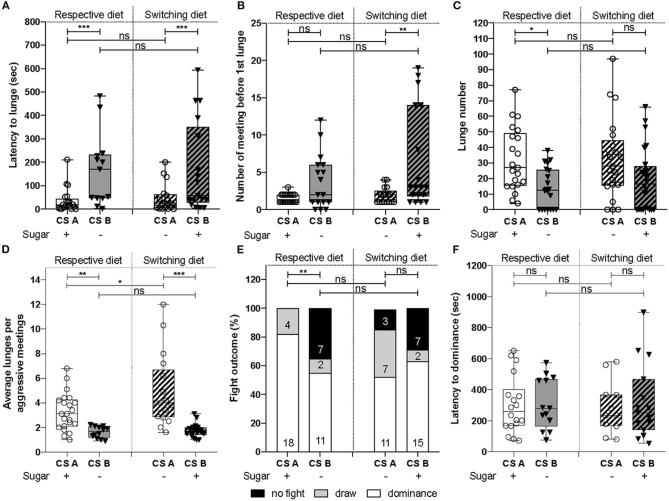
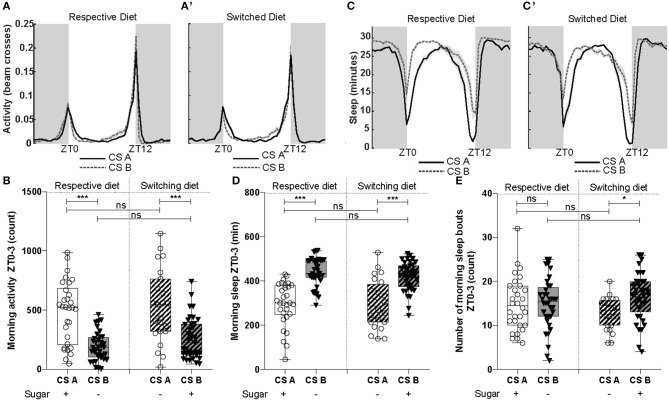
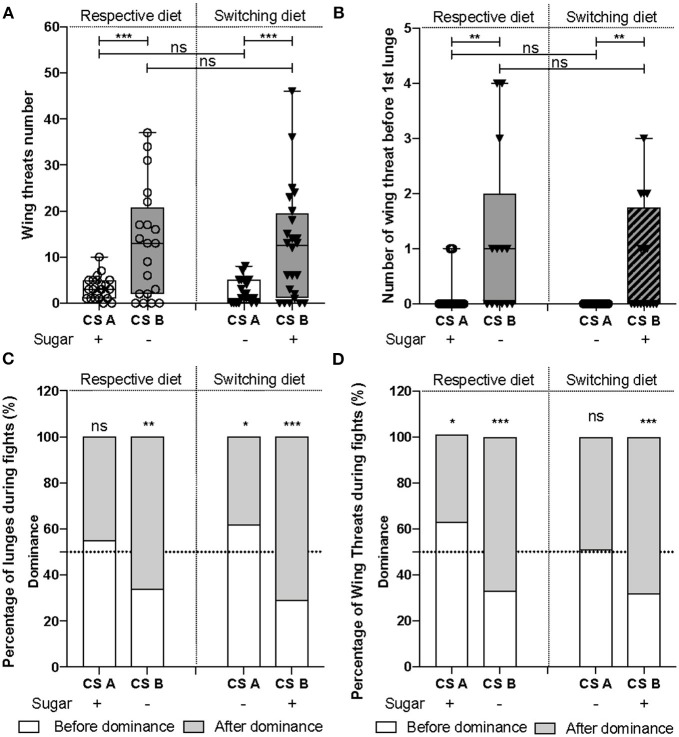
In competition for food, mates and territory, most animal species display aggressive behavior through visual threats and/or physical attacks. Such naturally-complex social behaviors have been shaped by evolution. Environmental pressure, such as the one imposed by dietary regimes, forces animals to adapt to specific conditions and ultimately to develop alternative behavioral strategies. The quality of the food resource during contests influence animals' aggression levels. However, little is known regarding the effects of a long-term dietary restriction-based environmental pressure on the development of alternative fighting strategies. To address this, we employed two lines of the wild-type Canton-S (CS) which originated from the same population but raised under two distinct diets for years. One diet contained both proteins and sugar, while the second one was sugar-free. We set up male-male aggression assays using both CS lines and found differences in aggression levels and the fighting strategies employed to establish dominance relationships. CS males raised on a sugar-containing diet started fights with a physical attack and employed a high number of lunges for establishing dominance but displayed few wing threats throughout the fight. In contrast, the sugar-free-raised males favored wing threats as an initial aggressive demonstration and used fewer lunges to establish dominance, but displayed a higher number of wing threats. This study demonstrates that fruit flies that have been raised under different dietary conditions have adapted their patterns of aggressive behavior and developed distinct fighting strategies: one favoring physical attacks, while the other one favoring visual threats.
在争夺食物、配偶和领地的竞争中,大多数动物物种通过视觉威胁和/或身体攻击来表现攻击行为。这种自然复杂的社会行为是由进化塑造的。环境压力,如饮食制度施加的压力,迫使动物适应特定条件并最终制定替代行为策略。竞争期间食物资源的质量会影响动物的攻击水平。然而,关于基于长期饮食限制的环境压力对替代战斗策略发展的影响,我们知之甚少。为了解决这个问题,我们使用了两个野生型广州-S(CS)品系,它们来自同一群体,但多年来在两种不同的饮食条件下饲养。一种饮食含有蛋白质和糖,而另一种不含糖。我们使用这两个CS品系进行了雄性间的攻击试验,发现攻击水平和用于建立优势关系的战斗策略存在差异。以含糖饮食饲养的CS雄性通过身体攻击开始战斗,并大量使用冲刺来确立优势,但在整个战斗中很少展示翅膀威胁。相比之下,无糖饲养的雄性更喜欢将翅膀威胁作为最初的攻击展示,并且使用较少的冲刺来确立优势,但展示出更多的翅膀威胁。这项研究表明,在不同饮食条件下饲养的果蝇已经适应了它们的攻击行为模式,并发展出了不同的战斗策略:一种倾向于身体攻击,而另一种倾向于视觉威胁。