Intan Sabrina Mohamad, Defi Irma Ruslina
Neurorehabilitation Unit, Department of Rehabilitation Medicine, Hospital Rehabilitasi Cheras, Kuala Lumpur, Malaysia.
Tung Shin Hospital, Kuala Lumpur, Malaysia.
Front Neurol. 2021 Jan 13;11:581649. doi: 10.3389/fneur.2020.581649. eCollection 2020.
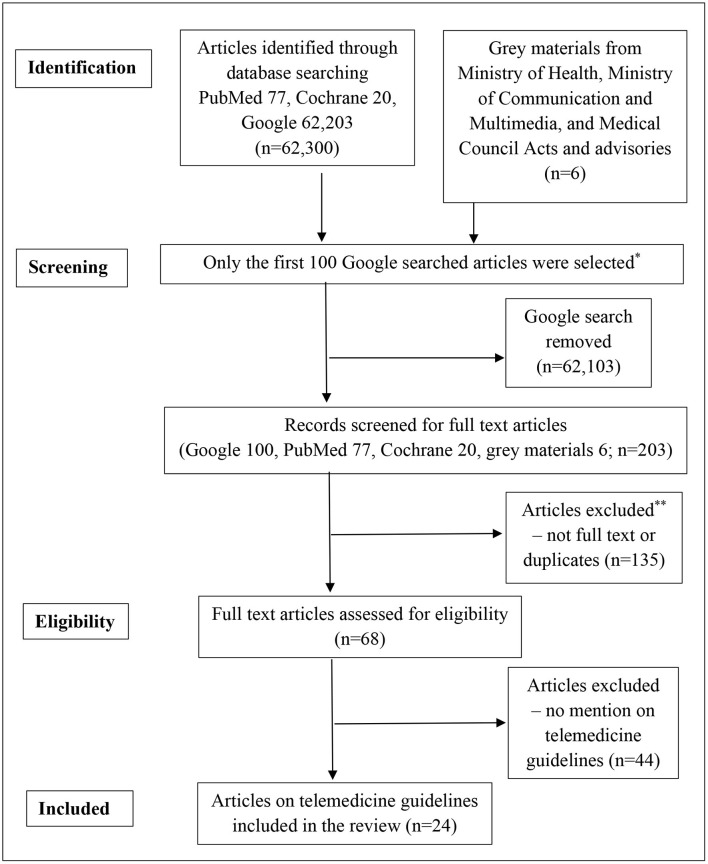
Telemedicine is a useful tool to deliver healthcare to communities in low- to high-income countries, especially in the coronavirus disease 2019 pandemic era. Guidelines on telemedicine would assist healthcare providers in delivering healthcare services based on local circumstances. To explore and compare guidelines on telehealth and telemedicine in South East Asian countries. Electronic databases such as Google, PubMed, and Cochrane reviews were searched for articles using keywords such as "telemedicine" OR "telehealth" OR "eHealth" OR "telemedis" AND "guidelines" AND "South East Asia" OR "Malaysia" OR "Singapore" OR "Indonesia" OR "Thailand" OR "Vietnam" published up to 2020. Inclusion criteria were full articles and gray materials (i.e., policy statements, advisories, blueprints, executive summaries, and circulars) related to telemedicine guidelines. No language restrictions were imposed. Only the first 100 Google searches were included for eligibility based on its relevance to telemedicine guidelines. Exclusion criteria were abstracts, duplicate publications, blogs, news articles, promotional brochures, conference proceedings, and telemedicine projects unrelated to telemedicine guidelines. A total of 62,300 articles were identified through the search engines (Google 62,203, PubMed 77, and Cochrane 20) and six articles from additional sources. Sixty-eight full-text articles fulfilled the inclusion criteria, but only 24 articles contained some form of guidelines on telemedicine: Indonesia (nine), Malaysia (seven), Singapore (five), Thailand (two), and Vietnam (one). There were six laws, six advisory guidelines, five policy statements, and two circulars (regulations) issued by either the Ministry of Communication and Multimedia, Ministry of Health, or Medical Councils from the respective countries. Issues addressed were clinical governance (100%); information and communication technology infrastructure (83.3%); privacy, storage, and record-keeping (77.8%, respectively); ethics and legal (77.8%); security and safety (72.2%); definitions and applications of telemedicine (72.2%); confidentiality (66.7%); licensing (66.7%); identification (55.6%); cost of information and communication technology infrastructure (55.6%); reimbursement (16.7%); mobile applications (11.1%); and feedback and choices (5.6%). The Singapore National Telemedicine Guidelines contained the most domains compared with other guidelines from South East Asia. Although there can be no "one-size-fits-all" telemedicine guideline, there should be a comprehensive and universal telemedicine guideline for any country to adapt based on the local context. Details on patient-identification, data ownership, back-up, and disposal; transregional cybersecurity laws and ways to overcome the limitations of telemedicine compared with face-to-face consultations should be outlined clearly to ensure uniformity of telemedicine service and patient safety.
远程医疗是一种向低收入到高收入国家的社区提供医疗保健服务的有用工具,尤其是在2019年冠状病毒病大流行时期。远程医疗指南将帮助医疗服务提供者根据当地情况提供医疗服务。为了探索和比较东南亚国家的远程健康和远程医疗指南。通过谷歌、PubMed和考科蓝综述等电子数据库,使用“远程医疗”或“远程健康”或“电子健康”或“远程医学”以及“指南”和“东南亚”或“马来西亚”或“新加坡”或“印度尼西亚”或“泰国”或“越南”等关键词搜索截至2020年发表的文章。纳入标准是与远程医疗指南相关的全文文章和灰色材料(即政策声明、咨询意见、蓝图、执行摘要和通知)。没有语言限制。仅根据与远程医疗指南的相关性,将谷歌搜索的前100条结果纳入合格范围。排除标准是摘要、重复出版物、博客、新闻文章、宣传手册、会议记录以及与远程医疗指南无关的远程医疗项目。通过搜索引擎共识别出62300篇文章(谷歌62203篇、PubMed 77篇、考科蓝20篇)以及另外6篇来自其他来源的文章。68篇全文文章符合纳入标准,但只有24篇文章包含某种形式的远程医疗指南:印度尼西亚(9篇)、马来西亚(7篇)、新加坡(5篇)、泰国(2篇)和越南(1篇)。有6项法律、6项咨询指南、5项政策声明以及2项由各国通信和多媒体部、卫生部或医学委员会发布的通知(法规)。涉及的问题包括临床治理(100%);信息和通信技术基础设施(83.3%);隐私、存储和记录保存(分别为77.8%);伦理和法律(77.8%);安全和安保(72.2%);远程医疗的定义和应用(72.2%);保密(66.7%);许可(66.7%);身份识别(55.6%);信息和通信技术基础设施成本(55.6%);报销(16.7%);移动应用(11.1%);以及反馈和选择(5.6%)。与东南亚其他指南相比,新加坡国家远程医疗指南包含的领域最多。虽然不存在“一刀切”的远程医疗指南,但任何国家都应有一个全面通用的远程医疗指南,以便根据当地情况进行调整。应明确概述患者身份识别、数据所有权、备份和处置的详细信息;跨区域网络安全法律以及与面对面咨询相比克服远程医疗局限性的方法,以确保远程医疗服务的一致性和患者安全。