Yamagishi Satoru, Bando Yuki, Sato Kohji
Department of Organ and Tissue Anatomy, Hamamatsu University School of Medicine, Hamamatsu, Japan.
Front Cell Dev Biol. 2021 Jan 15;8:590009. doi: 10.3389/fcell.2020.590009. eCollection 2020.
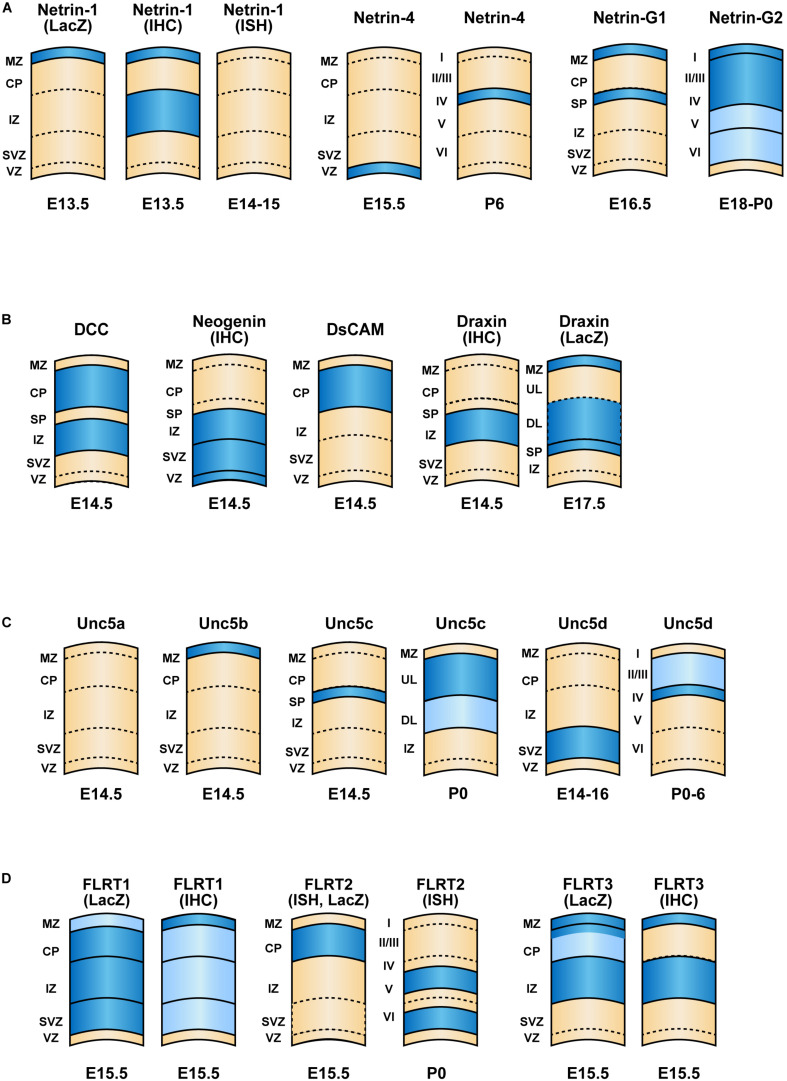
In mammals, excitatory cortical neurons develop from the proliferative epithelium and progenitor cells in the ventricular zone and subventricular zone, and migrate radially to the cortical plate, whereas inhibitory GABAergic interneurons are born in the ganglionic eminence and migrate tangentially. The migration of newly born cortical neurons is tightly regulated by both extracellular and intracellular signaling to ensure proper positioning and projections. Non-cell-autonomous extracellular molecules, such as growth factors, axon guidance molecules, extracellular matrix, and other ligands, play a role in cortical migration, either by acting as attractants or repellents. In this article, we review the guidance molecules that act as cell-cell recognition molecules for the regulation of neuronal migration, with a focus on netrin family proteins, their receptors, and related molecules, including neogenin, repulsive guidance molecules (RGMs), Down syndrome cell adhesion molecule (DSCAM), fibronectin leucine-rich repeat transmembrane proteins (FLRTs), and draxin. Netrin proteins induce attractive and repulsive signals depending on their receptors. For example, binding of netrin-1 to deleted in colorectal cancer (DCC), possibly together with Unc5, repels migrating GABAergic neurons from the ventricular zone of the ganglionic eminence, whereas binding to α3β1 integrin promotes cortical interneuron migration. Human genetic disorders associated with these and related guidance molecules, such as congenital mirror movements, schizophrenia, and bipolar disorder, are also discussed.
在哺乳动物中,兴奋性皮质神经元由脑室区和脑室下区的增殖上皮和祖细胞发育而来,并径向迁移至皮质板,而抑制性γ-氨基丁酸能中间神经元则在神经节隆起处产生并沿切线方向迁移。新生皮质神经元的迁移受到细胞外和细胞内信号的严格调控,以确保其正确定位和投射。非细胞自主的细胞外分子,如生长因子、轴突导向分子、细胞外基质和其他配体,通过作为吸引剂或排斥剂在皮质迁移中发挥作用。在本文中,我们综述了作为细胞-细胞识别分子来调节神经元迁移的导向分子,重点关注网蛋白家族蛋白、它们的受体以及相关分子,包括新基因蛋白、排斥导向分子(RGMs)、唐氏综合征细胞粘附分子(DSCAM)、富含亮氨酸重复序列的纤连蛋白跨膜蛋白(FLRTs)和驱蛋白。网蛋白根据其受体诱导吸引和排斥信号。例如,网蛋白-1与结直肠癌缺失基因(DCC)结合,可能与Unc5一起,排斥来自神经节隆起脑室区的迁移γ-氨基丁酸能神经元,而与α3β整合素结合则促进皮质中间神经元迁移。我们还讨论了与这些及相关导向分子相关的人类遗传疾病,如先天性镜像运动、精神分裂症和双相情感障碍。