Zhang Rou, Ma Wen-Qi, Fu Meng-Jun, Li Juan, Hu Chun-Hua, Chen Yi, Zhou Mi-Mi, Gao Zhi-Jie, He Ying-Li
Department of Infectious Diseases, The First Affiliated Hospital of Xi'an Jiaotong University, Xi'an 710061, Shaanxi Province, China.
World J Clin Cases. 2021 Jan 16;9(2):308-320. doi: 10.12998/wjcc.v9.i2.308.
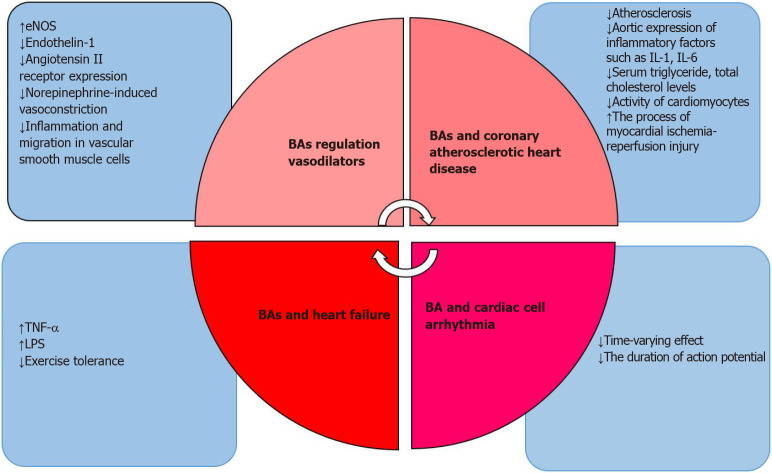
Bile acids (BAs) are classically known to play a vital role in the metabolism of lipids and in absorption. It is now well established that BAs act as signaling molecules, activating different receptors (such as farnesoid X receptor, vitamin D receptor, Takeda G-protein-coupled receptor 5, sphingosine-1-phosphate, muscarinic receptors, and big potassium channels) and participating in the regulation of energy homeostasis and lipid and glucose metabolism. In addition, increased BAs can impair cardiovascular function in liver cirrhosis. Approximately 50% of patients with cirrhosis develop cirrhotic cardiomyopathy. Exposure to high concentrations of hydrophobic BAs has been shown to be related to adverse effects with respect to vascular tension, endothelial function, arrhythmias, coronary atherosclerotic heart disease, and heart failure. The BAs in the serum BA pool have relevant through their hydrophobicity, and the lipophilic BAs are more harmful to the heart. Interestingly, ursodeoxycholic acid is a hydrophilic BA, and it is used as a therapeutic drug to reverse and protect the harmful cardiac effects caused by hydrophobic elevated BAs. In order to elucidate the mechanism of BAs and cardiovascular function, abundant experiments have been conducted and . The aim of this review was to explore the mechanism of BAs in the cardiovascular system.
胆汁酸(BAs)在脂质代谢和吸收中发挥着至关重要的作用,这是广为人知的。如今,人们已经充分认识到,胆汁酸作为信号分子,可激活不同受体(如法尼醇X受体、维生素D受体、武田G蛋白偶联受体5、鞘氨醇-1-磷酸、毒蕈碱受体和大钾通道),并参与能量稳态以及脂质和葡萄糖代谢的调节。此外,胆汁酸水平升高会损害肝硬化患者的心血管功能。约50%的肝硬化患者会发展为肝硬化性心肌病。研究表明,暴露于高浓度的疏水性胆汁酸会对血管张力、内皮功能、心律失常、冠状动脉粥样硬化性心脏病和心力衰竭产生不良影响。血清胆汁酸池中的胆汁酸因其疏水性而具有相关性,亲脂性胆汁酸对心脏的危害更大。有趣的是,熊去氧胆酸是一种亲水性胆汁酸,它被用作治疗药物,以逆转和保护由疏水性胆汁酸升高所导致的有害心脏效应。为了阐明胆汁酸与心血管功能的机制,已经进行了大量实验。本综述的目的是探讨胆汁酸在心血管系统中的作用机制。