Department of Pediatrics, Amalia Children's Hospital, Radboud University Medical Center, Nijmegen, the Netherlands.
Department of Pediatric Neurology, Radboud University Medical Center, Nijmegen, the Netherlands.
Dev Med Child Neurol. 2021 Apr;63(4):450-456. doi: 10.1111/dmcn.14811. Epub 2021 Jan 31.
To investigate the characteristics and severity of dysarthria in children and adults with ataxia telangiectasia.
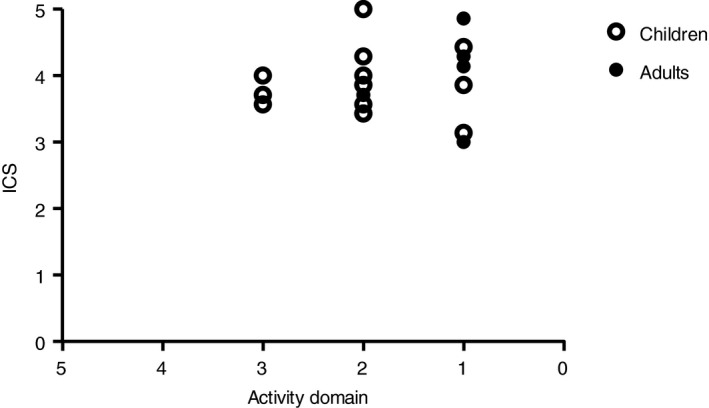
All children and adults with ataxia telangiectasia who visited our multidisciplinary outpatient clinic for ataxia telangiectasia were asked to participate in this study, which took place in March 2019. To evaluate dysarthria, we used the Radboud Dysarthria Assessment in adults (older than 18y) and the paediatric Radboud Dysarthria Assessment in children (5-18y), including the observational tasks 'conversation' and 'reading', and the speech-related maximum performance tasks 'repetition rate', 'phonation time', 'fundamental frequency range', and 'phonation volume'. Speech intelligibility was measured using the Intelligibility in Context Scale.
Twenty-two individuals (15 children [5-17y], seven adults [19-47y]; 14 males and eight females; mean age 19y, SD 15y 2mo) participated. Dysarthria was present in all participants and characterized by ataxic components in adults and similar uncontrolled movements in children. In most participants, speech was mildly to mildly/severely affected. Almost all participants had an abnormal score for at least one maximum performance task.
Dysarthria in ataxia telangiectasia is characterized by uncontrolled, ataxic, and involuntary movements, resulting in monotonous, unstable, slow, hypernasal, and chanted speech.
Dysarthria in ataxia telangiectasia is characterized by uncontrolled, ataxic, and involuntary movements. Dysarthria in ataxia telangiectasia results in monotonous, unstable, slow, hypernasal, and chanted speech. Dysarthria in ataxia telangiectasia can be assessed using the Radboud Dysarthria Assessment and the paediatric Radboud Dysarthria Assessment.
研究共济失调毛细血管扩张症患儿和成人的构音障碍的特点和严重程度。
2019 年 3 月,我们邀请所有共济失调毛细血管扩张症多学科门诊就诊的患儿和成人参加了这项研究。为了评估构音障碍,我们使用了成人(18 岁以上)的拉德堡构音障碍评估和儿童(5-18 岁)的儿科拉德堡构音障碍评估,包括观察任务“对话”和“阅读”,以及与言语相关的最大性能任务“重复率”、“发音时间”、“基频范围”和“发音音量”。言语可懂度使用语境可懂度量表进行测量。
共有 22 人(15 名儿童[5-17 岁],7 名成人[19-47 岁];14 名男性,8 名女性;平均年龄 19 岁,标准差 15 岁 2 个月)参与了研究。所有参与者均存在构音障碍,成人表现为共济失调成分,儿童表现为类似的无法控制的运动。在大多数参与者中,言语受到轻度至轻度/严重影响。几乎所有参与者在至少一项最大性能任务中得分异常。
共济失调毛细血管扩张症的构音障碍表现为无法控制、共济失调和不自主运动,导致单调、不稳定、缓慢、鼻音过重和吟诵样言语。
共济失调毛细血管扩张症的构音障碍的特点是无法控制、共济失调和不自主运动。共济失调毛细血管扩张症的构音障碍导致单调、不稳定、缓慢、鼻音过重和吟诵样言语。可以使用拉德堡构音障碍评估和儿科拉德堡构音障碍评估来评估共济失调毛细血管扩张症的构音障碍。