Tran Jeffrey S, Havakuk Ofer, McLeod Jennifer M, Hwang Jennifer, Kwong Hoi Yan, Shavelle David, Zile Michael R, Elkayam Uri, Fong Michael W, Grazette Luanda P
Department of Internal Medicine, Keck School of Medicine of the University of Southern California (USC), Los Angeles, CA, USA.
Department of Cardiology, Tel Aviv Medical Center, Tel Aviv University, Tel Aviv, Israel.
ESC Heart Fail. 2021 Apr;8(2):1706-1710. doi: 10.1002/ehf2.13225. Epub 2021 Jan 31.
Sacubitril/valsartan combines renin-angiotensin-aldosterone system inhibition with amplification of natriuretic peptides. In addition to well-described effects, natriuretic peptides exert direct effects on pulmonary vasculature. The effect of sacubitril/valsartan on pulmonary artery pressure (PAP) has not been fully defined.
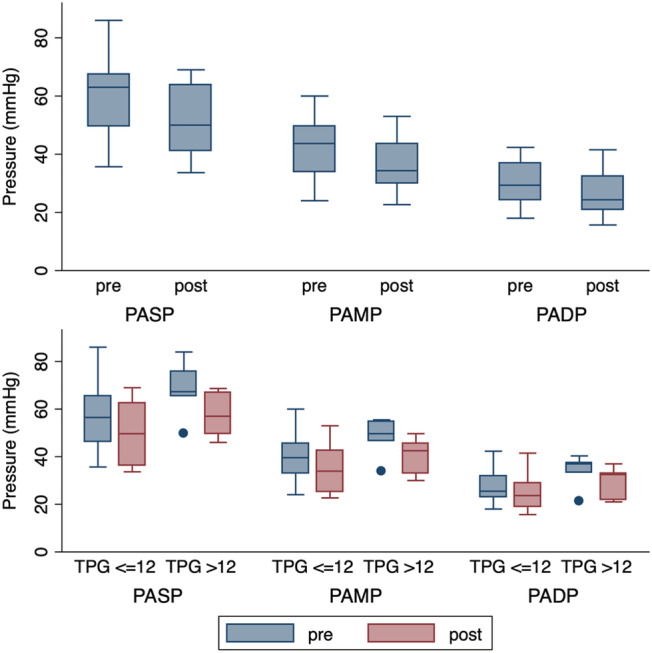
This was a retrospective case-series of PAP changes following transition from angiotensin-converting enzyme inhibitor (ACEI) or angiotensin receptor blocker (ARB) to sacubitril/valsartan in patients with heart failure reduced ejection fraction and a previously implanted CardioMEMS™ sensor. Pre-sacubitril/valsartan and post-sacubitril/valsartan PAPs were compared for each patient by examining averaged consecutive daily pressure readings from 1 to 5 days before and after sacubitril/valsartan exposure. PAP changes were also compared between patients based on elevated trans-pulmonary gradients (trans-pulmonary gradient ≥ 12 mmHg) at time of CardioMEMS™ sensor implantation. The cohort included 18 patients, 72% male, mean age 60.1 ± 13.6 years. There was a significant decrease in PAPs associated with transition from ACEI/ARB to sacubitril/valsartan. The median (interquartile range) pre-treatment and post-treatment change in mean, systolic and diastolic PAPs were -3.6 (-9.8, -0.7) mmHg (P < 0.001), -6.5 (-15.0, -2.0) mmHg (P = 0.001), and -2.5 (-5.7, -0.7) (P = 0.001), respectively. The decrease in PAPs was independent of trans-pulmonary gradient (F(1,16) = 0.49, P = 0.49).
In this retrospective case series, transition from ACEI/ARB to sacubitril/valsartan was associated with an early and significant decrease in PAPs.
沙库巴曲缬沙坦将肾素-血管紧张素-醛固酮系统抑制与利钠肽的增强作用相结合。除了已充分描述的作用外,利钠肽对肺血管系统有直接作用。沙库巴曲缬沙坦对肺动脉压(PAP)的影响尚未完全明确。
这是一项回顾性病例系列研究,观察射血分数降低的心力衰竭患者且先前已植入CardioMEMS™传感器,从血管紧张素转换酶抑制剂(ACEI)或血管紧张素受体阻滞剂(ARB)转换为沙库巴曲缬沙坦后PAP的变化。通过检查沙库巴曲缬沙坦暴露前后1至5天的连续每日平均压力读数,对每位患者的沙库巴曲缬沙坦治疗前和治疗后的PAP进行比较。还根据CardioMEMS™传感器植入时经肺梯度升高(经肺梯度≥12 mmHg)对患者之间的PAP变化进行比较。该队列包括18名患者,72%为男性,平均年龄60.1±13.6岁。从ACEI/ARB转换为沙库巴曲缬沙坦与PAP显著降低相关。平均、收缩压和舒张压PAP的治疗前和治疗后变化的中位数(四分位间距)分别为-3.6(-9.8,-0.7)mmHg(P<0.001)、-6.5(-15.0,-2.0)mmHg(P = 0.001)和-2.5(-5.7,-0.7)(P = 0.001)。PAP的降低与经肺梯度无关(F(1,16)=0.49,P = 0.49)。
在这个回顾性病例系列中,从ACEI/ARB转换为沙库巴曲缬沙坦与PAP的早期显著降低相关。