Laboratory Medicine, University Hospital of Lund, Lund, Sweden.
Scand J Immunol. 2021 Jun;93(6):e13024. doi: 10.1111/sji.13024. Epub 2021 Feb 7.
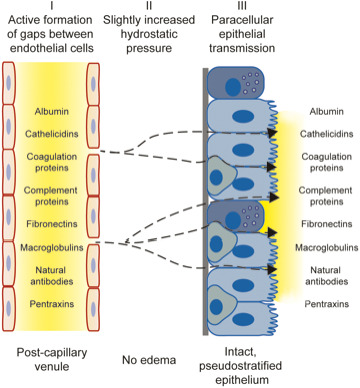
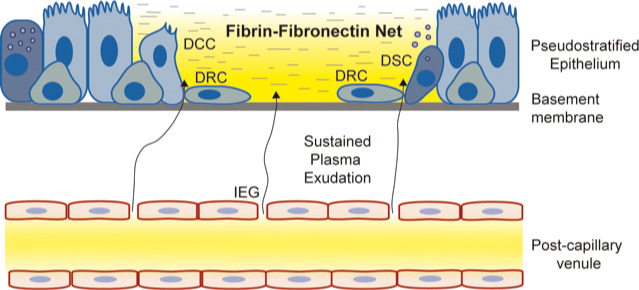
Early airway responses to severe acute respiratory syndrome coronavirus-2 (SARS-CoV-2) infection are of interest since they could decide whether coronavirus disease-19 (COVID-19) will proceed to life-threatening pulmonary disease stages. Here I discuss endothelial-epithelial co-operative in vivo responses producing first-line, humoral innate defence opportunities in human airways. The pseudostratified epithelium of human nasal and tracheobronchial airways are prime sites of exposure and infection by SARS-CoV-2. Just beneath the epithelium runs a profuse systemic microcirculation. Its post-capillary venules respond conspicuously to mucosal challenges with autacoids, allergens and microbes, and to mere loss of epithelium. By active venular endothelial gap formation, followed by transient yielding of epithelial junctions, non-sieved plasma macromolecules move from the microcirculation to the mucosal surface. Hence, plasma-derived protein cascade systems and antimicrobial peptides would have opportunity to operate jointly on an unperturbed mucosal lining. Similarly, a plasma-derived, dynamic gel protects sites of epithelial sloughing-regeneration. Precision for this indiscriminate humoral molecular response lies in restricted location and well-regulated duration of plasma exudation. Importantly, the endothelial responsiveness of the airway microcirculation differs distinctly from the relatively non-responsive, low-pressure pulmonary microcirculation that non-specifically, almost irreversibly, leaks plasma in life-threatening COVID-19. Observations in humans of infections with rhinovirus, coronavirus 229E, and influenza A and B support a general but individually variable early occurrence of plasma exudation in human infected nasal and tracheobronchial airways. Investigations are warranted to elucidate roles of host- and drug-induced airway plasma exudation in restriction of viral infection and, specifically, whether it contributes to variable disease responses following exposure to SARS-CoV-2.
早期严重急性呼吸综合征冠状病毒 2 型 (SARS-CoV-2) 感染的气道反应很重要,因为它们可能决定新型冠状病毒病 19 (COVID-19) 是否会进展为危及生命的肺部疾病阶段。在这里,我讨论了内皮-上皮合作的体内反应,这些反应产生了人体气道的一线体液先天防御机会。人类鼻和气管支气管气道的假复层上皮是 SARS-CoV-2 暴露和感染的主要部位。上皮细胞下方是丰富的全身微循环。其毛细血管后静脉对粘膜挑战反应明显,包括自体活性物质、过敏原和微生物,甚至仅仅是上皮细胞的丧失。通过主动形成静脉内皮间隙,随后上皮连接短暂开放,非筛状的血浆大分子从微循环转移到粘膜表面。因此,血浆来源的蛋白级联系统和抗菌肽将有机会在未受干扰的粘膜衬里上共同发挥作用。同样,血浆来源的动态凝胶保护上皮脱落-再生部位。这种无差别体液分子反应的精确性在于血浆渗出的位置限制和时间调节。重要的是,气道微循环的血管内皮反应与相对非反应性、低压性肺微循环明显不同,后者在危及生命的 COVID-19 中会非特异性、几乎不可逆转地漏出血浆。人类感染鼻病毒、冠状病毒 229E、流感 A 和 B 的观察结果支持在感染的鼻和气管支气管气道中普遍存在但个体差异的早期血浆渗出。需要进行研究以阐明宿主和药物诱导的气道血浆渗出在限制病毒感染中的作用,特别是它是否有助于接触 SARS-CoV-2 后疾病反应的变化。