Advanced Centre for Biochemical Engineering, Department of Biochemical Engineering, University College London, Gower Street, London, WC1E 6BT, UK.
Sartorius Stedim Biotech, York Way, Royston, SG8 5WY, UK.
Biotechnol Lett. 2021 May;43(5):1103-1116. doi: 10.1007/s10529-021-03076-3. Epub 2021 Feb 2.
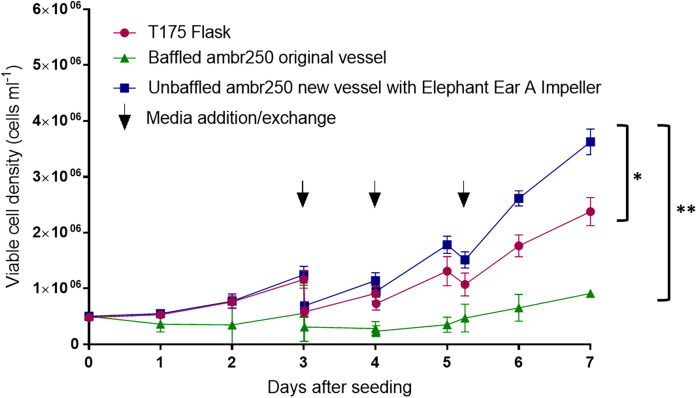
The emergence of cell and gene therapies has generated significant interest in their clinical and commercial potential. However, these therapies are prohibitively expensive to manufacture and can require extensive time for development due to our limited process knowledge and understanding. The automated ambr250® stirred-tank bioreactor platform provides an effective platform for high-throughput process development. However, the original dual pitched-blade 20 mm impeller and baffles proved sub-optimal for cell therapy candidates that require suspension of microcarriers (e.g. for the culture of adherent human mesenchymal stem cells) or other particles such as activating Dynabeads® (e.g. for the culture of human T-cells). We demonstrate the development of a new ambr250® stirred-tank bioreactor vessel which has been designed specifically to improve the suspension of microcarriers/beads and thereby improve the culture of such cellular systems. The new design is unbaffled and has a single, larger elephant ear impeller. We undertook a range of engineering and physical characterizations to determine which vessel and impeller configuration would be most suitable for suspension based on the minimum agitation speed (N) and associated specific power input (P/V). A vessel (diameter, T, = 60 mm) without baffles and incorporating a single elephant ear impeller (diameter 30 mm and 45° pitch-blade angle) was selected as it had the lowest (P/V) and therefore potentially, based on Kolmogorov concepts, was the most flexible system. These experimentally-based conclusions were further validated firstly with computational fluid dynamic (CFD) simulations and secondly experimental studies involving the culture of both T-cells with Dynabeads® and hMSCs on microcarriers. The new ambr250® stirred-tank bioreactor successfully supported the culture of both cell types, with the T-cell culture demonstrating significant improvements compared to the original ambr250® and the hMSC-microcarrier culture gave significantly higher yields compared with spinner flask cultures. The new ambr250® bioreactor vessel design is an effective process development tool for cell and gene therapy candidates and potentially for autologous manufacture too.
细胞和基因治疗的出现引起了人们对其临床和商业潜力的极大兴趣。然而,由于我们对工艺知识和理解的有限,这些疗法的制造成本非常高,并且开发过程可能需要很长时间。自动化 ambr250®搅拌槽生物反应器平台为高通量工艺开发提供了有效的平台。然而,最初的双叶 20 毫米叶轮和挡板对于需要悬浮微载体(例如培养贴壁人骨髓间充质干细胞)或其他颗粒(例如培养人 T 细胞)的细胞治疗候选物来说效果不佳。我们展示了一种新的 ambr250®搅拌槽生物反应器容器的开发,该容器专门设计用于改善微载体/珠的悬浮效果,从而改善此类细胞系统的培养。新设计无挡板,采用单个较大的象耳叶轮。我们进行了一系列工程和物理特性研究,以确定哪种容器和叶轮配置最适合基于最小搅拌速度 (N) 和相关比功率输入 (P/V) 的悬浮。选择了一个没有挡板且采用单个象耳叶轮(直径 30 毫米,叶片角度为 45°)的容器(直径 T=60 毫米),因为它的(P/V)最低,因此根据科尔莫戈罗夫的概念,它是最灵活的系统。这些基于实验的结论首先通过计算流体动力学 (CFD) 模拟进行了验证,其次通过涉及 Dynabeads®与微载体上 hMSCs 培养的实验研究进行了验证。新型 ambr250®搅拌槽生物反应器成功支持了这两种细胞类型的培养,与原始 ambr250®相比,T 细胞培养显示出显著改善,hMSC-微载体培养与摇瓶培养相比产量显著提高。新型 ambr250®生物反应器容器设计是细胞和基因治疗候选物以及潜在的自体制造的有效工艺开发工具。