Department of Physical Therapy, Graduate School.
Department of Physical Therapy, Daejeon University, Dong-gu, Daejeon city, Republic of Korea.
Medicine (Baltimore). 2021 Jan 29;100(4):e23285. doi: 10.1097/MD.0000000000023285.
Intensive neuromuscular stabilization exercise on highly obese patients with low back pain results in positive effects of body fat decline and prevention of complications. The purpose of this study is to investigate the effects of progressive neuromuscular stabilization exercise on unstable surface on pain, motor function, psychosocial factors, balance, and abdominal contraction with highly obese patients with lumbar instability.
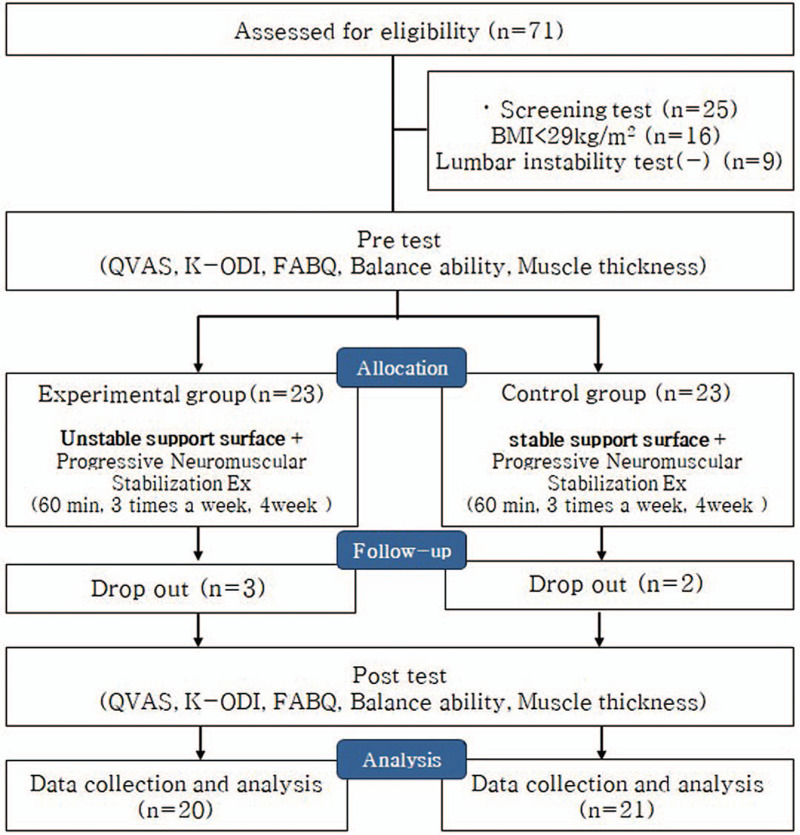
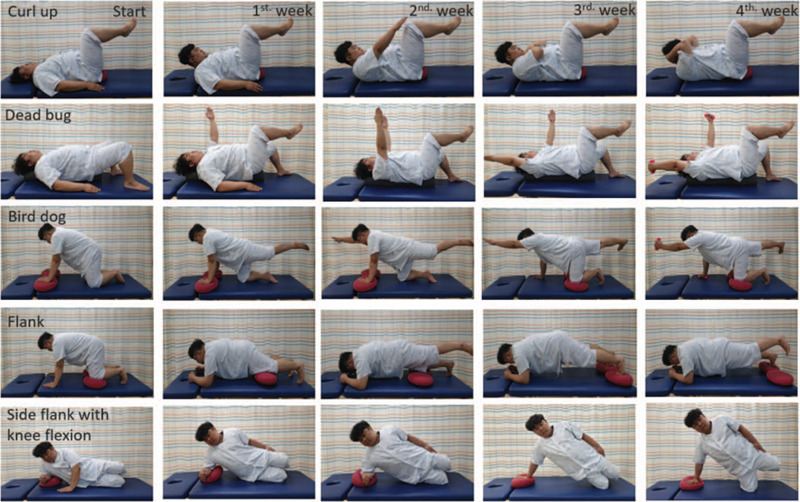
This study is a double-blinded randomized controlled trial. A total of 46 highly obese patients (body mass index [BMI] ≥ 30 kg/m2) with lumbar instability were assigned randomly to experimental group (n = 23) and control group (n = 23). The control group performed the intensive progressive exercise on a stable surface and the experimental group on an unstable surface.
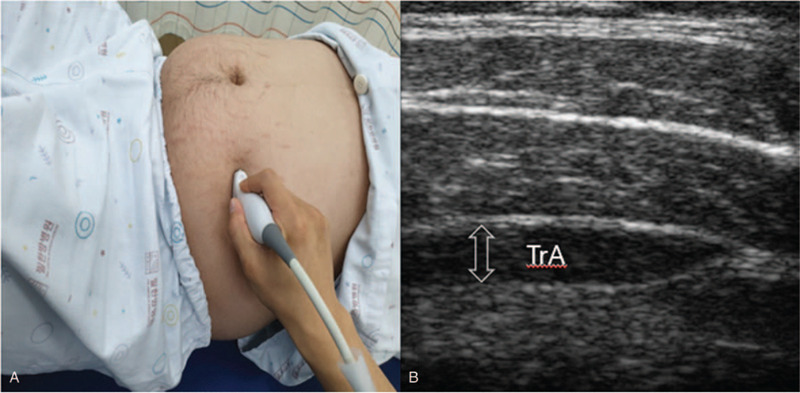
Significant differences were shown for BMI, QVAS, K-ODI, FABQ, and balance ability for both groups before and after the intervention (P < .05), and only the experimental group showed significant difference for transverse abdominis muscle thickness in contraction and contraction rate (P < .05). Compared to the control group, the experimental group showed significant difference (P < .05) in the amount of changes for QVAS, K-ODI, balance ability, transverse abdominis muscle thickness in contraction, and contraction rate.
Progressive neuromuscular stabilization exercise program on unstable surfaces demonstrated to be an effective and clinically useful method to decrease pain level, increase motor function, balance, and transverse abdominis muscle thickness in contraction and contraction rate for highly obese patients with lumbar instability.
针对患有腰痛的肥胖患者,强化神经肌肉稳定训练可带来体脂减少和并发症预防的积极效果。本研究旨在调查渐进式神经肌肉稳定训练对腰椎失稳肥胖患者的不稳定表面上的疼痛、运动功能、心理社会因素、平衡和腹内压的影响。
这是一项双盲随机对照试验。共纳入 46 名肥胖(BMI≥30kg/m2)腰椎失稳患者,随机分为实验组(n=23)和对照组(n=23)。对照组在稳定表面上进行强化渐进式运动,实验组在不稳定表面上进行。
两组干预前后 BMI、QVAS、K-ODI、FABQ 和平衡能力均有显著差异(P<.05),仅实验组腹横肌厚度收缩和收缩率有显著差异(P<.05)。与对照组相比,实验组 QVAS、K-ODI、平衡能力、腹横肌厚度收缩和收缩率的变化量有显著差异(P<.05)。
不稳定表面上的渐进式神经肌肉稳定训练计划对肥胖腰椎失稳患者的疼痛水平降低、运动功能、平衡和腹横肌厚度收缩和收缩率增加具有积极效果,是一种有效且具有临床意义的方法。