Department of Respiratory and Critical Care Medicine, Beijing Chaoyang Hospital, Capital Medical University, Beijing 100020, People's Republic of China.
The Clinical Research Center, Beijing Chaoyang Hospital, Capital Medical University, Beijing 100020, People's Republic of China.
Int J Chron Obstruct Pulmon Dis. 2021 Jan 26;16:147-158. doi: 10.2147/COPD.S272711. eCollection 2021.
Chronic obstructive pulmonary disease (COPD), characterized by irreversible airflow limitation, is a highly prevalent lung disease worldwide and imposes increasing disease burdens globally. Emphysema is one of the primary pathological features contributing to the irreversible decline of pulmonary function in COPD patients, but the pathogenetic mechanisms remain unclear. Reticulocalbin 3 (Rcn3) is an endoplasmic reticulum (ER) lumen protein localized in the secretory pathway of living cells. Rcn3 in type II alveolar epithelial cell (AECIIs) has been reported to play a critical role in regulating perinatal lung development and bleomycin-induced lung injury-repair processes. We hypothesized that Rcn3 deficiency is associated with the development of emphysema during COPD, which is associated with the dysfunction of injury-repair modulated by alveolar epithelial cells.
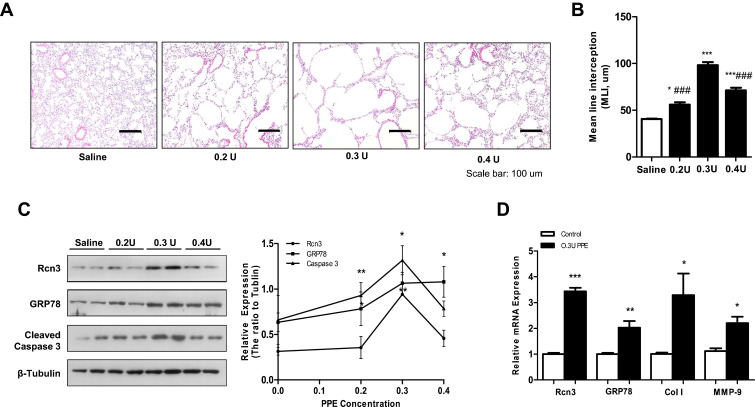
We examined Rcn3 expression in lung specimens from COPD patients and non-COPD control patients undergoing lung lobectomy or pneumonectomy. Two mouse models of emphysema were established by cigarette smoke (CS) exposure and intratracheal instillation of porcine pancreatic elastase (PPE). Rcn3 expression was detected in the lung tissues from these mice. Furthermore, conditional knockout (CKO) mice with Rcn3 deletion specific to AECIIs were used to explore the role of Rcn3 in PPE-induced emphysema progression. Rcn3 protein expression in lung tissues was evaluated by Western blot and immunohistochemistry. Rcn3 mRNA expression in lung tissues was detected by qPCR.
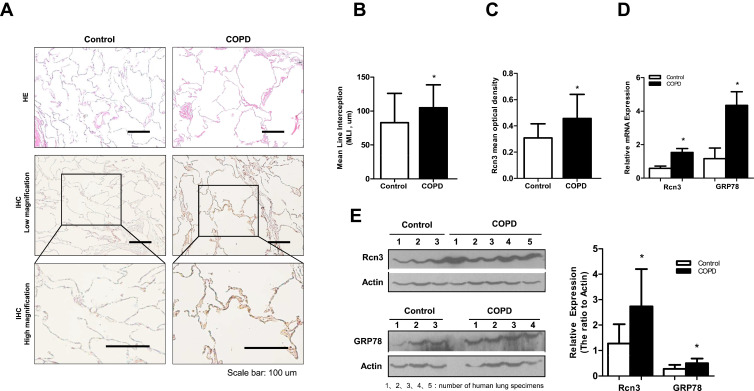
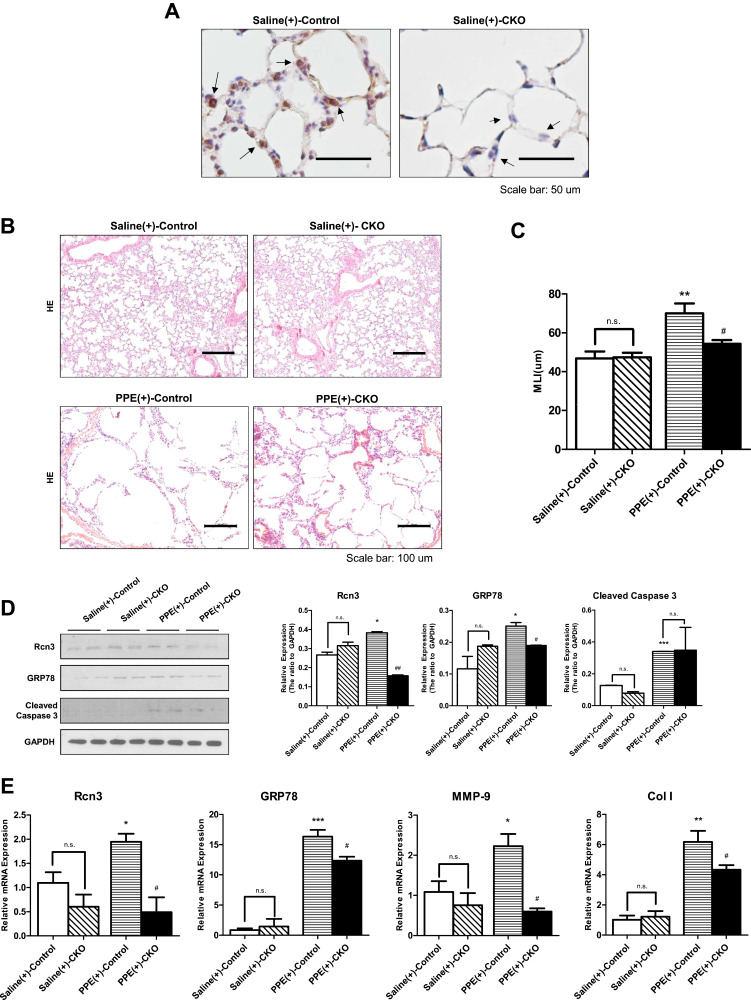
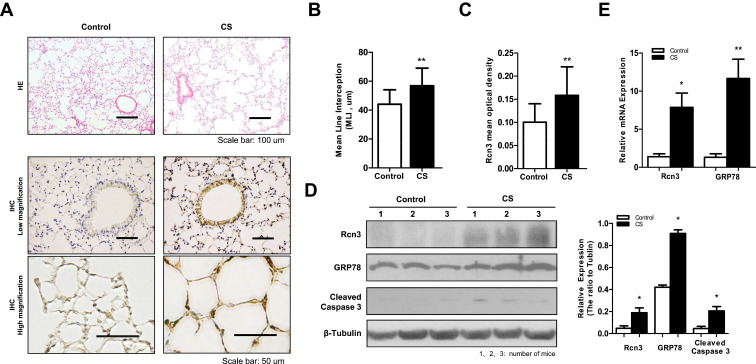
Rcn3 expression was significantly increased in the lung specimens from COPD patients versus non-COPD patients and the level of Rcn3 increase was associated with the degree of emphysema. Rcn3 expression were also significantly up-regulated in both CS-induced and PPE-induced emphysematous mouse lungs. Moreover, the selective ablation of Rcn3 in AECIIs significantly alleviated severity of the mouse emphysema in response to intratracheal installation of PPE.
Our data, for the first time, indicated that suppression of Rcn3 expression in AECIIs has a beneficial effect on PPE-induced emphysema.
慢性阻塞性肺疾病(COPD)以不可逆性气流受限为特征,是一种在全球范围内高发的肺部疾病,在全球范围内造成的疾病负担日益加重。肺气肿是导致 COPD 患者肺功能不可逆下降的主要病理特征之一,但发病机制尚不清楚。网钙蛋白 3(Rcn3)是一种内质网(ER)腔蛋白,定位于活细胞的分泌途径中。有研究报道,II 型肺泡上皮细胞(AECII)中的 Rcn3 在调节围产期肺发育和博来霉素诱导的肺损伤修复过程中发挥着关键作用。我们假设 Rcn3 缺失与 COPD 期间肺气肿的发展有关,这与肺泡上皮细胞调节的损伤修复功能障碍有关。
我们检测了 COPD 患者和接受肺叶切除术或肺切除术的非 COPD 对照患者的肺组织标本中的 Rcn3 表达。通过香烟烟雾(CS)暴露和猪胰弹性蛋白酶(PPE)气管内滴注建立了两种肺气肿小鼠模型。检测了这些小鼠肺组织中的 Rcn3 表达。此外,使用具有 AECII 特异性 Rcn3 缺失的条件敲除(CKO)小鼠来探讨 Rcn3 在 PPE 诱导的肺气肿进展中的作用。通过 Western blot 和免疫组织化学检测肺组织中的 Rcn3 蛋白表达。通过 qPCR 检测肺组织中的 Rcn3 mRNA 表达。
与非 COPD 患者相比,COPD 患者的肺组织标本中 Rcn3 表达显著增加,并且 Rcn3 增加的程度与肺气肿的严重程度相关。CS 诱导和 PPE 诱导的肺气肿小鼠的肺组织中 Rcn3 表达也显著上调。此外,AECII 中 Rcn3 的选择性缺失显著减轻了 PPE 气管内滴注引起的小鼠肺气肿的严重程度。
我们的数据首次表明,抑制 AECII 中的 Rcn3 表达对 PPE 诱导的肺气肿有有益的影响。