
新冠疫情期间家庭内部面临的劳动力市场风险:来自墨西哥的经验教训
Intra-household exposure to labor market risk in the time of Covid-19: lessons from Mexico.
作者信息
Peluffo Cecilia, Viollaz Mariana
机构信息
Department of Economics, University of Florida, 224 Matherly Hall, P.O. Box 117140, Gainesville, FL 32611-7140 USA.
Centro de Estudios Distributivos, Laborales y Sociales (CEDLAS), IIE-FCE, Universidad Nacional de La Plata, La Plata, Argentina.
出版信息
Rev Econ Househ. 2021;19(2):327-351. doi: 10.1007/s11150-020-09541-8. Epub 2021 Jan 29.
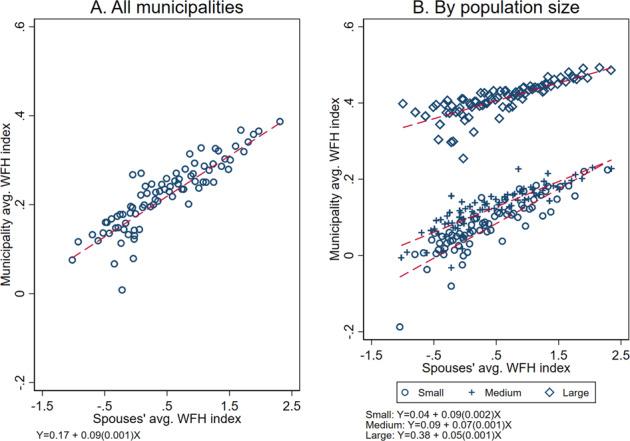
The ability to work from home can be critical during pandemics. We calculate an index that measures the possibility of working from home based on the characteristics of the pre-Covid-19 pandemic distribution of occupations and on internet access at home, using microdata for Mexico. Focusing on households with two partners employed in nonessential occupations, we show that there is high within-household correlation in the possibility of working remotely, which is likely to be positively associated with job stability during the pandemic. Poor families, with low access to formal credit and who rely heavily on informal mechanisms for consumption smoothing have lower chances of working remotely than richer families with higher access to formal credit. High within-household correlation in the work-from-home index restricts the likelihood of intra-household risk-sharing and consumption smoothing, and is likely to contribute to an increase in inequality.
在疫情期间,居家工作的能力可能至关重要。我们基于新冠疫情前职业分布特征和家庭互联网接入情况,利用墨西哥的微观数据计算了一个衡量居家工作可能性的指数。针对有两名从事非必要职业的伴侣的家庭,我们发现家庭内部远程工作可能性存在高度相关性,这可能与疫情期间的工作稳定性呈正相关。获得正规信贷机会少且严重依赖非正规消费平滑机制的贫困家庭,比获得正规信贷机会多的富裕家庭远程工作的机会更低。居家工作指数在家庭内部的高度相关性限制了家庭内部风险分担和消费平滑的可能性,可能会加剧不平等。


 Zotero 插件