Slade Austen D, Christiansen Andrew R, Keihani Sorena, Brant William O, Hotaling James M
Department of Surgery, Division of Urology, University of Utah School of Medicine, Salt Lake City, UT, USA.
Transl Androl Urol. 2021 Jan;10(1):49-55. doi: 10.21037/tau-20-788.
Male infertility can be associated with secondary sexual characteristics, hypogonadism, and several findings in the examination of external genitalia. We sought to identify if stretched penile length (SPL) is associated with infertility or baseline testosterone.
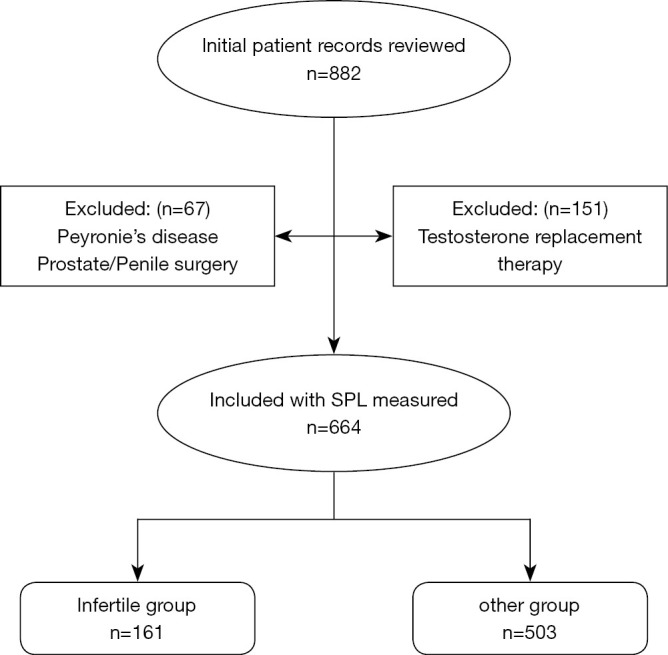
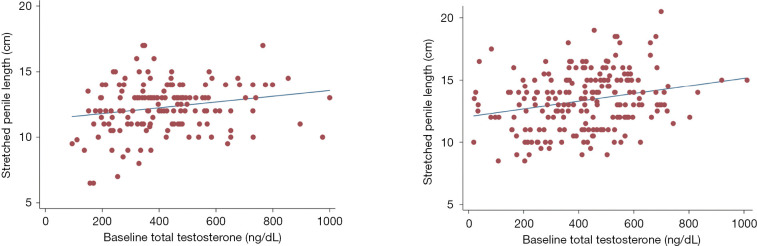
We performed a retrospective review of all males age 18-59 presenting to a Men's health clinic from 2014 to 2017. SPL of patients with infertility were compared to patients with any other complaint. Patients with Peyronie's disease, prior penile surgery, prostatectomy, on testosterone replacement, clomiphene or β-hCG were excluded from our study. Baseline characteristics were compared between the two groups (infertile vs. other). Linear regression was used to assess the association between infertility and testosterone with SPL after adjusting for patient age, BMI, and race. Scatterplot was used for correlation between testosterone and SPL.
Six hundred and sixty-four men were included in our study (161 infertile, 503 other). The unadjusted mean SPL in the infertile group was 12.3 cm compared to 13.4 cm in the other group (P<0.001). The significance remained when adjusted for age, BMI, testosterone and race (12.4 13.3, P<0.001). Mean total testosterone in the infertile group was not significantly different than the other group (414 422, P=0.68). Infertile men were younger than the other group (33.2 42.1 years, P<0.001). BMI did not significantly differ (28.9 28.9 kg/m, P=0.57). There was a weak positive correlation between testosterone and penile size in both the infertile group (r=0.20, P=0.01) and the other group (r=0.24, P<0.001).
Though SPL differed amongst our groups, adult testosterone levels did not. If developmental levels of testosterone exposure accounted for some of the differences in SPL between our two groups, these variations did not persist into adulthood. It remains unknown if reduced length is a result of genetic or congenital factors associated with infertility. Further investigation is needed to better understand the association of shorter SPL with male infertility.
男性不育可能与第二性征、性腺功能减退以及外生殖器检查中的多项发现有关。我们试图确定阴茎拉伸长度(SPL)是否与不育或基线睾酮水平相关。
我们对2014年至2017年到男性健康诊所就诊的所有18 - 59岁男性进行了回顾性研究。将不育患者的SPL与有其他任何主诉的患者进行比较。患有佩罗尼氏病、既往阴茎手术史、前列腺切除术、正在接受睾酮替代治疗、克罗米芬或β - 人绒毛膜促性腺激素治疗的患者被排除在我们的研究之外。比较两组(不育组与其他组)的基线特征。在调整患者年龄、体重指数(BMI)和种族后,使用线性回归评估不育和睾酮与SPL之间的关联。使用散点图分析睾酮与SPL之间的相关性。
我们的研究纳入了664名男性(161名不育,503名其他)。不育组未经调整的平均SPL为12.3厘米,而另一组为13.4厘米(P<0.001)。在调整年龄、BMI、睾酮和种族后,差异仍然显著(12.4对13.3,P<0.001)。不育组的平均总睾酮水平与另一组无显著差异(414对422,P = 0.68)。不育男性比另一组更年轻(33.2对42.1岁,P<0.001)。BMI无显著差异(28.9对28.9kg/m²,P = 0.57)。不育组(r = 0.20,P = 0.01)和另一组(r = 0.24,P<0.001)中,睾酮与阴茎大小之间均存在弱正相关。
虽然我们研究中的组间SPL存在差异,但成年男性的睾酮水平并无差异。如果睾酮暴露的发育水平是两组之间SPL差异的部分原因,那么这些差异在成年后并未持续存在。阴茎长度缩短是否是与不育相关的遗传或先天性因素的结果仍不清楚。需要进一步研究以更好地理解较短的SPL与男性不育之间的关联。