Tarantino Ilaria, Peralta Marco, Ligresti Dario, Amata Michele, Barresi Luca, Cipolletta Fabio, Antonio Granata, Traina Mario
Endoscopy Service, Department of Diagnostic and Therapeutic Services, IRCCS - ISMETT, Palermo, Italy.
Endosc Int Open. 2021 Feb;9(2):E110-E115. doi: 10.1055/a-1313-6850. Epub 2021 Jan 25.
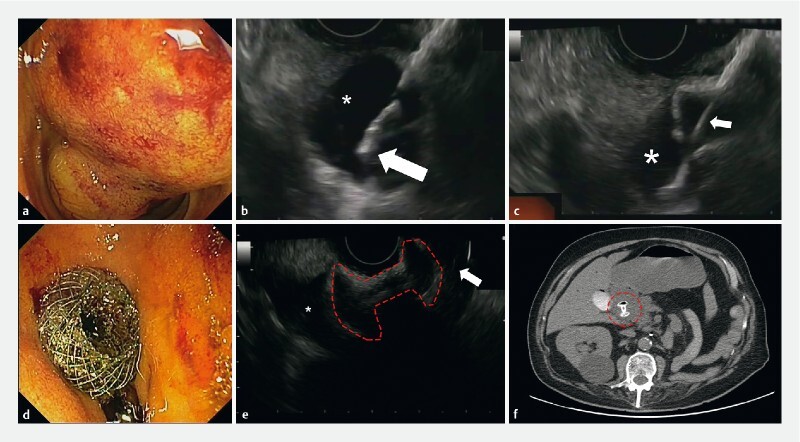
The therapeutic role of endoscopic ultrasound (EUS) evolved in recent decade,s opening a new chapter in the field of endoscopic biliary drainage (BD). EUS-BD has emerged as a new mini-invasive technique for neoplastic jaundice not amenable to endoscopic retrograde cholangiopancreatography (ERCP). The primary study aims were to assess the clinical efficacy of EUS-BD using an electrocautery-enhanced lumen apposing metal stent (ECE-LAMS) in patients with malignant biliary obstruction with failed\unfeasible ERCP and the adverse event (AE) rate. The secondary aims were to evaluate the technical success and incidence of jaundice recurrence. Data from All patients referred to our tertiary-care Institute with obstructive jaundice due to unresectable malignant distal biliary stricture and unfeasible\failed ERCP, were prospectively recorded from January 2015 to February 2018. The procedures were performed by a single-step ECE-LAMS (AXIOS-EC, Boston Scientific) placement, from the upper gut lumen to the biliary tree, for definitive biliary decompression. Twenty-one patients were consecutively enrolled. Mean pre-procedure common bile duct diameter was 16 mm and the bilirubin level was 13.9 mg/dL (range 3.8-29.5). LAMS was positioned from the duodenal bulb (n = 19) to gastric antrum (n = 2). We registered a 100 % of technical and clinical success. No AEs occurred. We observed a single case of delayed AE consisting of a buried LAMS, which was successfully resolved endoscopically. Despite the limits of being non-comparative, our study shows outcomes in a homogeneous population in terms of indications and technique. EUS-BD with dedicated ECE-LAMS is associated with extremely good clinical efficacy and safety and can be considered as an alternative in cases of failed/unfeasible ERCP.
近十年来,内镜超声(EUS)的治疗作用不断发展,为内镜下胆道引流(BD)领域开启了新篇章。EUS-BD已成为一种用于治疗无法进行内镜逆行胰胆管造影(ERCP)的肿瘤性黄疸的新型微创技术。主要研究目的是评估使用电灼增强管腔贴附金属支架(ECE-LAMS)对ERCP失败或不可行的恶性胆道梗阻患者进行EUS-BD的临床疗效及不良事件(AE)发生率。次要目的是评估技术成功率和黄疸复发率。2015年1月至2018年2月,前瞻性记录了所有因不可切除的恶性远端胆管狭窄且ERCP不可行或失败而转诊至我们三级医疗机构的梗阻性黄疸患者的数据。通过单步将ECE-LAMS(AXIOS-EC,波士顿科学公司)从上部肠腔放置到胆管树进行确定性胆道减压。连续纳入21例患者。术前胆总管平均直径为16毫米,胆红素水平为13.9毫克/分升(范围3.8-29.5)。LAMS从十二指肠球部(n = 19)放置到胃窦部(n = 2)。我们记录到技术和临床成功率均为100%。未发生不良事件。我们观察到1例延迟性AE,表现为LAMS被包埋,经内镜成功解决。尽管本研究存在非对照的局限性,但在适应证和技术方面显示了同质人群的结果。使用专用ECE-LAMS的EUS-BD具有极佳的临床疗效和安全性,在ERCP失败或不可行的情况下可被视为一种替代方法。