Fundação Ezequiel Dias, Diretoria do Instituto Octávio Magalhães, Serviço de Virologia e Riquetsioses, Belo Horizonte, MG, Brasil.
Centro Universitário de Belo Horizonte, Belo Horizonte, MG, Brasil.
Mem Inst Oswaldo Cruz. 2021 Jan 29;115:e200287. doi: 10.1590/0074-02760200287. eCollection 2021.
The heat-labile nature of Dengue virus (DENV) in serum samples must be considered when applying routine diagnostic tests to avoid issues that could impact the accuracy of test results with direct implications for case management and disease reporting.
To check if pre-analytical variables, such as storage time and temperature, have an impact on the accuracy of the main routine diagnostic tests for dengue.
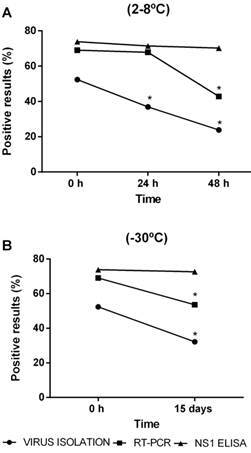
Virus isolation, reverse transcription real-time polymerase chain reaction (RT-PCR) and NS1 enzyme-linked immunosorbent assay (ELISA) were evaluated using 84 samples submitted to different pre-analytical conditions.
Sensitivity and negative predictive value were directly affected by sample storage conditions. RT-PCR and virus isolation showed greater dependence on well-conserved samples for an accurate diagnosis. Interestingly, even storage at -30ºC for a relatively short time (15 days) was not adequate for accurate results using virus isolation and RT-PCR tests. On the other hand, NS1 ELISA showed no significant reduction in positivity for aliquots tested under the same conditions as in the previous tests.
Our results support the stability of the NS1 marker in ELISA diagnosis and indicate that the accuracy of routine tests such as virus isolation and RT-PCR is significantly affected by inadequate transport and storage conditions of serum samples.
在应用常规诊断检测时,必须考虑血清样本中登革热病毒(DENV)的热不稳定特性,以避免可能影响检测结果准确性的问题,这直接关系到病例管理和疾病报告。
检查预分析变量(如储存时间和温度)是否会影响登革热的主要常规诊断检测的准确性。
使用提交至不同预分析条件的 84 个样本评估病毒分离、逆转录实时聚合酶链反应(RT-PCR)和 NS1 酶联免疫吸附测定(ELISA)。
灵敏度和阴性预测值直接受到样本储存条件的影响。RT-PCR 和病毒分离对保存良好的样本更依赖,以实现准确诊断。有趣的是,即使在 -30°C 下储存相对较短的时间(15 天),也不足以确保病毒分离和 RT-PCR 检测的准确性。另一方面,NS1 ELISA 显示,在与之前测试相同的条件下测试等分样本时,阳性率没有明显降低。
我们的结果支持 ELISA 诊断中 NS1 标志物的稳定性,并表明病毒分离和 RT-PCR 等常规检测的准确性受到血清样本运输和储存条件不当的显著影响。