Ertl M, Zu Eulenburg P, Woller M, Dieterich M
Department of Psychology, University of Bern, Fabrikstrasse 8, 3012, Bern, Switzerland.
Department of Neurology, Ludwig-Maximilians-Universität München, München, Germany.
Exp Brain Res. 2021 Apr;239(4):1073-1083. doi: 10.1007/s00221-020-06030-3. Epub 2021 Feb 3.
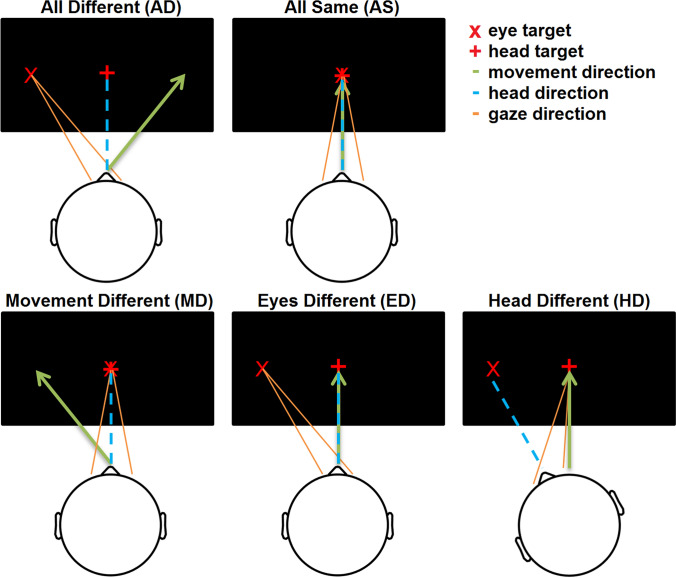
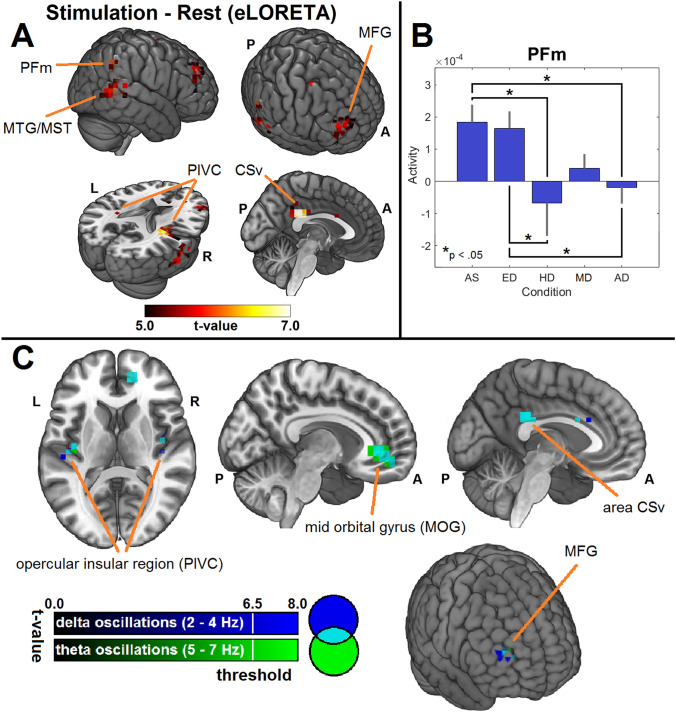
The successful cortical processing of multisensory input typically requires the integration of data represented in different reference systems to perform many fundamental tasks, such as bipedal locomotion. Animal studies have provided insights into the integration processes performed by the neocortex and have identified region specific tuning curves for different reference frames during ego-motion. Yet, there remains almost no data on this topic in humans.In this study, an experiment originally performed in animal research with the aim to identify brain regions modulated by the position of the head and eyes relative to a translational ego-motion was adapted for humans. Subjects sitting on a motion platform were accelerated along a translational pathway with either eyes and head aligned or a 20° yaw-plane offset relative to the motion direction while EEG was recorded.Using a distributed source localization approach, it was found that activity in area PFm, a part of Brodmann area 40, was modulated by the congruency of translational motion direction, eye, and head position. In addition, an asymmetry between the hemispheres in the opercular-insular region was observed during the cortical processing of the vestibular input. A frequency specific analysis revealed that low-frequency oscillations in the delta- and theta-band are modulated by vestibular stimulation. Source-localization estimated that the observed low-frequency oscillations are generated by vestibular core-regions, such as the parieto-opercular region and frontal areas like the mid-orbital gyrus and the medial frontal gyrus.
多感官输入的成功皮质处理通常需要整合以不同参考系统表示的数据,以执行许多基本任务,如双足运动。动物研究为新皮质执行的整合过程提供了见解,并确定了自我运动期间不同参考框架的区域特异性调谐曲线。然而,关于这个主题在人类中几乎没有数据。在本研究中,一项最初在动物研究中进行的旨在识别受头部和眼睛相对于平移自我运动的位置调制的脑区的实验被改编用于人类。坐在运动平台上的受试者沿着平移路径加速,眼睛和头部要么对齐,要么相对于运动方向在偏航平面上有20°的偏移,同时记录脑电图。使用分布式源定位方法,发现Brodmann 40区的一部分PFm区的活动受平移运动方向、眼睛和头部位置的一致性调制。此外,在前庭输入的皮质处理过程中,观察到岛盖区半球之间的不对称。频率特异性分析表明,δ波和θ波频段的低频振荡受前庭刺激调制。源定位估计观察到的低频振荡由前庭核心区域产生,如顶叶岛盖区和额叶区域,如眶中回和额内侧回。