Department of Cellular and Molecular Biology, The University of Texas Health Science Center at Tyler, Tyler, TX.
Coagulation Biology Laboratory, Oklahoma Medical Research Foundation, Oklahoma City, OK; and.
Blood. 2021 Jun 17;137(24):3428-3442. doi: 10.1182/blood.2020008417.
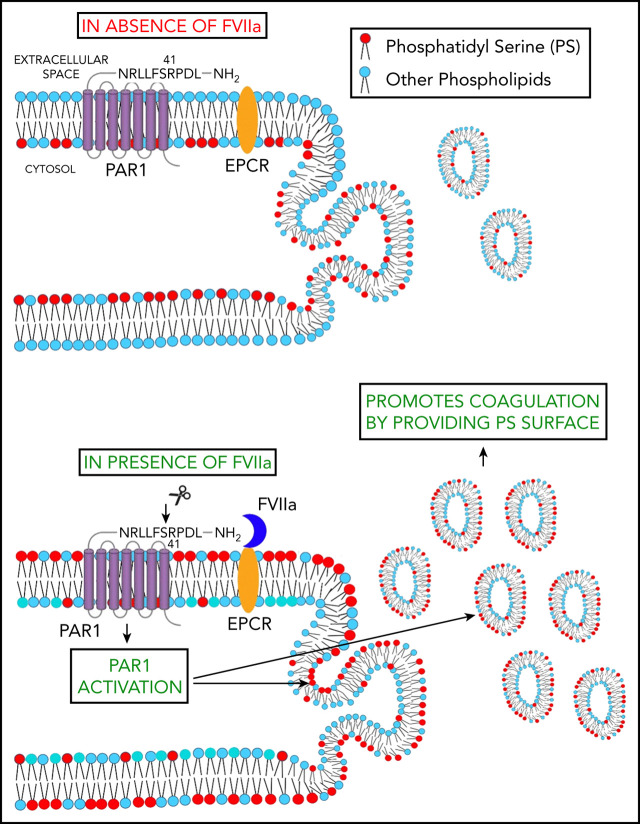
Recombinant factor FVIIa (rFVIIa) is used as a hemostatic agent to treat bleeding disorders in hemophilia patients with inhibitors and other groups of patients. Our recent studies showed that FVIIa binds endothelial cell protein C receptor (EPCR) and induces protease-activated receptor 1 (PAR1)-mediated biased signaling. The importance of FVIIa-EPCR-PAR1-mediated signaling in hemostasis is unknown. In the present study, we show that FVIIa induces the release of extracellular vesicles (EVs) from endothelial cells both in vitro and in vivo. Silencing of EPCR or PAR1 in endothelial cells blocked the FVIIa-induced generation of EVs. Consistent with these data, FVIIa treatment enhanced the release of EVs from murine brain endothelial cells isolated from wild-type (WT), EPCR-overexpressing, and PAR1-R46Q-mutant mice, but not EPCR-deficient or PAR1-R41Q-mutant mice. In vivo studies revealed that administration of FVIIa to WT, EPCR-overexpressing, and PAR1-R46Q-mutant mice, but not EPCR-deficient or PAR1-R41Q-mutant mice, increased the number of circulating EVs. EVs released in response to FVIIa treatment exhibit enhanced procoagulant activity. Infusion of FVIIa-generated EVs and not control EVs to platelet-depleted mice increased thrombin generation at the site of injury and reduced blood loss. Administration of FVIIa-generated EVs or generation of EVs endogenously by administering FVIIa augmented the hemostatic effect of FVIIa. Overall, our data reveal that FVIIa treatment, through FVIIa-EPCR-PAR1 signaling, releases EVs from the endothelium into the circulation, and these EVs contribute to the hemostatic effect of FVIIa.
重组凝血因子 FVIIa(rFVIIa)被用作止血剂,用于治疗血友病患者伴抑制剂和其他患者群体的出血性疾病。我们最近的研究表明,FVIIa 与内皮细胞蛋白 C 受体(EPCR)结合,并诱导蛋白酶激活受体 1(PAR1)介导的偏向信号转导。FVIIa-EPCR-PAR1 介导的信号转导在止血中的重要性尚不清楚。在本研究中,我们表明 FVIIa 在体外和体内均诱导内皮细胞释放细胞外囊泡(EVs)。在内皮细胞中沉默 EPCR 或 PAR1 可阻断 FVIIa 诱导的 EV 生成。与这些数据一致,FVIIa 处理增强了从野生型(WT)、EPCR 过表达和 PAR1-R46Q 突变小鼠分离的鼠脑内皮细胞中 EV 的释放,但不能增强 EPCR 缺失或 PAR1-R41Q 突变小鼠中 EV 的释放。体内研究表明,给予 FVIIa 至 WT、EPCR 过表达和 PAR1-R46Q 突变小鼠,但不给 EPCR 缺失或 PAR1-R41Q 突变小鼠,增加了循环 EVs 的数量。对 FVIIa 治疗反应释放的 EVs 表现出增强的促凝活性。向血小板耗竭小鼠输注 FVIIa 生成的 EVs 而非对照 EVs 增加了损伤部位的凝血酶生成并减少了失血。给予 FVIIa 生成的 EVs 或给予 FVIIa 内源性生成 EVs 增强了 FVIIa 的止血作用。总的来说,我们的数据表明,FVIIa 治疗通过 FVIIa-EPCR-PAR1 信号转导,从内皮细胞释放 EVs 进入循环,这些 EVs 有助于 FVIIa 的止血作用。