Section of Cell Biology and Functional Genomics, Department of Medicine, Imperial College London, Hammersmith Hospital, Du Cane Road, London W12 0NN, UK.
Section of Genetics and Genomics, Department of Metabolism, Digestion, and Reproduction, Imperial College London, Hammersmith Hospital, Du Cane Road, London W12 0NN, UK.
Cell Rep. 2021 Feb 2;34(5):108703. doi: 10.1016/j.celrep.2021.108703.
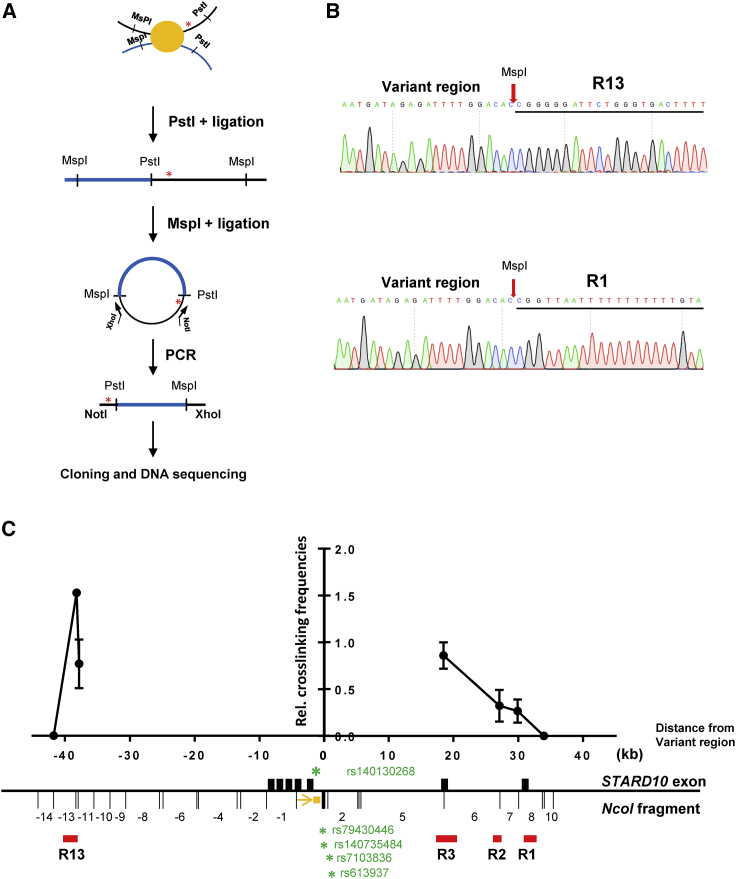
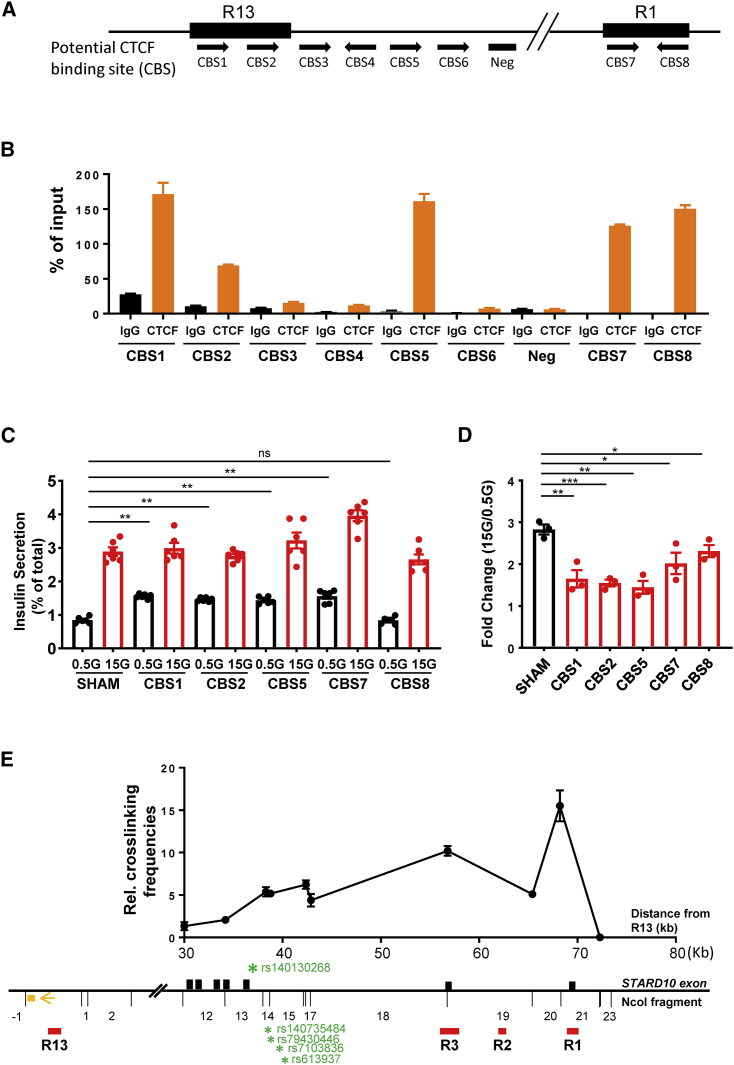
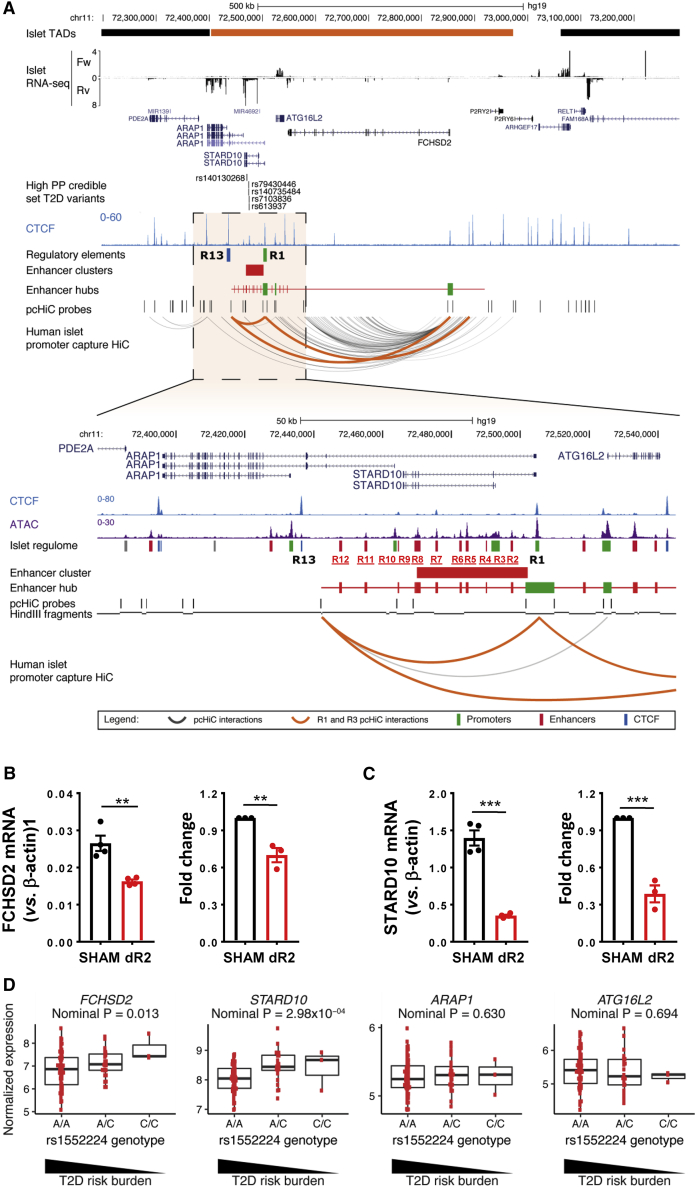
Using chromatin conformation capture, we show that an enhancer cluster in the STARD10 type 2 diabetes (T2D) locus forms a defined 3-dimensional (3D) chromatin domain. A 4.1-kb region within this locus, carrying 5 T2D-associated variants, physically interacts with CTCF-binding regions and with an enhancer possessing strong transcriptional activity. Analysis of human islet 3D chromatin interaction maps identifies the FCHSD2 gene as an additional target of the enhancer cluster. CRISPR-Cas9-mediated deletion of the variant region, or of the associated enhancer, from human pancreas-derived EndoC-βH1 cells impairs glucose-stimulated insulin secretion. Expression of both STARD10 and FCHSD2 is reduced in cells harboring CRISPR deletions, and lower expression of STARD10 and FCHSD2 is associated, the latter nominally, with the possession of risk variant alleles in human islets. Finally, CRISPR-Cas9-mediated loss of STARD10 or FCHSD2, but not ARAP1, impairs regulated insulin secretion. Thus, multiple genes at the STARD10 locus influence β cell function.
使用染色质构象捕获技术,我们发现 STARD10 型 2 型糖尿病(T2D)基因座中的一个增强子簇形成了一个定义明确的三维(3D)染色质结构域。该基因座内的一个 4.1kb 区域携带有 5 个与 T2D 相关的变异体,与 CTCF 结合区域以及具有强烈转录活性的增强子发生物理相互作用。对人类胰岛 3D 染色质相互作用图谱的分析确定了 FCHSD2 基因是该增强子簇的另一个靶基因。在源自人胰腺的 EndoC-βH1 细胞中,使用 CRISPR-Cas9 介导的缺失技术,删除该变异体区域或相关的增强子,会损害葡萄糖刺激的胰岛素分泌。携带 CRISPR 缺失的细胞中 STARD10 和 FCHSD2 的表达均降低,并且 STARD10 和 FCHSD2 的表达降低与胰岛中携带风险变异等位基因相关,后者在名义上具有相关性。最后,CRISPR-Cas9 介导的 STARD10 或 FCHSD2 的缺失,但不是 ARAP1 的缺失,会损害调节性胰岛素分泌。因此,STARD10 基因座上的多个基因影响β细胞功能。