Department of Neurology, 4501Leiden University Medical Center, Leiden, the Netherlands.
Department of Neurology and Neurosurgery, University Medical Center Utrecht Brain Center, Utrecht University, Utrecht, the Netherlands.
Int J Stroke. 2021 Dec;16(9):1031-1038. doi: 10.1177/1747493021991961. Epub 2021 Feb 3.
To investigate whether a striped occipital cortex and intragyral hemorrhage, two markers recently detected on ultra-high-field 7-tesla-magnetic resonance imaging in hereditary cerebral amyloid angiopathy (CAA), also occur in sporadic CAA (sCAA) or non-sCAA intracerebral hemorrhage (ICH).
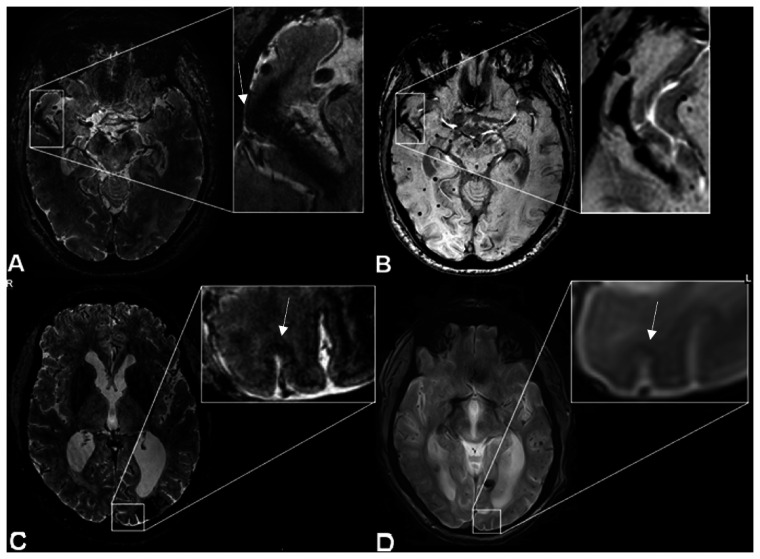
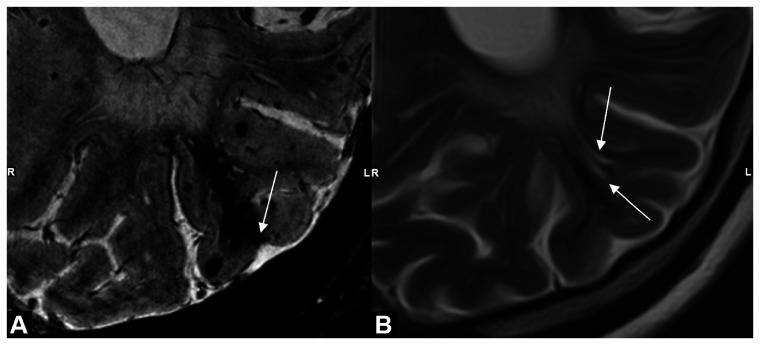
We performed 7-tesla-magnetic resonance imaging in patients with probable sCAA and patients with non-sCAA-ICH. Striped occipital cortex (linear hypointense stripes perpendicular to the cortex) and intragyral hemorrhage (hemorrhage restricted to the juxtacortical white matter of one gyrus) were scored on T*-weighted magnetic resonance imaging. We assessed the association between the markers, other CAA-magnetic resonance imaging markers and clinical features.
We included 33 patients with sCAA (median age 70 years) and 29 patients with non-sCAA-ICH (median age 58 years). Striped occipital cortex was detected in one (3%) patient with severe sCAA. Five intragyral hemorrhages were found in four (12%) sCAA patients. The markers were absent in the non-sCAA-ICH group. Patients with intragyral hemorrhages had more lobar ICHs (median count 6.5 vs. 1.0), lobar microbleeds (median count >50 vs. 15), and lower median cognitive scores (Mini Mental State Exam: 20 vs. 28, Montreal Cognitive Assessment: 18 vs. 24) compared with patients with sCAA without intragyral hemorrhage. In 12 (36%) patients, sCAA diagnosis was changed to mixed-type small vessel disease due to deep bleeds previously unobserved on lower field-magnetic resonance imaging.
Whereas a striped occipital cortex is rare in sCAA, 12% of patients with sCAA have intragyral hemorrhages. Intragyral hemorrhages seem to be related to advanced disease and their absence in patients with non-sCAA-ICH could suggest specificity for CAA.
本研究旨在探究条纹状枕叶皮质和脑内血肿(intragyral hemorrhage)两种在遗传性脑淀粉样血管病(hereditary cerebral amyloid angiopathy,CAA)超高清场 7 特斯拉磁共振成像(magnetic resonance imaging,MRI)中发现的标志物是否也存在于散发性 CAA(sporadic CAA,sCAA)或非 sCAA 脑出血(intracerebral hemorrhage,ICH)中。
我们对疑似 sCAA 患者和非 sCAA-ICH 患者进行了 7 特斯拉 MRI 检查。在 T*-加权 MRI 上对条纹状枕叶皮质(垂直于皮质的线性低信号条纹)和脑内血肿(局限于一个脑回皮质下白质的血肿)进行评分。我们评估了这些标志物与其他 CAA-MRI 标志物和临床特征之间的关系。
我们纳入了 33 例 sCAA 患者(中位年龄 70 岁)和 29 例非 sCAA-ICH 患者(中位年龄 58 岁)。1 例严重 sCAA 患者中发现 1 个条纹状枕叶皮质。4 例 sCAA 患者中发现 5 个脑内血肿。非 sCAA-ICH 组中未发现这些标志物。脑内血肿患者的脑叶 ICH 更多(中位数 6.5 个 vs. 1.0 个)、脑叶微出血(中位数>50 个 vs. 15 个)和更低的认知评分中位数(简易精神状态检查:20 分 vs. 28 分,蒙特利尔认知评估:18 分 vs. 24 分),与无脑内血肿的 sCAA 患者相比。由于先前在较低场 MRI 上未观察到深部出血,12 例(36%)患者的 sCAA 诊断更改为混合性小血管疾病。
尽管条纹状枕叶皮质在 sCAA 中较为罕见,但 12%的 sCAA 患者存在脑内血肿。脑内血肿似乎与疾病的晚期有关,而非 sCAA-ICH 患者中无脑内血肿的存在可能提示其对 CAA 的特异性。