Zembyla Morfo, Liamas Evangelos, Andablo-Reyes Efren, Gu Kewei, Krop Emma M, Kew Ben, Sarkar Anwesha
Food Colloids and Bioprocessing Group, School of Food Science and Nutrition, University of Leeds, Leeds, LS2 9JT, UK.
Food Hydrocoll. 2021 Feb;111:106364. doi: 10.1016/j.foodhyd.2020.106364.
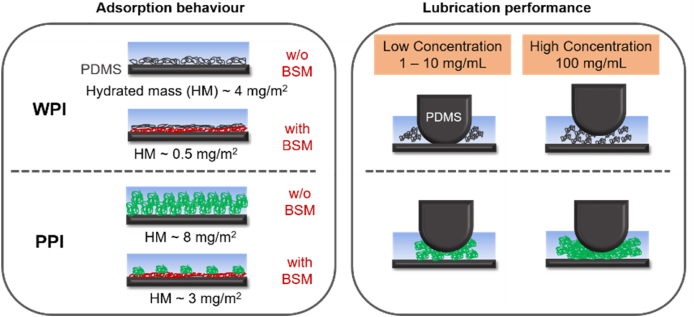
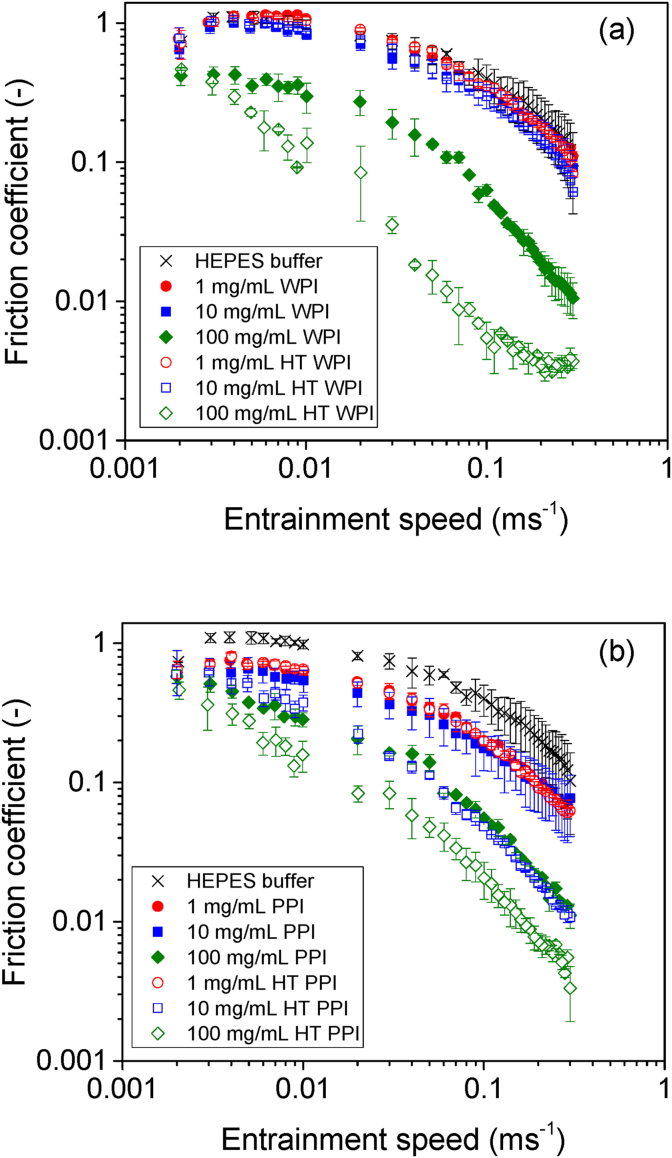
The aim of this work was to compare the surface adsorption and lubrication properties of plant and dairy proteins. Whey protein isolate (WPI) and pea protein isolate (PPI) were chosen as model animal and plant proteins, respectively, and various protein concentrations (0.1-100 mg/mL) were studied with/without heat treatment (90 °C/60 min). Quartz crystal microbalance with dissipation monitoring (QCM-D) experiments were performed on hydrophilic (gold) and hydrophobic polydimethylsiloxane (PDMS) sensors, with or without a mucin coating, latter was used to mimic the oral surface. Soft tribology using PDMS tribopairs in addition to wettability measurements, physicochemical characterization (size, charge, solubility) and gel electrophoresis were performed. Soluble fractions of PPI adsorbed to significantly larger extent on PDMS surfaces, forming more viscous films as compared to WPI regardless of heat treatment. Introducing a mucin coating on a PDMS surface led to a decrease in binding of the subsequent dietary protein layers, with PPI still adsorbing to a larger extent than WPI. Such large hydrated mass of PPI resulted in superior lubrication performance at lower protein concentration (≤10 mg/mL) as compared to WPI. However, at 100 mg/mL, WPI was a better lubricant than PPI, with the former showing the onset of elastohydrodynamic lubrication. Enhanced lubricity upon heat treatment was attributed to the increase in apparent viscosity. Fundamental insights from this study reveal that pea protein at higher concentrations demonstrates inferior lubricity than whey protein and could result in unpleasant mouthfeel, and thus may inform future replacement strategies when designing sustainable food products.
这项工作的目的是比较植物蛋白和乳蛋白的表面吸附及润滑性能。分别选用乳清分离蛋白(WPI)和豌豆分离蛋白(PPI)作为动物蛋白和植物蛋白的模型,并研究了不同蛋白质浓度(0.1 - 100 mg/mL)在有无热处理(90 °C/60分钟)情况下的性能。采用带耗散监测的石英晶体微天平(QCM-D)实验,在有或没有粘蛋白涂层的亲水性(金)和疏水性聚二甲基硅氧烷(PDMS)传感器上进行,后者用于模拟口腔表面。除了润湿性测量外,还进行了使用PDMS摩擦副的软摩擦学研究、物理化学表征(尺寸、电荷、溶解度)和凝胶电泳。无论是否经过热处理,PPI的可溶部分在PDMS表面的吸附程度都明显更大,形成的膜比WPI更粘稠。在PDMS表面引入粘蛋白涂层会导致后续膳食蛋白层的结合减少,PPI的吸附程度仍比WPI大。与WPI相比,PPI如此大的水合质量在较低蛋白质浓度(≤10 mg/mL)时具有更好的润滑性能。然而,在100 mg/mL时,WPI比PPI是更好的润滑剂,前者表现出弹流润滑的开始。热处理后润滑性增强归因于表观粘度的增加。这项研究的基本见解表明,较高浓度的豌豆蛋白润滑性不如乳清蛋白,可能会导致不愉快的口感,因此在设计可持续食品时,可为未来的替代策略提供参考。