Department of Cardiovascular Surgery, The No. 1 Central Hospital of Baoding City, Baoding, Hebei 071000, P.R. China.
Department of Pharmacy, Tianjin Binhai New Area Hospital of Traditional Chinese Medicine, Tianjin 300450, P.R. China.
Mol Med Rep. 2021 Apr;23(4). doi: 10.3892/mmr.2021.11883. Epub 2021 Feb 4.
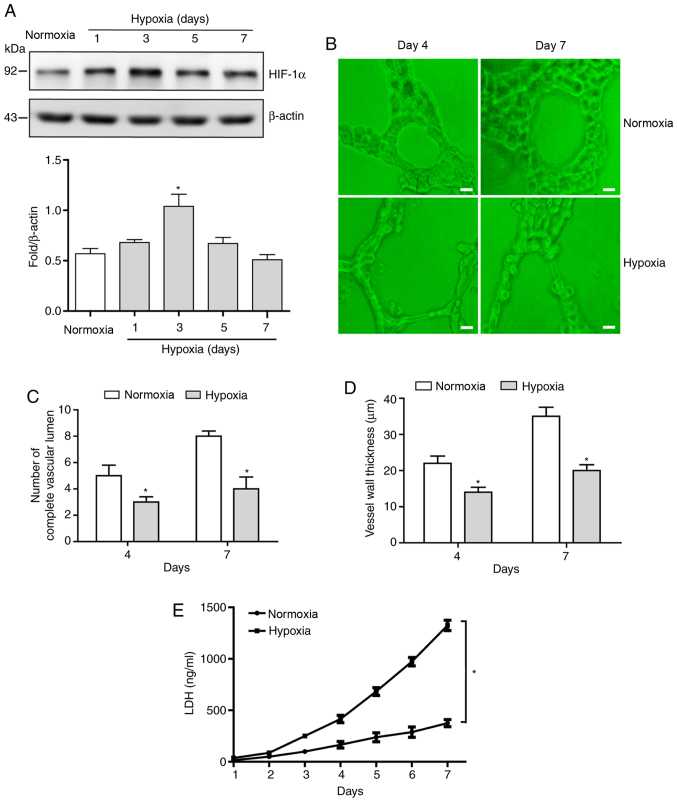
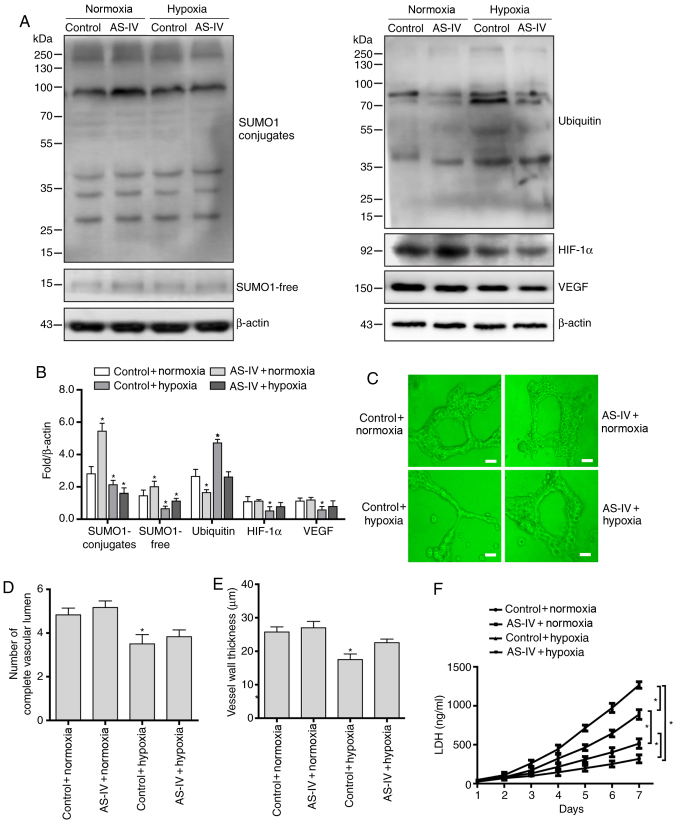
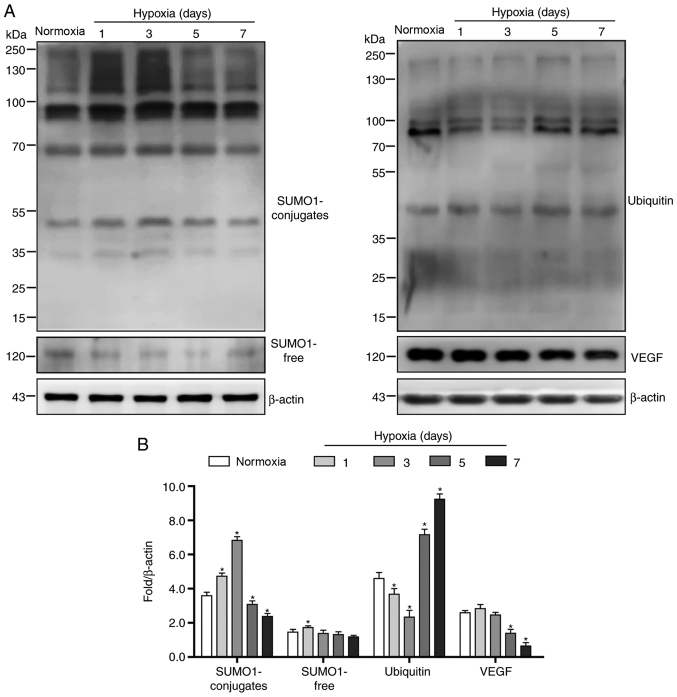
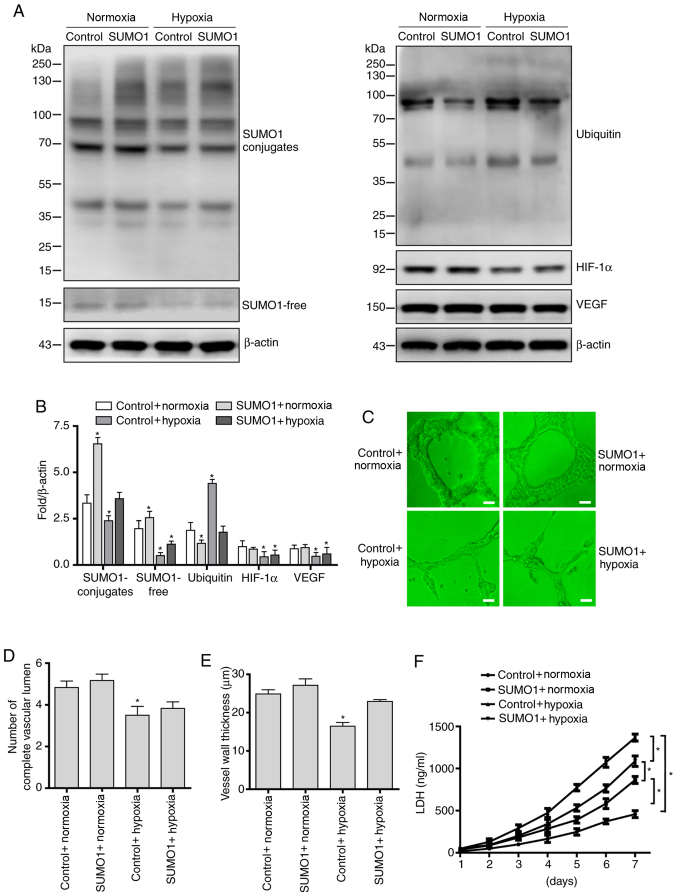
Improving angiogenic capacity under hypoxic conditions is essential for improving the survival of skin grafts, as they often lack the necessary blood supply. The stable expression levels of hypoxia‑inducible factor‑1α (HIF‑1α) in the nucleus directly affect the downstream vascular endothelial growth factor (VEGF) signaling pathway and regulate angiogenesis in a hypoxic environment. Astragaloside IV (AS‑IV), an active component isolated from , has multiple biological effects including antioxidant and anti‑diabetic effects, and the ability to provide protection from cardiovascular damage. However, the mechanisms underlying these effects have not previously been elucidated. The present study investigated whether AS‑IV promotes angiogenesis via affecting the balance between ubiquitination and small ubiquitin‑related modifier (SUMO) modification of HIF‑1α. The results demonstrated that persistent hypoxia induces changes in expression levels of HIF‑1α protein and significantly increases the proportion of dysplastic blood vessels. Further western blotting experiments showed that rapid attenuation and delayed compensation of SUMO1 activity is one of the reasons for the initial increase then decrease in HIF‑1α levels. SUMO1 overexpression stabilized the presence of HIF‑1α in the nucleus and decreased the extent of abnormal blood vessel morphology observed following hypoxia. AS‑IV induces vascular endothelial cells to continuously produce SUMO1, stabilizes the HIF‑1α/VEGF pathway and improves angiogenesis in hypoxic conditions. In summary, the present study confirmed that AS‑IV stimulates vascular endothelial cells to continuously resupply SUMO1, stabilizes the presence of HIF‑1α protein and improves angiogenesis in adverse hypoxic conditions, which may improve the success rate of flap graft surgery following trauma or burn.
在缺氧条件下提高血管生成能力对于改善皮肤移植物的存活率至关重要,因为它们通常缺乏必要的血液供应。核内缺氧诱导因子-1α(HIF-1α)的稳定表达水平直接影响下游血管内皮生长因子(VEGF)信号通路,并调节缺氧环境中的血管生成。黄芪甲苷(AS-IV)是从 中分离得到的一种活性成分,具有多种生物学作用,包括抗氧化和抗糖尿病作用,以及提供心血管损伤保护的能力。然而,这些作用的机制尚未阐明。本研究探讨了 AS-IV 是否通过影响 HIF-1α的泛素化和小泛素相关修饰物(SUMO)修饰之间的平衡来促进血管生成。结果表明,持续缺氧诱导 HIF-1α蛋白表达水平的变化,并显著增加畸形血管的比例。进一步的 Western blot 实验表明,SUMO1 活性的快速衰减和延迟补偿是 HIF-1α 水平最初增加然后减少的原因之一。SUMO1 的过表达稳定了 HIF-1α在核内的存在,并减少了缺氧后观察到的异常血管形态的程度。AS-IV 诱导血管内皮细胞持续产生 SUMO1,稳定 HIF-1α/VEGF 通路,并改善缺氧条件下的血管生成。综上所述,本研究证实 AS-IV 刺激血管内皮细胞持续供应 SUMO1,稳定 HIF-1α 蛋白的存在,并改善不利缺氧条件下的血管生成,这可能提高创伤或烧伤后皮瓣移植手术的成功率。