Department of Experimental and Clinical Biomedical Sciences, Section of Biochemistry, University of Florence, Viale Morgagni 50, 50134 Florence, Italy.
Centre for Misfolding Diseases, Department of Chemistry, University of Cambridge, Cambridge CB2 1EW, U.K.
ACS Chem Neurosci. 2021 Feb 17;12(4):766-781. doi: 10.1021/acschemneuro.0c00811. Epub 2021 Feb 4.
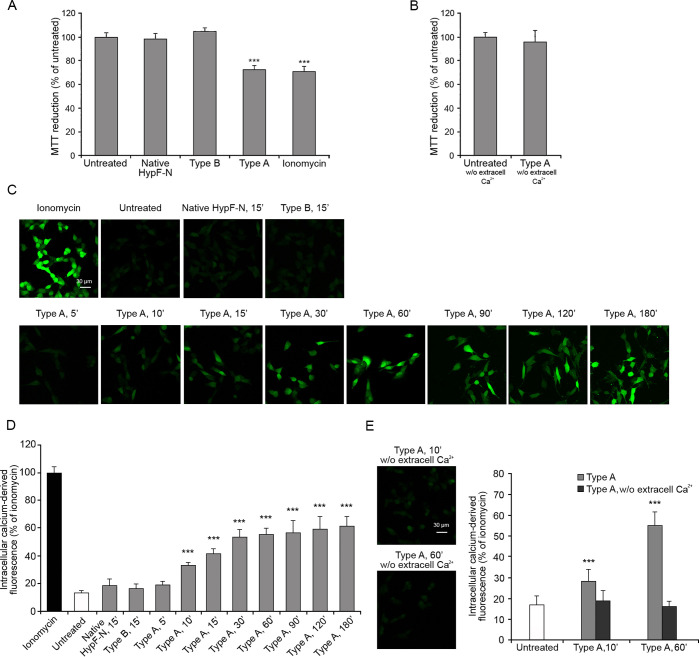
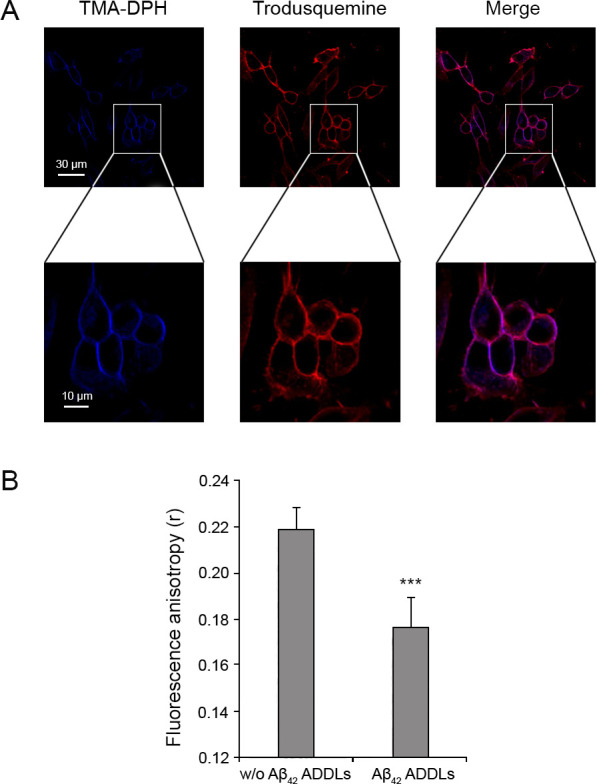
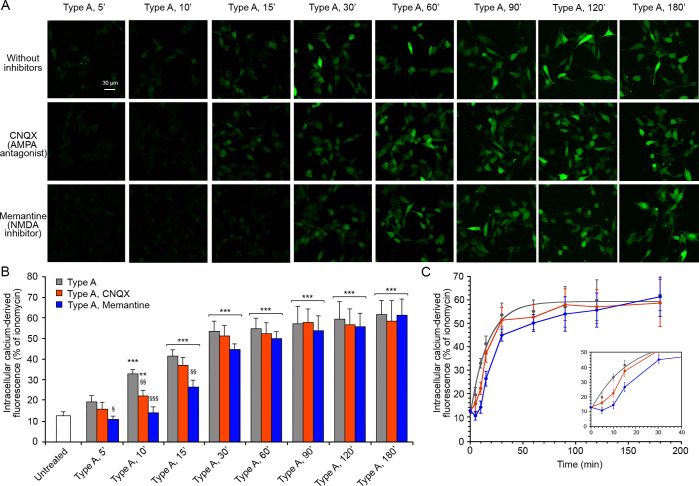
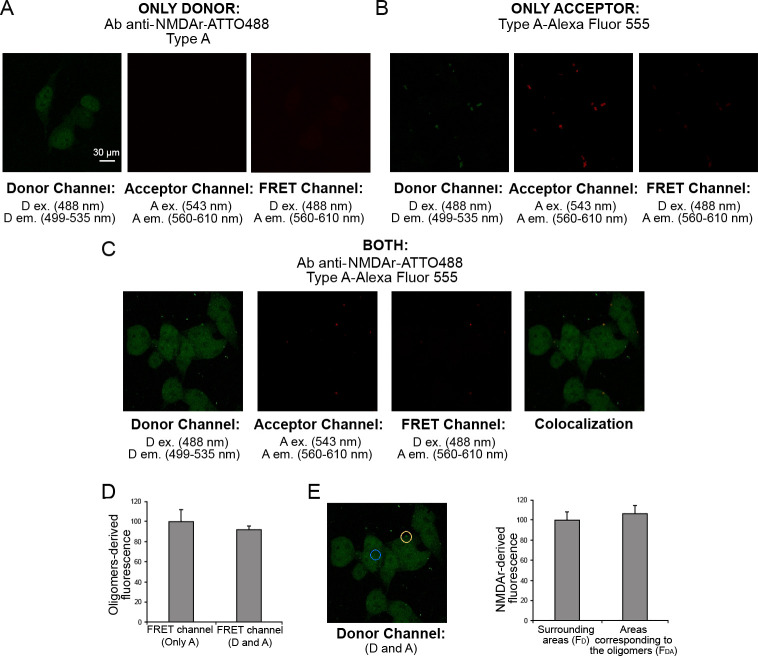
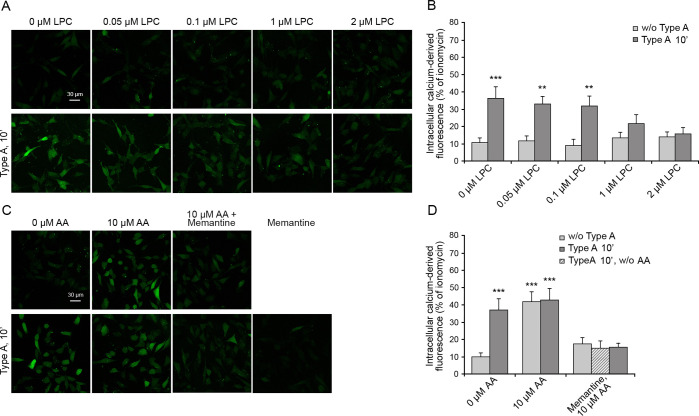
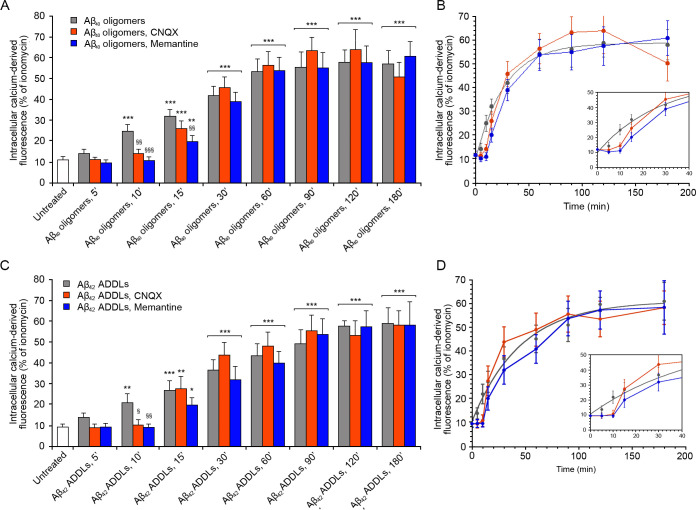
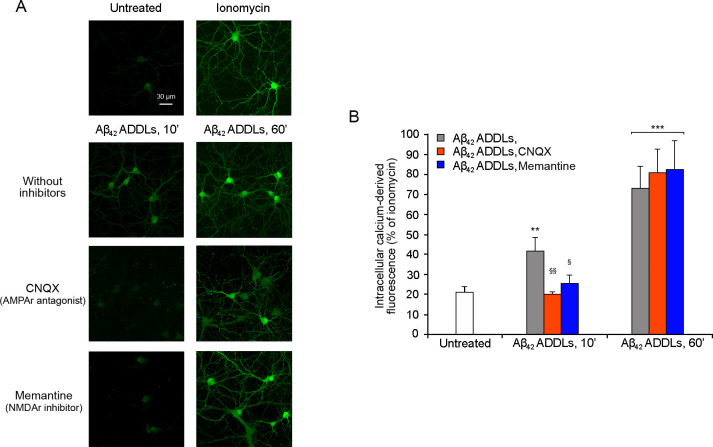
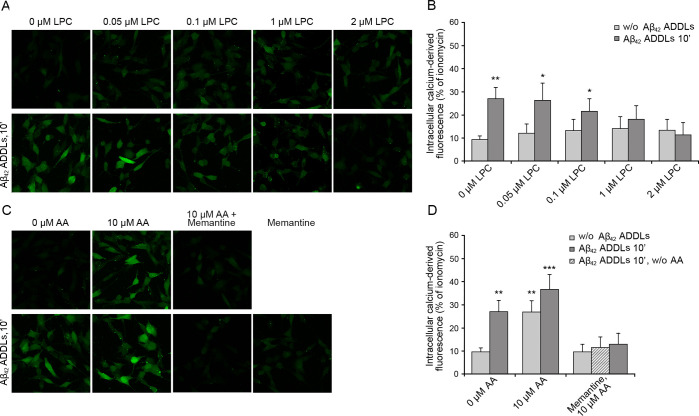
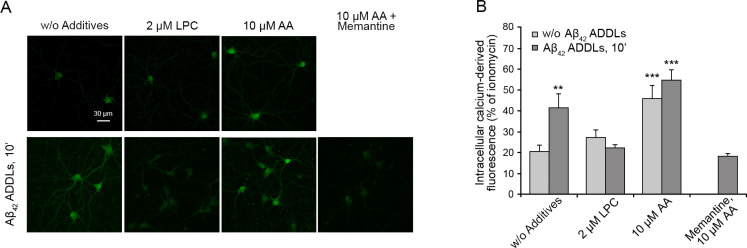
Alzheimer's disease, which is the most common form of dementia, is characterized by the aggregation of the amyloid β peptide (Aβ) and by an impairment of calcium homeostasis caused by excessive activation of glutamatergic receptors (excitotoxicity). Here, we studied the effects on calcium homeostasis caused by the formation of Aβ oligomeric assemblies. We found that Aβ oligomers cause a rapid influx of calcium ions (Ca) across the cell membrane by rapidly activating extrasynaptic -methyl-d-aspartate (NMDA) receptors and, to a lower extent, α-amino-3-hydroxy-5-methyl-4-isoxazolepropionic acid (AMPA) receptors. We also observed, however, that misfolded oligomers do not interact directly with these receptors. Further experiments with lysophosphatidylcholine and arachidonic acid, which cause membrane compression and stretch, respectively, indicated that these receptors are activated through a change in membrane tension induced by the oligomers and transmitted mechanically to the receptors via the lipid bilayer. Indeed, lysophosphatidylcholine is able to neutralize the oligomer-induced activation of the NMDA receptors, whereas arachidonic acid activates the receptors similarly to the oligomers with no additive effects. An increased rotational freedom observed for a fluorescent probe embedded within the membrane in the presence of the oligomers also indicates a membrane stretch. These results reveal a mechanism of toxicity of Aβ oligomers in Alzheimer's disease through the perturbation of the mechanical properties of lipid membranes sensed by NMDA and AMPA receptors.
阿尔茨海默病是最常见的痴呆症形式,其特征是淀粉样 β 肽 (Aβ) 的聚集以及由谷氨酸能受体(兴奋性毒性)过度激活引起的钙稳态失调。在这里,我们研究了 Aβ 寡聚体形成引起的钙稳态变化。我们发现 Aβ 寡聚体通过快速激活细胞外 -甲基-D-天冬氨酸 (NMDA) 受体和在较低程度上激活 α-氨基-3-羟基-5-甲基-4-异恶唑丙酸 (AMPA) 受体,导致钙离子(Ca)快速跨细胞膜内流。然而,我们也观察到错误折叠的寡聚体不会直接与这些受体相互作用。进一步用溶血磷脂酰胆碱和花生四烯酸进行实验,它们分别导致膜压缩和拉伸,表明这些受体通过寡聚体诱导的膜张力变化而被激活,并通过脂质双层机械地传递到受体。事实上,溶血磷脂酰胆碱能够中和寡聚体诱导的 NMDA 受体激活,而花生四烯酸以类似于寡聚体的方式激活受体,没有附加效果。在存在寡聚体的情况下,嵌入膜中的荧光探针观察到的旋转自由度增加也表明存在膜拉伸。这些结果揭示了 Aβ 寡聚体在阿尔茨海默病中的毒性机制,即通过 NMDA 和 AMPA 受体感知的脂质膜机械特性的扰动。