Division of Cancer Control & Policy, National Cancer Control Institute, National Cancer Center, Goyang, South Korea.
Department of Clinical Research Design and Evaluation, SAIHST, Sungkyunkwan University, Seoul, South Korea.
PLoS One. 2021 Feb 4;16(2):e0246143. doi: 10.1371/journal.pone.0246143. eCollection 2021.
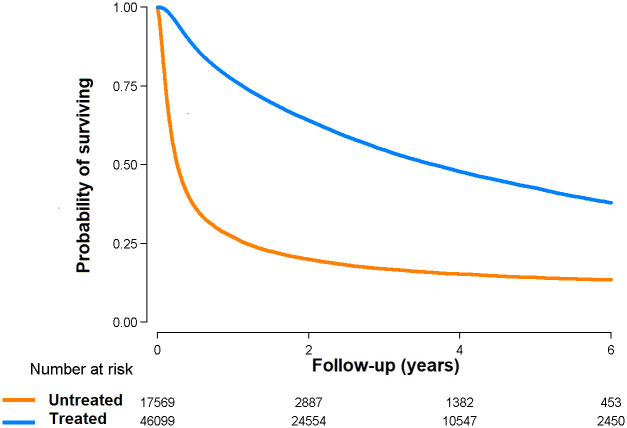
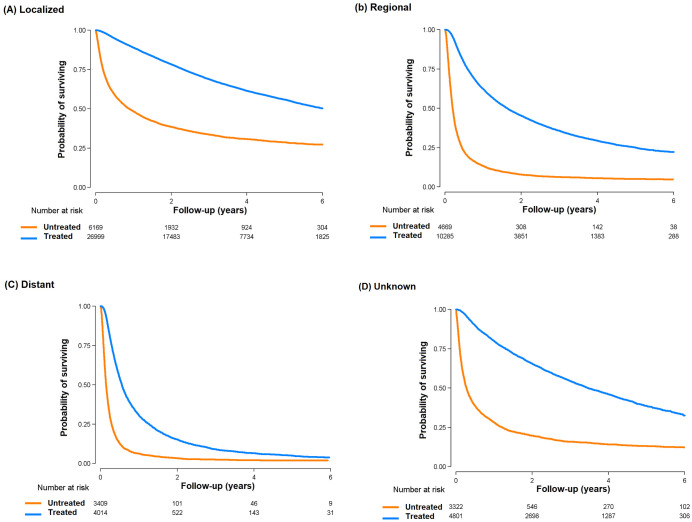
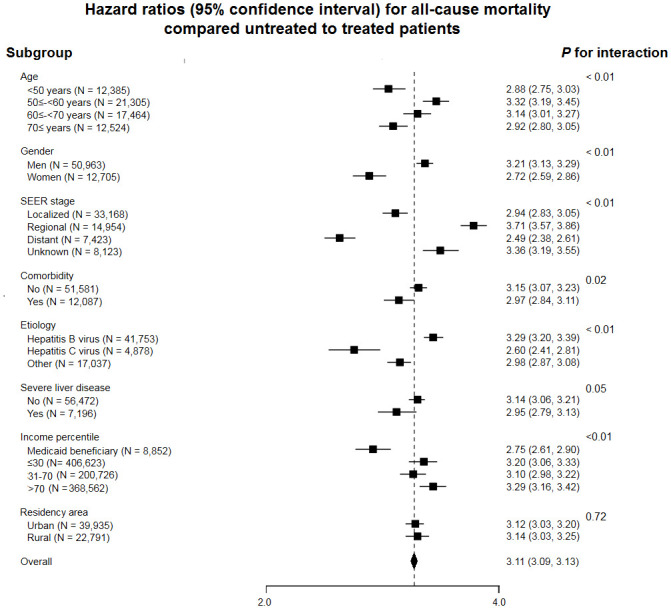
This study aimed to analyze the proportion, characteristics and prognosis of untreated hepatocellular carcinoma (HCC) patients in a large representative nationwide study. A cohort study was conducted using the National Health Insurance Service (NHIS) database in Korea. A total of 63,668 newly-diagnosed HCC patients between January 2008 and December 2013 were analyzed. Patients were categorized into treatment group and no treatment group using claim codes after HCC diagnosis. The proportion of untreated HCC patients was 27.6%, decreasing from 33.4% in 2008 to 24.8% in 2013. Compared to treated patients, untreated patients were more likely to be older (P < 0.001), female (P < 0.01), to have a distant SEER stage (P < 0.001), severe liver disease (P < 0.001), and lower income (P < 0.001). The fully-adjusted hazard ratio for all-cause mortality comparing untreated to treated patients was 3.11 (95% CI, 3.04-3.18). The risk of mortality was higher for untreated patients in all pre-defined subgroups, including those with distant SEER stage and those with severe liver disease. About one fourth of newly diagnosed HCC patients did not receive any HCC-specific treatment. Untreated patients showed higher risk of mortality compared to treated patients in all subgroups. Further studies are needed to identify obstacles for HCC treatment and to improve treatment rates.
本研究旨在通过一项大型全国代表性研究分析未经治疗的肝细胞癌(HCC)患者的比例、特征和预后。本研究使用韩国国家健康保险服务(NHIS)数据库进行了一项队列研究。分析了 2008 年 1 月至 2013 年 12 月期间新诊断的 63668 例 HCC 患者。根据 HCC 诊断后的理赔代码,将患者分为治疗组和未治疗组。未经治疗的 HCC 患者比例为 27.6%,从 2008 年的 33.4%降至 2013 年的 24.8%。与治疗患者相比,未经治疗的患者年龄更大(P<0.001)、女性(P<0.01)、远处 SEER 分期(P<0.001)、严重肝脏疾病(P<0.001)和收入较低(P<0.001)。未经治疗与治疗患者全因死亡率的完全调整风险比为 3.11(95%CI,3.04-3.18)。在所有预先定义的亚组中,包括远处 SEER 分期和严重肝脏疾病患者,未经治疗的患者的死亡风险更高。约四分之一的新诊断 HCC 患者未接受任何 HCC 特异性治疗。未经治疗的患者在所有亚组中的死亡风险均高于治疗患者。需要进一步研究以确定 HCC 治疗的障碍,并提高治疗率。