Department of Chemistry, Hunter College Belfer Research Center, City University of New York, New York, NY 10021, USA.
Graduate Programs in Biology, Biochemistry, Chemistry, Graduate Center, City University of New York, New York, NY 10016, USA.
Toxins (Basel). 2021 Feb 2;13(2):108. doi: 10.3390/toxins13020108.
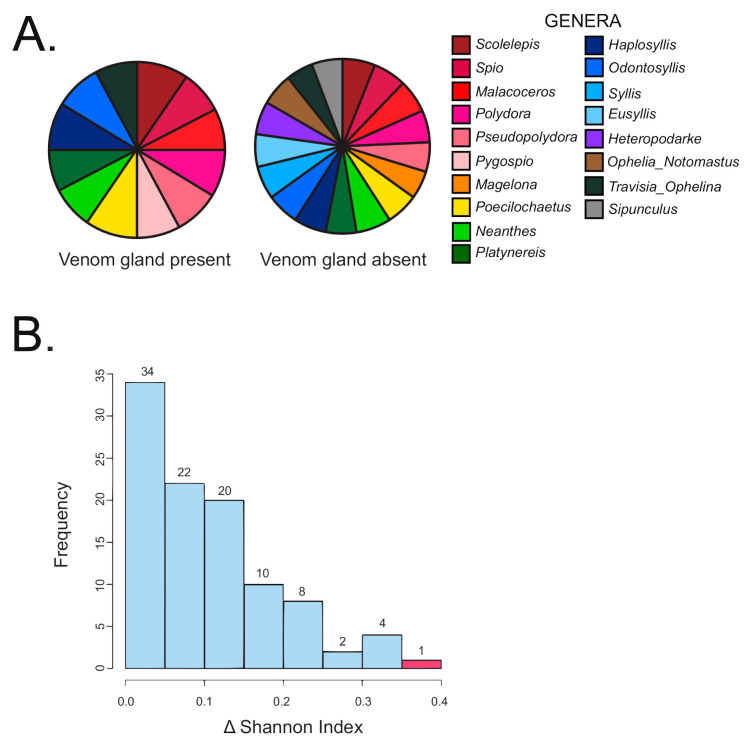
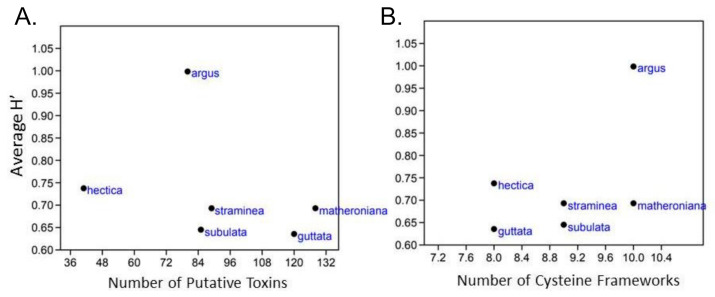
Predator-prey interactions are thought to play a driving role in animal evolution, especially for groups that have developed venom as their predatory strategy. However, how the diet of venomous animals influences the composition of venom arsenals remains uncertain. Two prevailing hypotheses to explain the relationship between diet and venom composition focus on prey preference and the types of compounds in venom, and a positive correlation between dietary breadth and the number of compounds in venom. Here, we examined venom complexity, phylogenetic relationship, collection depth, and biogeography of the Terebridae (auger snails) to determine if repeated innovations in terebrid foregut anatomy and venom composition correspond to diet variation. We performed the first molecular study of the diet of terebrid marine snails by metabarcoding the gut content of 71 terebrid specimens from 17 species. Our results suggest that the presence or absence of a venom gland is strongly correlated with dietary breadth. Specifically, terebrid species without a venom gland displayed greater diversity in their diet. Additionally, we propose a revision of the definition of venom complexity in conoidean snails to more accurately capture the breadth of ecological influences. These findings suggest that prey diet is an important factor in terebrid venom evolution and diversification and further investigations of other understudied organisms, like terebrids, are needed to develop robust hypotheses in this area.
捕食者-猎物相互作用被认为在动物进化中起着主导作用,特别是对于那些将毒液作为其捕食策略的群体。然而,毒液动物的饮食如何影响毒液库的组成仍不确定。有两种流行的假说可以解释饮食与毒液成分之间的关系,一种是关注猎物偏好和毒液中化合物的类型,另一种是饮食广度与毒液中化合物数量之间存在正相关关系。在这里,我们研究了 Terebridae(螺旋蜗牛)的毒液复杂性、系统发育关系、采集深度和生物地理学,以确定 terebrid 前肠解剖结构和毒液成分的重复创新是否与饮食变化相对应。我们通过对来自 17 个物种的 71 个 terebrid 标本的肠道内容物进行 metabarcoding,首次对 terebrid 海洋蜗牛的饮食进行了分子研究。我们的结果表明,毒液腺的存在与否与饮食广度密切相关。具体来说,没有毒液腺的 terebrid 物种在饮食上表现出更大的多样性。此外,我们提出了对 conoidean 蜗牛毒液复杂性定义的修订,以更准确地捕捉生态影响的广度。这些发现表明,猎物饮食是 terebrid 毒液进化和多样化的一个重要因素,需要进一步研究其他研究不足的生物,如 terebrid,以在该领域提出稳健的假设。