Fiedler Stefan, Ambros Inge M, Glogova Evgenia, Benesch Martin, Urban Christian, Mayer Marlene, Ebetsberger-Dachs Georg, Bardi Edit, Jones Neil, Gamper Agnes, Meister Bernhard, Crazzolara Roman, Amann Gabriele, Dieckmann Karin, Horcher Ernst, Kerbl Reinhold, Brunner-Herglotz Bettina, Ziegler Andrea, Ambros Peter F, Ladenstein Ruth
St. Anna Children's Hospital, 1090 Vienna, Austria.
CCRI, Children's Cancer Research Institute, 1090 Vienna, Austria.
Cancers (Basel). 2021 Feb 2;13(3):572. doi: 10.3390/cancers13030572.
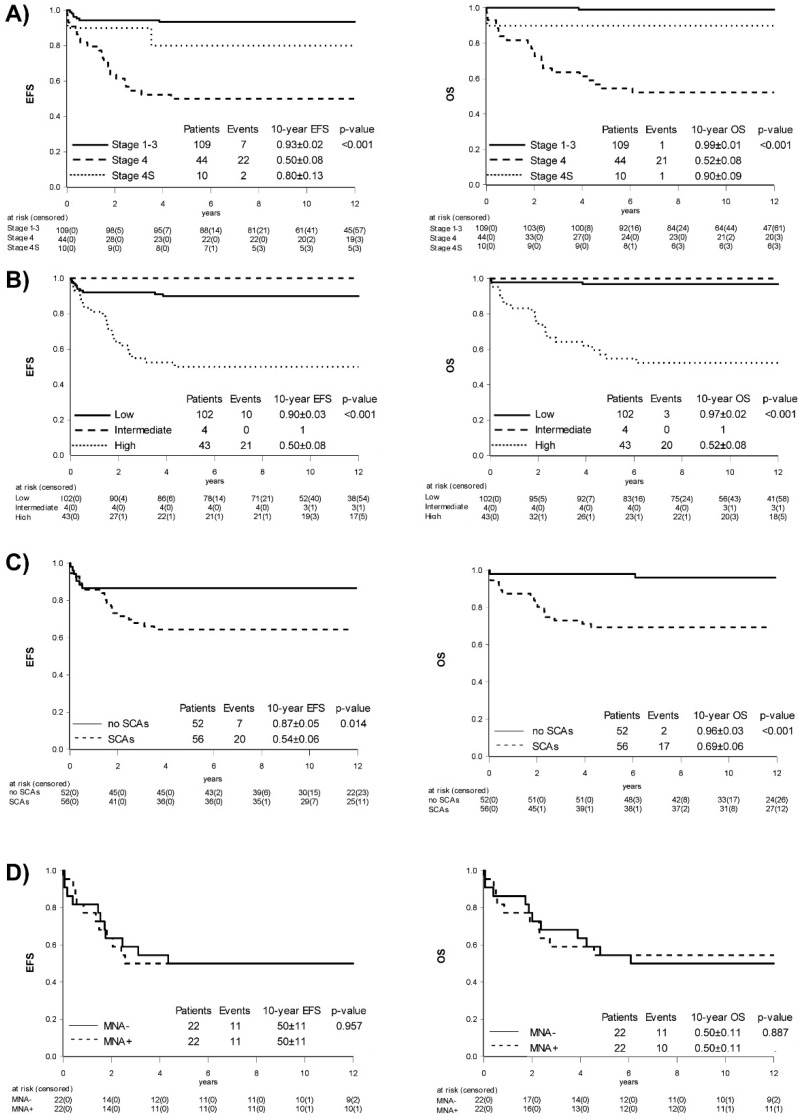
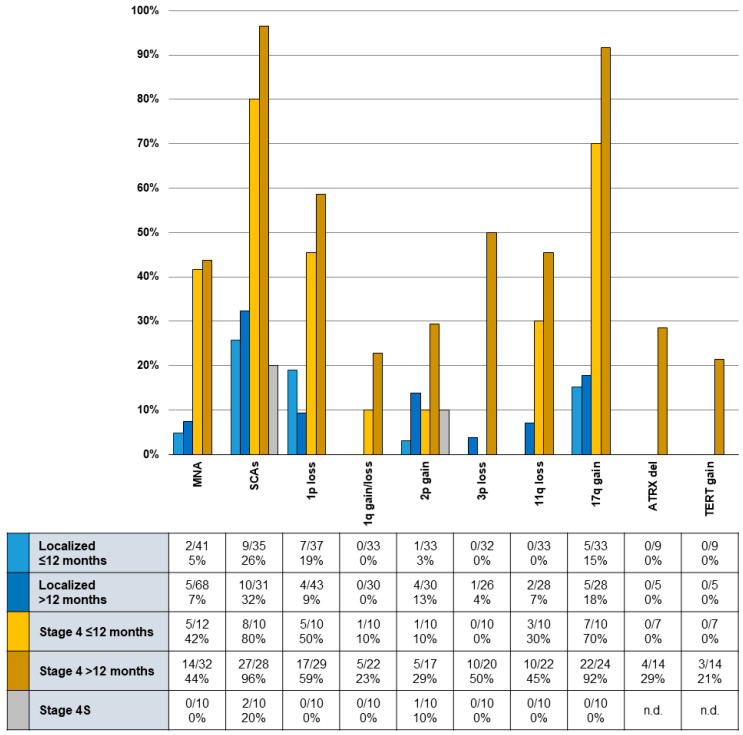
We evaluated long-term outcome and genomic profiles in the Austrian Neuroblastoma Trial A-NB94 which applied a risk-adapted strategy of treatment (RAST) using stage, age and amplification (MNA) status for stratification. RAST ranged from surgery only to intensity-adjusted chemotherapy, single or multiple courses of high-dose chemotherapy (HDT) followed by autologous stem cell rescue depending on response to induction chemotherapy, and irradiation to the primary tumor site. Segmental chromosomal alterations (SCAs) were investigated retrospectively using multi- and pan-genomic techniques. The A-NB94 trial enrolled 163 patients. Patients with localized disease had an excellent ten-year (10y) event free survival (EFS) and overall survival (OS) of 99 ± 1% and 93 ± 2% whilst it was 80 ± 13% and 90 ± 9% for infants with stage 4S and for infants with stage 4 non-MNA disease both 83 ± 15%. Stage 4 patients either >12 months or ≤12 months but with MNA had a 10y-EFS and OS of 45 ± 8% and 47 ± 8%, respectively. SCAs were present in increasing frequencies according to stage and age: in 29% of localized tumors but in 92% of stage 4 tumors ( < 0.001), and in 39% of patients ≤ 12 months but in 63% of patients > 12 months ( < 0.001). RAST successfully reduced chemotherapy exposure in low- and intermediate-risk patients with excellent long-term results while the outcome of high-risk disease met contemporary trials.
我们在奥地利神经母细胞瘤试验A-NB94中评估了长期预后和基因组概况,该试验采用了风险适应性治疗策略(RAST),根据分期、年龄和 扩增(MNA)状态进行分层。RAST范围从仅手术到强度调整化疗、单疗程或多疗程高剂量化疗(HDT)随后根据诱导化疗反应进行自体干细胞救援以及对原发肿瘤部位进行放疗。使用多基因组和泛基因组技术对节段性染色体改变(SCA)进行了回顾性研究。A-NB94试验招募了163名患者。局限性疾病患者的十年无事件生存率(EFS)和总生存率(OS)极佳,分别为99±1%和93±2%,而4S期婴儿和4期非MNA疾病婴儿的EFS和OS分别为80±13%和90±9%,两者均为83±15%。年龄大于12个月或小于等于12个月但伴有MNA 的4期患者10年EFS和OS分别为45±8%和47±8%。SCA 的出现频率根据分期和年龄增加:在29% 的局限性肿瘤中出现,但在92% 的4期肿瘤中出现(<0.001),在39% 年龄小于等于12个月的患者中出现,但在63% 年龄大于12个月的患者中出现(<0.001)。RAST成功减少了低风险和中风险患者的化疗暴露,长期结果极佳,而高风险疾病的预后与当代试验相当。