Institute for Inorganic and Analytical Chemistry, Justus Liebig University Giessen, Heinrich-Buff-Ring 17, 35392, Giessen, Germany.
Institute of Phytomedicine, University of Hohenheim, Otto-Sander-Straße 5, 70599, Stuttgart, Germany.
Anal Bioanal Chem. 2021 Mar;413(8):2125-2134. doi: 10.1007/s00216-021-03177-y. Epub 2021 Feb 5.
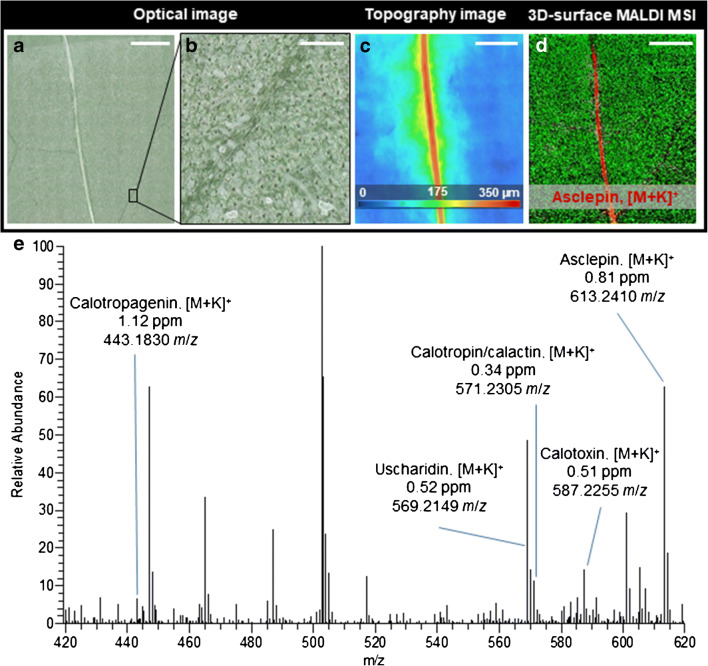
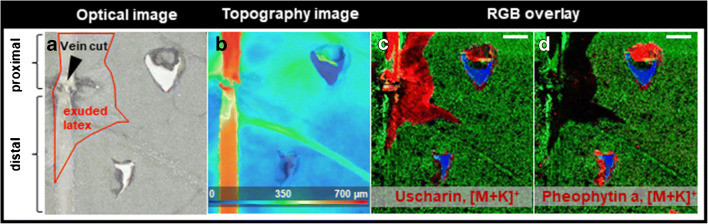
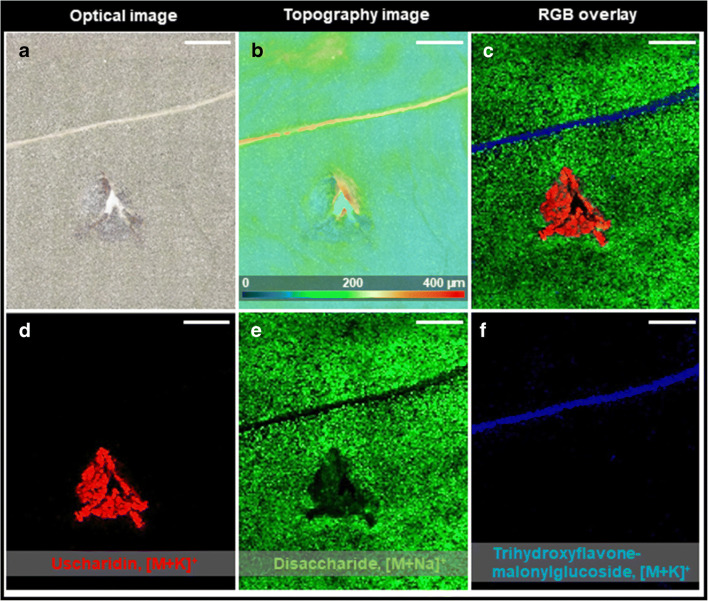
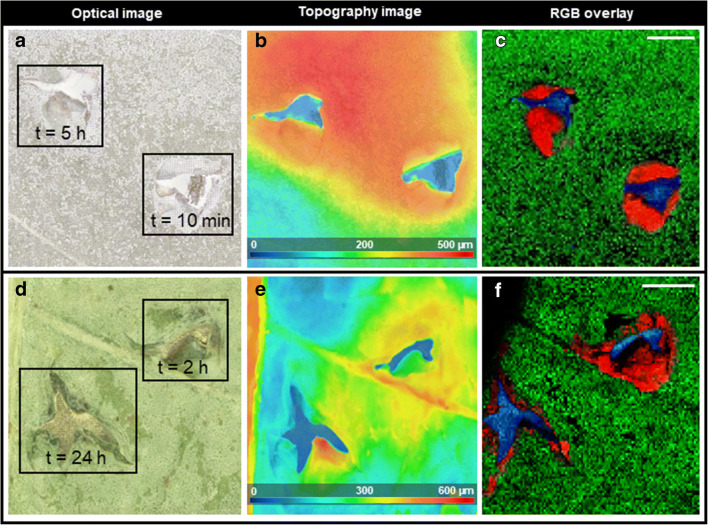
Mass spectrometry-based imaging (MSI) has emerged as a promising method for spatial metabolomics in plant science. Several ionisation techniques have shown great potential for the spatially resolved analysis of metabolites in plant tissue. However, limitations in technology and methodology limited the molecular information for irregular 3D surfaces with resolutions on the micrometre scale. Here, we used atmospheric-pressure 3D-surface matrix-assisted laser desorption/ionisation mass spectrometry imaging (3D-surface MALDI MSI) to investigate plant chemical defence at the topographic molecular level for the model system Asclepias curassavica. Upon mechanical damage (simulating herbivore attacks) of native A. curassavica leaves, the surface of the leaves varies up to 700 μm, and cardiac glycosides (cardenolides) and other defence metabolites were exclusively detected in damaged leaf tissue but not in different regions of the same leaf. Our results indicated an increased latex flow rate towards the point of damage leading to an accumulation of defence substances in the affected area. While the concentration of cardiac glycosides showed no differences between 10 and 300 min after wounding, cardiac glycosides decreased after 24 h. The employed autofocusing AP-SMALDI MSI system provides a significant technological advancement for the visualisation of individual molecule species on irregular 3D surfaces such as native plant leaves. Our study demonstrates the enormous potential of this method in the field of plant science including primary metabolism and molecular mechanisms of plant responses to abiotic and biotic stress and symbiotic relationships.
基于质谱的成像(MSI)已成为植物科学中空间代谢组学的一种有前途的方法。几种离子化技术已显示出对植物组织中代谢物进行空间分辨分析的巨大潜力。然而,技术和方法学的限制限制了不规则 3D 表面的分子信息,分辨率在微米级。在这里,我们使用常压 3D 表面基质辅助激光解吸/电离质谱成像(3D 表面 MALDI MSI)来研究模型系统 Asclepias curassavica 的拓扑分子水平上的植物化学防御。在原生 Asclepias curassavica 叶片受到机械损伤(模拟食草动物攻击)后,叶片表面的变化高达 700μm,并且心脏糖苷(强心苷)和其他防御代谢物仅在受损叶片组织中检测到,而不在同一叶片的不同区域检测到。我们的结果表明,在受伤部位附近,乳状液的流速增加,导致防御物质在受影响区域积聚。虽然心脏糖苷的浓度在受伤后 10 至 300 分钟之间没有差异,但在 24 小时后心脏糖苷减少。所采用的自动聚焦 AP-SMALDI MSI 系统为不规则 3D 表面(如原生植物叶片)上的单个分子物种的可视化提供了重要的技术进步。我们的研究表明,该方法在植物科学领域具有巨大的潜力,包括初级代谢以及植物对非生物和生物胁迫和共生关系的分子机制的响应。